The big awards shows come and go around this time of year, and it generally makes me pause and wonder: have I been too hung up on outdated culture (classic movies, old books) to keep up with current cultural developments? And from there, I usually go on to a different question: why should I bother keeping up with current culture, when 99% of it... even the greatest, most memorable, award-winning movies... will slip out of cultural consciousness in about five months? I really don't think ANY of the acclaimed films will be worth talking about after a few months have gone by.
Still, this year is exceptional. I've seen most of them -- I saw Dark Knight a number of times, I saw The Wrestler and Revolutionary Road and Doubt, and just recently I managed to see Slumdog Millionaire. I've seen Wall-e a couple times, too. The big winners I've missed are The Curious Case of Benajmin Button, Rachel Getting Married, Frost/Nixon, The Reader, and Defiance.
Here, as you can see, we have our usual round-up of Oscar contenders. There are a few historical epics, one of which deals with World War II. There was bound to be a holocaust movie in there, with the likes of Valkyrie, The Reader, and Defiance all floating around. There are also two emotional dramas, the type of movie that involves a lot of yelling and leads to a restrained but tragic conclusion. I was lucky enough to see both of these character dramas, and they are both more than worth a trip to the cinema. I'll discuss them in a little more detail below. Aside from these, there was an off-the-beaten-path character study by Aaronofsky, and a Forrest Gump -esque piece of magical realism by David Fincher. Except for the enormous acclaim given to a comic book movie, there weren't too many surprises in store for the Hollywood enthusiast.
My own take on these Oscar contenders involves the question: which ones will resonate? In ten years, which ones will you be proud to remember seeing in theaters? Which ones will you heard mentioned in conversation, or referenced in a classroom? It's sort of a standard lineup of genres and directors... will any of the big winners this year really be remembered by cinema history?
The character dramas, Doubt and Revolutionary Road, and the historical epics, The Reader, Frost/Nixon, and Defiance, are probably the least likely to last. These are annual Oscar stuffing, films that follow our expectations for "good movies," and there have been a LOT of these types of films that have come and gone. Fincher's entry is probably the same -- it draws on certain magical realist genre conventions, along with Forrest Gump and Big Fish, and even though I'm sure it's luminant and gorgeous, I don't think it will be remembered above these predecessors. I think Fincher will have to be a lot more radical with his style and approach if he's ever going to top what he did with Seven.
The Wrestler may make a more lasting impression. Aaronofsky is being accorded an auteur's status in Hollywood, so his films will be regarded as more than mere flashes in the vanishing slipstream of Hollywood... they'll be evaluated as part of an ouvere. This particular film will be seen as a turning point for Aaronofsky, and will be remembered, just as history remembers OK Computer as Radiohead's stylistic defining moment.
The Dark Knight is the other 2008 film that history will certainly remember, for a number of reasons. Its association with Christopher Nolan, a director in his prime, and Heath Ledger's shocking death before its premiere, have created a perfect storm for the film's cultural legacy. The fact that it lived up to fans' expectations will cement its longevity. There's also something more subtle in The Dark Knight's success, and that's the fact that it's a comic-book/action movie that's made a serious impression on audiences, reviewers, and even the Academy. Culture is increasingly answering to the tastes of the mass audience, with the ubiquity of snide bloggers (ahem), mash-ups, leaked gossip, and YouTube clips. The Academy won't be able to continue ignoring popular film -- action, comedy, science fiction, and comic book movies -- when they look for Best Picture nominees. The Dark Knight is an early harbinger of a trend that's inevitably going to continue.
For me, Slumdog Millionaire is a big wildcard. It had a number of qualities to set it apart, both from the 2008 films and within the scope of cinema history. It's the most popular, acclaimed Hollywood/Bollywood crossover (though there have been others, like Bend It Like Beckham) and, again, it's associated with an up-and-coming director (Danny Boyle). However, it depended heavily on a pop culture aesthetic, and this fact -- which is an asset in The Dark Knight, whose purpose was grave and whose historical circumstances were striking -- may turn out to work against Slumdog Millionaire, whose stylistic playfulness may prevent it from being taken seriously in the long term.
Before I sign off on this little award show rumination, I need to give a shout-out to Doubt and Revolutionary Road. Doubt won't be remembered in history, except as a good film, but it's a phenomenal piece of character drama. The strength of the film may be due largely to the strength of the source material, and honestly, the film even felt like a play. The settings were small and generic enough that it seemed like they could have been set up in a small theater and rotated to create a space for exposition. Within this cramped, intimate format, Phillip Seymore Hoffman and Meryl Streep depict flawed heroic personalities that continue to resonate with me, and their clash -- charisma versus conviction -- is like the real-world version of Hector and Achylles. The strength of Streep's character will leave you in awe.
Revolutionary Road resonated with me, as well, though its appeal may be less universal in this regard. Though this is undeniably a tale of the insecurities and social pressures that hovered over the heads of families in the 50's, it also uses those sensibilities to tap a more universal theme. For me, this was the theme of hope and fear that goes along with defying the expectations of those around you. For anyone who sees themselves reaching for a dream (welcome to New York), but who knows they may have to give up everything for it, and to reconsider every role they've been conditioned to fill, the anxiety and powerlessness of Frank and April will seem brutally timeless. The film taps our natural fears of failure and need to conform, and it asks a tough question: did society destroy Frank and April by denying them their dreams? Did they destroy themselves by reaching for those dreams? Or did they destroy themselves by not reaching far enough for them?
Those are my many and varied thoughts on the Oscar and Globe movies of 2008. I think it's time for me to go back to my classics... Hollywood, I'll see you in a year or so.
Monday, January 26, 2009
Thursday, January 08, 2009
No Country for Old Men and Pascal's Wager
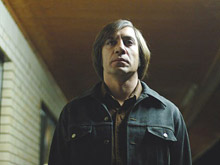 It's been a long time since No Country for Old Men passed through theaters, earned widespread acclaim, won an Academy Award, and took its place in the Cohen Brothers' filmography. Aside from some thoughts on muscular minimalism in prose and film, and maybe some musings on open narrative and thwarted expectations, I didn't have much to say about it. However, I've considered the movie some more recently while musing over philosophy in relation to film narrative, and now I think I should go back and give this film a little bit of commentary.
The underpinning of this film was its distillation of old Western archetypes into brutal central characters who seem so rugged and iconic... so intent on survival... that watching them come to blows is an epic experience. Llewelyn was a perfect rugged hero, salvaging blood money from the scene of a crime and struggling to keep him family safe from its pursuers. Tommy Lee Jones made a compelling weathered country Sheriff, driven out of his field by the injustice he has to face. However, I think most viewers will agree that it was Javier Bardem's character, the chilling, soulless hitman Anton Chigurh, who was most inspiring in the eye of the camera. He was a ghastly presence who moved through the narrative like a silent steam engine, and though he wasn't the narrator nor the protagonist, he was probably the true central character of the film.
At the time, Anton's gimmick... asking each of his victims to bet their life on a coin toss... seemed a bit trite, a little too much like Two Face's games with a two-headed silver dollar. However, on some reflection, it occurs to me that Anton's coin tosses were framed very much in terms of choice and agency, and so they took on a more philosophical edge than Two Face's little sadisms.
It is Llewelyn's wife, Carla Ann Moss (played by Kelly MacDonald), who brings this philosophical edge to light. At the last moment, before he kills her (a promise he made to Llewelyn), Anton gives Carla the choice to bet her life on a coin toss. This is her one chance to save her own life, and in an act of suicidal defiance, she gives it up, telling Anton that she doesn't believe she's really choosing... that he is the one with the gun, and he is the one who will decide whether to shoot her. In a certain way, she is entrusting herself to Anton, rather than to fate, and we, as the audience, know this isn't a particularly good idea.
It strikes me how much this game of Anton's is like Pascal's Wager. You may or may not have heard of it... it's the rationalist Pascal's idea that we can't know whether God exists, but we know that if He DOES exist, He will reward our belief in him. Thus, Pascal says, we should bet on belief, rather than submitting to uncertainty. By refusing to believe, our only possible futures are nothingness (if there's no God), or damnation (if there is a God). By contrast, if we gamble on God's existence, our possible outcomes are nothingness (again, in the case of God's non-existence) or eternal bliss (if God does actually exist).
This is a game theory decision. As rational actors, we're expected to weigh all possible options, recognize the one with the greatest strategic advantage, and follow that path. This may seem like a very cold, calculating reason to adopt Jesus as your personal Savior, but for Pascal, the point isn't the game. The point is that we all have the option to choose, and God has given us something to gamble on. If we refuse to believe, we're resigning ourselves to uncertainty and refusing to take agency over our own beliefs. It's sort of a precursor to Kierkegaard's existentialist "leap of faith."
Anton offers his victims a similar option... Carla in particular. Confronting her in her own home, he clearly intends to kill her. However, in her hands he places at least one final option -- the option to call a coin toss, and possibly save herself. Anton is saying to her, "you can choose to play the game, and entrust your life to something you truly can't predict, if you can overcome your fears of the unknown."
By this reading, Carla remains the staunch atheist, telling Anton that he, rather than she, is the one who must choose. This is not the right answer, as the film subsequently suggests. Anton was offering her a leap of faith -- giving her a 50/50 chance to save her own life, just as we may look into the face of a 50/50 chance for eternal salvation. And by this reading, perhaps Anton, by all accounts a force of nature, was trying to give Carla the chance she needed to escape. Perhaps the final moral infraction is the denial of one's own agency, and perhaps it's Carla's sin to bear after all.
Friday, January 02, 2009
Aronofsky's The Wrestler: accolade with a touch of feminist critique
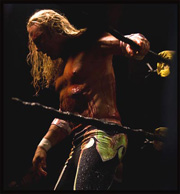 Darren Aronofsky is a filmmaker right on the border between avant-garde and well-recognized. It's a nice place to inhabit, as an artist... a space where you'll find most of the "hip" stuff in this day and age. There's some status associated with being edgy and non-formulaic, but your name is also easy to drop and sounds good in all the trendsetting circles. Having thus pigeonholed DA, I'd like to discuss his newest film, The Wrestler, which came to New York in December 08.
The Wrestler is refreshing. Aronofsky has spent the last ten years making unhinged films about madness, addiction, and desperation. Whether in Pi's paranoid delusion, Requiem's claustrophobic dependency, or The Fountain's densely symbolic story of epic self-denial, we're always in a gratingly alien head-space in Aaronofsky's films. We're put through paces that are so intense, we can barely relate to them, and we're left with nothing to talk about at the end of the picture. The Wrestler contrasts starkly with these previous films. It's a sympathetic, restrained story with a lot of authentic pathos. For the first time, we have an Aronofsky film about character, rather than concept, and though it's less twisted, it may be a lot more interesting.
For a "hip" director (I'll put that in scare quotes to show that I actually really admire Aronofsky, and have no interest in trivializing his work), making a film about professional wrestling can be a touchy endeavor. When you're a serious director and you put your hands on something many people take very un-seriously, it can come across as satirical, or obnoxiously ironic. Aronofsky does an excellent job, though. He doesn't approach wrestling as a curiosity or a carnival side-show... he approaches it as a fan would approach it. It's obvious why people would want to cheer for Randy, not just because we feel his pain backstage, but also because we see his trials as an athlete, and the importance that pro wrestling has for him.
With my opinion well-established, I'll go ahead and offer one critical perspective on the film. Considered as a character tragedy, or as a realist narrative, it's truly an achievement. However, from a feminist perspective, The Wrestler may warrant some critique. After all, there are essentially three main characters -- Randy, Cassidy (his love interest), and Stephanie (his daughter) -- and two are female. Ultimately, it is these central characters who bring about Randy's downfall. They are no more flawed than he is, but they are the ones who complicate his real life to such a degree that he loses control over it.
In fact, Randy's downfall can be attributed to three characters, and each of these characters fills certain traditional/literary sexist roles. Cassidy, his love interest, is the ice queen, so committed to her own aspirations that she can't make room in her heart for Randy, and she has to turn him away when he tries to open up to her. Stephanie, his daughter, is the hysteric, the female character so overcome by emotion that she rages at the people who love her, and ultimately drives them away. The third instrumental female, who only has one scene, is the girl at the bar who asks Randy if he wants to "party," and ultimately prevents him from making it to dinner. She's the temptress... the opposite role from Cassidy, offering Randy something to undermine him when he's at his weakest.
Aronofsky's film wasn't about the perils of the female sex... it was about Randy trying to sort out a life of emotional neglect, and naturally, these emotional commitments are the ones that cross the gender gap. It's a film about a wrestler, and it's a moving portrayal. So take the above feminist perspective into consideration, but don't forget what a fantastic piece of cinema this was, all told. I hope Aronofsky, Rourke, and Marissa Tomei are all remembered for this film, which will be a unique badge of honor on their careers.
Monday, December 29, 2008
Orwellian Glasses and Spiritual Jeans in Midtown NYC
Advertising: the art of pitching to a generic audience in a way that makes them feel unique, and uniquely suited to purchase a particular product. Excellent example: CRUNCH, the New York gym, whose marketing pitch is that people need a place to work out that's flexible and doesn't expect them to turn into jocks. However, BAD marketing, based loosely on the afore-cited principle but applying it in all the wrong ways, isn't just unconvincing... it's actually a little scary.
 Case in point: my.Vu
These ads popped up all over the 34th Street subway station one day, and I've had to endure them ever since. Each one has a stock-photo-esque portrait of a young model-esque adult wearing the product being advertised... a tiny pair of pseudo-sleek goggles with a video screen on the inside of the lens, so you can watch TV from a centimeter away. Each of these models has a practiced look of enjoyment, generally slightly flirtatious (especially when they're looking at you over the tops of the lenses). Each one also has some sort of "preference" listed at the bottom, like "retro punk," or "cooking shows." Each model's genre seems to have nothing whatsoever to do with their personality in the photo, and this is where the trouble starts.
Two problems here. One: the models and their poses are brutally generic, as if they were all taken from a modeling agency's B-Roll and outfitted by the mannquins at the Gap. Two: the posters, which would otherwise be blessedly forgettable, seem to be selling their product based on "individuality" implied by the genre preferences. Even to someone who's willing to give credit to the most crass advertising, this is offensive, a veritable insult to my gullibility. This is generic advertising gone mad.
In fact, it's ultimately rather Orwellian. We're given characters who are attractive, but in the most generic way possible... a standardization of an ideal, made placidly predictable in a series of fashion portraits... and in order to assuage our fears that we all might become the same person, we're provided with token "preferences" that we can check off on our personality forms, assuring us that we're individuals, I promise, I swear it. Of course, the fact that these models are depicted encased in personal video screens, a la 1984 meets Videodrome... that doesn't do anything to help the cause.
Bad advertising.
 But once I saw this, and discerned the source of my distaste, I ran across yet another sign of our dystopian corporate future. This, outside a Lincoln Center adorned with a pulsating Christmas phantasmagoria, was a large poster for "True Religion brand Jeans." This is truly a statement about what's really important during the Christmas season.
As a young, avant-garde progressive nihilist hipster, I must celebrate. Now that we've gotten through our enlightenment skepticism phase, pioneered by such skeptics as Leo Tolstoy and Karl Marx, we can move on to find some postmodern replacement for a genuinely spiritual deity... and who better to provide such an idol of complacency than Fashion Avenue? We know people like Richard Dawkins won't let us look to anything metaphysical for solace, what with all the breathing down our necks about "science," so we may as well look to the physical, social, commercial world for transcendance ("brandscendance?")
We are living in strange times, my friends. Pretty soon I'll need a prescription for my TV and a confessional for my fashion guilt.
Case in point: my.VuThese ads popped up all over the 34th Street subway station one day, and I've had to endure them ever since. Each one has a stock-photo-esque portrait of a young model-esque adult wearing the product being advertised... a tiny pair of pseudo-sleek goggles with a video screen on the inside of the lens, so you can watch TV from a centimeter away. Each of these models has a practiced look of enjoyment, generally slightly flirtatious (especially when they're looking at you over the tops of the lenses). Each one also has some sort of "preference" listed at the bottom, like "retro punk," or "cooking shows." Each model's genre seems to have nothing whatsoever to do with their personality in the photo, and this is where the trouble starts.
Two problems here. One: the models and their poses are brutally generic, as if they were all taken from a modeling agency's B-Roll and outfitted by the mannquins at the Gap. Two: the posters, which would otherwise be blessedly forgettable, seem to be selling their product based on "individuality" implied by the genre preferences. Even to someone who's willing to give credit to the most crass advertising, this is offensive, a veritable insult to my gullibility. This is generic advertising gone mad.
In fact, it's ultimately rather Orwellian. We're given characters who are attractive, but in the most generic way possible... a standardization of an ideal, made placidly predictable in a series of fashion portraits... and in order to assuage our fears that we all might become the same person, we're provided with token "preferences" that we can check off on our personality forms, assuring us that we're individuals, I promise, I swear it. Of course, the fact that these models are depicted encased in personal video screens, a la 1984 meets Videodrome... that doesn't do anything to help the cause.
Bad advertising.
But once I saw this, and discerned the source of my distaste, I ran across yet another sign of our dystopian corporate future. This, outside a Lincoln Center adorned with a pulsating Christmas phantasmagoria, was a large poster for "True Religion brand Jeans." This is truly a statement about what's really important during the Christmas season.As a young, avant-garde progressive nihilist hipster, I must celebrate. Now that we've gotten through our enlightenment skepticism phase, pioneered by such skeptics as Leo Tolstoy and Karl Marx, we can move on to find some postmodern replacement for a genuinely spiritual deity... and who better to provide such an idol of complacency than Fashion Avenue? We know people like Richard Dawkins won't let us look to anything metaphysical for solace, what with all the breathing down our necks about "science," so we may as well look to the physical, social, commercial world for transcendance ("brandscendance?")
We are living in strange times, my friends. Pretty soon I'll need a prescription for my TV and a confessional for my fashion guilt.
Wednesday, November 05, 2008
A long reflection on movie-watching
When I initiated my current project of experiencing film history by watching all the essential pictures, I expected it to be one of the many endeavors to fall victim to my short attention span. A few friends’ lists of films, perhaps twenty movies in total, provided a list that seemed overwhelming at the time. How often could I sacrifice an evening for a film that I might find obtuse, dated, and almost unwatchable? At the time, it seemed like a mere flight of fancy, easy to pursue because it was just a long list and an impotent plan.
How surprised I am, even now, to find that the quest has endured. In the last four months, I’ve watched around thirty films and tripled the size of my NetFlix queue, and I’ve seen my curiosity grow into something like an obsession. I’m hesitant to add too many more films to my queue (the purview of film is starting to lose its shape), and I can only watch a couple movies a week, so I find myself simply milling over the ones I’ve seen and impotently searching for “essentials” that I’ve managed to miss. Of course, there can’t be many more “essentials,” because the word loses its meaning when it's applied to such a vast range of films, so looking for more additions can be a frustrating pastime.
I’ve found that there are a number of possible approaches to the idea of “essential cinema.” My first approach to this topic was through a few friends, all very different, but all passionate about movies. I asked each of them for a list of five movies that everybody should see, and I got five completely different angles on the art and history of the medium. One list was a cluster of “influential films,” the experimental and artistic pieces that have inspired other directors to expand their visions… people like Bergman, Herzog, and Antonioni, who are essential for the uniqueness of their visions. Another list was a group of key blockbusters, including Star Wars, the Godfather, and three other films that have become inescapable references in pop culture. A third friend offered an historical list, a survey of silver screen and golden-age masterpieces that have served as Hollywood’s perennial prototypes.
I’ve discovered two inescapable names in this process. These are Ingmar Bergman and Akira Kurosawa… these two auteurs are the definitive artists of cinema history, having produced an almost endless filmography of apparent masterpieces according to their respective unique visions. Bergman’s best-known films are Persona, The Seventh Seal, and Wild Strawberries, but if you dig into his work, you find that virtually every film he produced is considered a masterpiece in some way. Kurosawa’s films have a similar power over his audiences… beyond Seven Samurai and Yojimbo, you’ll find a wealth of films that demonstrate a vast range of talent, from epic Samurai films to surreal film noir. It seems like every one of Kurosawa’s films is “perhaps his best,” or “enormously influential.”
You may notice: they’re not Steven Spielberg or James Cameron. They didn’t have a whole lot of budget for pyrotechnics, and they certainly didn’t have computer animation. In fact, going back into the history of cinema, you discover a much simpler art form. I’m not going to argue that these visionaries were better than our blockbuster purveyors, or even that they made better films. However, I’m going to point out that they had more control, back in the day. For Bergman in Persona, or for Warner Herzog in Stroszek, filmmaking was still related to theater and photography, and the camera was still a manual tool, a distant cousin of the paintbrush.
And though there have always been massive, big-budget motion pictures, going as far back as Intolerance, that silent epic, it was still an art form for individual creators for most of the twentieth century. Realizing this fact is part of the key to enjoying the older "classic" films, the ones that seem impossibly dated if you're mostly watching Guy Ritchie these days. When you get past the strange feeling that old films aren't managing to cue your emotions with obvious signals (sad music, close-ups of a single tear), you may discover a certain complex personality in the older pieces of cinema. There may be no twisted, angular plot to follow, and nobody to root for, so you have to start getting to know film like you get to a human being... strange, with emotional pieces that fit together messily, the product of a whole mass of conflicting influences and human history, wanting to speak but rarely knowing quite what it wants to say. So many old films are sullen, possibly because they're explorations of difficult psychic spaces. Some are over-masculine and callous, but undercut by gawky self-consciousness (Sergio Leone), and some use buoyancy and escapism to distract from the fact that they're wrestling with crippling uncertainty (Federico Fellini).
I've made a point to watch films in related groups, but to make sure I'm not watching all of one type of film at any particular time. Thus, I'll be poking around Poetic Realism, and mixing in a few 80's and 90's suspense and sci-fi essentials while I'm at it. The intention, in part, has been for me to avoid getting lost in one genre or period, and to get a broad purview of cinema history. It's apparent that film, as it stands today, has been shaped in some way by every major genre and movement, from the early silent films, which established all the basic camera conventions (the Soviet montage, for instance) to the Golden era of film, which brought the celebrity actor to Hollywood, to film noir, which brought us face to face with the cynical, self-preserving hero of late modernism.
Though film is a constant elaboration on its entire history, it seems that perhaps the current world of popular movies was born around the 1980's, with directors like Lucas, Cameron, and Ridley Scott. For years, film was disposed to be realist, simply by the limitations of budget and economy... with Star Wars, THX, Blade Runner, Alien(s), and The Terminator, directors were able to start creating their own worlds, and these visionaries became the godfathers of new American fiction. Since that time, set design, costuming, and post-production have matched cinematography and acting as the decisive factors in the cinema arts, and the vast majority of large-volume blockbusters, from Sin City to The Lord of the Rings to Gladiator, have drawn from this tendency, born in a molten pitch of 80's sci-fi.
It's taken some time for this project to bear any strong opinions, and though I've discovered some favorite movies, and traced some of my old favorites back to their historical influences, I haven't really formed much in the way of preferences for certain eras, styles, or movements. The one deeply personal conclusion I have arrived at is a pretty simple, broad reinforcement of something that I've actually known for a long time: I LOVE cinema, from the old silent pictures to the new Oscar winners, and from the most inane romances to the most obtuse art films.
I wish I had something better to tell you, at the end of this rambling post, but this is all I have for you. Movies are awesome. Thank you. Good night.
How surprised I am, even now, to find that the quest has endured. In the last four months, I’ve watched around thirty films and tripled the size of my NetFlix queue, and I’ve seen my curiosity grow into something like an obsession. I’m hesitant to add too many more films to my queue (the purview of film is starting to lose its shape), and I can only watch a couple movies a week, so I find myself simply milling over the ones I’ve seen and impotently searching for “essentials” that I’ve managed to miss. Of course, there can’t be many more “essentials,” because the word loses its meaning when it's applied to such a vast range of films, so looking for more additions can be a frustrating pastime.
I’ve found that there are a number of possible approaches to the idea of “essential cinema.” My first approach to this topic was through a few friends, all very different, but all passionate about movies. I asked each of them for a list of five movies that everybody should see, and I got five completely different angles on the art and history of the medium. One list was a cluster of “influential films,” the experimental and artistic pieces that have inspired other directors to expand their visions… people like Bergman, Herzog, and Antonioni, who are essential for the uniqueness of their visions. Another list was a group of key blockbusters, including Star Wars, the Godfather, and three other films that have become inescapable references in pop culture. A third friend offered an historical list, a survey of silver screen and golden-age masterpieces that have served as Hollywood’s perennial prototypes.
I’ve discovered two inescapable names in this process. These are Ingmar Bergman and Akira Kurosawa… these two auteurs are the definitive artists of cinema history, having produced an almost endless filmography of apparent masterpieces according to their respective unique visions. Bergman’s best-known films are Persona, The Seventh Seal, and Wild Strawberries, but if you dig into his work, you find that virtually every film he produced is considered a masterpiece in some way. Kurosawa’s films have a similar power over his audiences… beyond Seven Samurai and Yojimbo, you’ll find a wealth of films that demonstrate a vast range of talent, from epic Samurai films to surreal film noir. It seems like every one of Kurosawa’s films is “perhaps his best,” or “enormously influential.”
You may notice: they’re not Steven Spielberg or James Cameron. They didn’t have a whole lot of budget for pyrotechnics, and they certainly didn’t have computer animation. In fact, going back into the history of cinema, you discover a much simpler art form. I’m not going to argue that these visionaries were better than our blockbuster purveyors, or even that they made better films. However, I’m going to point out that they had more control, back in the day. For Bergman in Persona, or for Warner Herzog in Stroszek, filmmaking was still related to theater and photography, and the camera was still a manual tool, a distant cousin of the paintbrush.
And though there have always been massive, big-budget motion pictures, going as far back as Intolerance, that silent epic, it was still an art form for individual creators for most of the twentieth century. Realizing this fact is part of the key to enjoying the older "classic" films, the ones that seem impossibly dated if you're mostly watching Guy Ritchie these days. When you get past the strange feeling that old films aren't managing to cue your emotions with obvious signals (sad music, close-ups of a single tear), you may discover a certain complex personality in the older pieces of cinema. There may be no twisted, angular plot to follow, and nobody to root for, so you have to start getting to know film like you get to a human being... strange, with emotional pieces that fit together messily, the product of a whole mass of conflicting influences and human history, wanting to speak but rarely knowing quite what it wants to say. So many old films are sullen, possibly because they're explorations of difficult psychic spaces. Some are over-masculine and callous, but undercut by gawky self-consciousness (Sergio Leone), and some use buoyancy and escapism to distract from the fact that they're wrestling with crippling uncertainty (Federico Fellini).
I've made a point to watch films in related groups, but to make sure I'm not watching all of one type of film at any particular time. Thus, I'll be poking around Poetic Realism, and mixing in a few 80's and 90's suspense and sci-fi essentials while I'm at it. The intention, in part, has been for me to avoid getting lost in one genre or period, and to get a broad purview of cinema history. It's apparent that film, as it stands today, has been shaped in some way by every major genre and movement, from the early silent films, which established all the basic camera conventions (the Soviet montage, for instance) to the Golden era of film, which brought the celebrity actor to Hollywood, to film noir, which brought us face to face with the cynical, self-preserving hero of late modernism.
Though film is a constant elaboration on its entire history, it seems that perhaps the current world of popular movies was born around the 1980's, with directors like Lucas, Cameron, and Ridley Scott. For years, film was disposed to be realist, simply by the limitations of budget and economy... with Star Wars, THX, Blade Runner, Alien(s), and The Terminator, directors were able to start creating their own worlds, and these visionaries became the godfathers of new American fiction. Since that time, set design, costuming, and post-production have matched cinematography and acting as the decisive factors in the cinema arts, and the vast majority of large-volume blockbusters, from Sin City to The Lord of the Rings to Gladiator, have drawn from this tendency, born in a molten pitch of 80's sci-fi.
It's taken some time for this project to bear any strong opinions, and though I've discovered some favorite movies, and traced some of my old favorites back to their historical influences, I haven't really formed much in the way of preferences for certain eras, styles, or movements. The one deeply personal conclusion I have arrived at is a pretty simple, broad reinforcement of something that I've actually known for a long time: I LOVE cinema, from the old silent pictures to the new Oscar winners, and from the most inane romances to the most obtuse art films.
I wish I had something better to tell you, at the end of this rambling post, but this is all I have for you. Movies are awesome. Thank you. Good night.
Tuesday, November 04, 2008
Victory for Barack Obama
I know I haven't posted in a while, but I just wanted to say congratulations to my fellow leftists and centrists, my fellow students and young voters, and the whole mass of a nation that needed to see politics take a fresh turn. As with Hegel and my enlightenment forefathers, I believe history has a trajectory that will become clear in time, and this election has reassured me that it's a direction I can understand and appreciate.
Benefit of the Doubt believes in the power of public discourse, but more importantly, I believe that this discourse isn't empty -- the words of a public figure, whether spoken in private or from behind a podium, are a window into that figure's consciousness. Each of us has been forced, over the last year, to turn our ears toward these candidates, and I believe that we, as a collective culture, have heard the truth in them, and we have made a sound judgement.
So most of all, congratulations to Barack Obama, our new President... may he bring a new voice to our nation, and may its echo endure in history.
Benefit of the Doubt believes in the power of public discourse, but more importantly, I believe that this discourse isn't empty -- the words of a public figure, whether spoken in private or from behind a podium, are a window into that figure's consciousness. Each of us has been forced, over the last year, to turn our ears toward these candidates, and I believe that we, as a collective culture, have heard the truth in them, and we have made a sound judgement.
So most of all, congratulations to Barack Obama, our new President... may he bring a new voice to our nation, and may its echo endure in history.
Sunday, September 28, 2008
Highest Praise: Vertov's Man With the Movie Camera
Since I'm not really interested in deconstructing the body language of presidential candidates, or celebrating the stupidity of an opposing party, I'm going to keep away from overtly political commentary for the moment. It's a sad day when reasoned analysis seems like folly in the face of strategic absurdity, which is currently having an undue influence over public opinion, and I think, for the moment, I'd rather talk about something from 1920 than I would about what's going on right now.
So I saw The Man With The Movie Camera, which is one of the greatest films you've never heard of. It clocked in at number 95 on the 1000 greatest films ever made, which I think shortchanges it a bit... among the silent films I've seen, it's been by far the most interesting. Battleship Potemkin was ranked at number 49, a full fifty places ahead, and it seems to me that Potemkin, made only four years earlier, had hardly an iota of the formal and artistic complexity of Man With the Movie Camera.
Part of the reason Man With the Movie Camera is such an artistic feat is that it seems formally and semantically deliberate, right down to the core. Its complexity never seems like the accident of experimentation, perhaps because it was created within a very clear conceptual framework. This framework is what you might call the theory of pure montage, the attempt to use juxtaposition and parallel alone to create meaning, rather than using narrative continuity and the invisible cut. Battleship Potemkin's experiments with montage were within a framework of telling a story, which was itself in service to reinforcing an ideology. Eisenstein's montage was conceived as a means to an end, and thus it wasn't able to reach its full potential as a craft in itself.
Vertov's stated mission, to purge film of the conventions of literature and theater, is evident in practice in Man With the Movie Camera, and this allows the film to act as a complex, 75-minute wireframe that can in turn be analyzed in parts, as a series of sub-montages, and together, as a meta-montage. The levels of parallelism are almost limitless... the parallel between the mechanisms of the city and the engineering of the human body, the association between the window, the eye, and the lens, the parallel drawn between narrative fiction and slumber (i.e. bourgeousie laziness), the references to the substructure of labor and the superstructure of urban life, the stories of awareness of the camera, both ours as the audience and the citizens' as the subject of the lens, the flocking and unfolding of urban populations, including both birds and humans, and the comparison of sewing of clothes and sealing of fingernails to the stitiching and developing of the director's film. These are just the first observations I can think of, a few isolated cases in a wellspring of concepts.
It's strange that this film came so long before those theories that seem to describe it. Postmodernism is so often cited as a post-World War II phenomenon, but this film is a shining predecessor to the postmodern obsession with spectacle and representation. Man With the Movie Camera makes a compelling attempt to contain and represent itself, and in its tentative success, it prefigures all those partial successes of postmodern ideas to bring recursive framing to culture. This is an ideologically-specific film depicting the construction of its own substance, which is a pseudo-narrative of a cameraman making a film whose subject is an ideological culture struggling to free itself from the anesthetisizing conventions of narrative... the signifiers can be drawn out almost ad infinitum. Why hasn't Derrida written about this? He's much better at creating clever grammatical sequences than I am.
This film also predates Marshall McLuhan by about a lifetime and a half, and yet it seems to speak directly to McLuhan's ideas about the power of media and the nature of content. The sequence with the seamstresses, carrying out their craft on the human body, is shown in parallel with a sequence on the film developing and editing process, which shows the craft behind the scenes of film, preparing images for mass consumption. Vertov seems to realize that a cosmetic procedure, carried out on the body, is no less a "medium" than a film, whose content is those unrefined images captured on journeys through Soviet Russia. At the same time, he seems to be making the reverse connection, as well: just as clothing and cosmetic services are forms of production, so the information-refining processes of capturing and editing images are forms of intellectual production, and this film, contained within its metafilm, is the product whose value is to be found in its refinement.
I have the urge to claim that the film is about man and his relationship with technology, which defines his culture and his ideology from the bottom up. However, that would be an unfair reduction of an infinitely complex, ambiguous film. The hypnotic rhythm, and intuitive order, and the deceptively complex conceptual framework... these all fit together to create one of the most important films in history, and one of my favorites among all the cinema I've seen.
So you should check it out.
So I saw The Man With The Movie Camera, which is one of the greatest films you've never heard of. It clocked in at number 95 on the 1000 greatest films ever made, which I think shortchanges it a bit... among the silent films I've seen, it's been by far the most interesting. Battleship Potemkin was ranked at number 49, a full fifty places ahead, and it seems to me that Potemkin, made only four years earlier, had hardly an iota of the formal and artistic complexity of Man With the Movie Camera.
Part of the reason Man With the Movie Camera is such an artistic feat is that it seems formally and semantically deliberate, right down to the core. Its complexity never seems like the accident of experimentation, perhaps because it was created within a very clear conceptual framework. This framework is what you might call the theory of pure montage, the attempt to use juxtaposition and parallel alone to create meaning, rather than using narrative continuity and the invisible cut. Battleship Potemkin's experiments with montage were within a framework of telling a story, which was itself in service to reinforcing an ideology. Eisenstein's montage was conceived as a means to an end, and thus it wasn't able to reach its full potential as a craft in itself.
Vertov's stated mission, to purge film of the conventions of literature and theater, is evident in practice in Man With the Movie Camera, and this allows the film to act as a complex, 75-minute wireframe that can in turn be analyzed in parts, as a series of sub-montages, and together, as a meta-montage. The levels of parallelism are almost limitless... the parallel between the mechanisms of the city and the engineering of the human body, the association between the window, the eye, and the lens, the parallel drawn between narrative fiction and slumber (i.e. bourgeousie laziness), the references to the substructure of labor and the superstructure of urban life, the stories of awareness of the camera, both ours as the audience and the citizens' as the subject of the lens, the flocking and unfolding of urban populations, including both birds and humans, and the comparison of sewing of clothes and sealing of fingernails to the stitiching and developing of the director's film. These are just the first observations I can think of, a few isolated cases in a wellspring of concepts.
It's strange that this film came so long before those theories that seem to describe it. Postmodernism is so often cited as a post-World War II phenomenon, but this film is a shining predecessor to the postmodern obsession with spectacle and representation. Man With the Movie Camera makes a compelling attempt to contain and represent itself, and in its tentative success, it prefigures all those partial successes of postmodern ideas to bring recursive framing to culture. This is an ideologically-specific film depicting the construction of its own substance, which is a pseudo-narrative of a cameraman making a film whose subject is an ideological culture struggling to free itself from the anesthetisizing conventions of narrative... the signifiers can be drawn out almost ad infinitum. Why hasn't Derrida written about this? He's much better at creating clever grammatical sequences than I am.
This film also predates Marshall McLuhan by about a lifetime and a half, and yet it seems to speak directly to McLuhan's ideas about the power of media and the nature of content. The sequence with the seamstresses, carrying out their craft on the human body, is shown in parallel with a sequence on the film developing and editing process, which shows the craft behind the scenes of film, preparing images for mass consumption. Vertov seems to realize that a cosmetic procedure, carried out on the body, is no less a "medium" than a film, whose content is those unrefined images captured on journeys through Soviet Russia. At the same time, he seems to be making the reverse connection, as well: just as clothing and cosmetic services are forms of production, so the information-refining processes of capturing and editing images are forms of intellectual production, and this film, contained within its metafilm, is the product whose value is to be found in its refinement.
I have the urge to claim that the film is about man and his relationship with technology, which defines his culture and his ideology from the bottom up. However, that would be an unfair reduction of an infinitely complex, ambiguous film. The hypnotic rhythm, and intuitive order, and the deceptively complex conceptual framework... these all fit together to create one of the most important films in history, and one of my favorites among all the cinema I've seen.
So you should check it out.
Wednesday, September 24, 2008
Hitchcock: Theories on The Birds and Psycho
Since my last list of films, I've seen a few others... Renoir's Rules of the Game, Port of Shadows, Fellini's 8 1/2, Murnau's Nosferatu, and most recently, two essential Hitchcock films that I'd never seen: The Birds and Psycho. I've focused my viewing habits a bit more in order to attend to seminal works of European and American popular film, and I've discovered some interesting trends. For instance, it seems to me that European film naturally groups itself into movements, often nationalistic and stylistic (Italian Neorealism, Poetic Realism, German Expressionism, etc) whereas American cinema organizes itself into genres that are specifically semantic and topical in nature (film noir, Western, horror). This is probably worthy of another blog post in the future; however, for today, I'd like to reflect on those Hitchcock films.
Hitchcock's experimentation with sound is among the most cosmetic, but the most striking, of the innovations appearing in these two films. I've seen three wildly different approaches to music in Hitchcock: in Psycho, the music was essential to the mood, and some extended scenes... like Marion's long drive to the Bates Motel... were entirely dependent upon the soundtrack. The music goes far beyond the famous screeching violins, and sets the unbalanced, trembling tone for the whole film. In The Birds, there is no music, which is one of the most unsettling aspects. This is not a movie about humans and their need for order and aesthetics, after all, and the lack of a soundtrack highlights the alien character of the natural world which envelopes them and threatens them with its tempraments. In Rear Window, which I saw a year or so ago, there is a soundtrack, but it's always created within the scene (i.e. diegetic music). I'm not going to focus on this film, but I thought it worth mentioning, since it's a third example of an experiment in audio-visual synergy.
The soundtrack for Psycho is perfectly suited to the tone of the film. In the key scenes, Hitchcock spends his time bringing us into the psychological space where Norman Bates resides, and the film's interiors represent this. Apparently Zizek hypothesized that the three levels of Bates' home represented his superego, ego, and id, respectively. This draws attention more generally to the fact that this was a film of interiors, and especially of the interior of Bates' mind. We spend some of the early scenes in Marion's head, where she hears the voices of her acquaintances as they decide how to pursue her. However, through most of the film, we're so close to Bates, and so involved with his anxiety and his complexes, that we're essentially seeing through his eyes, albiet with some contextual omnipresence added for effect.
What does this have to do with the soundtrack? Simply that the jarring violins and cellos were well-suited to representing an unbalanced mental space. The presence of music sets a mood and an atmosphere, and even a personality, within the space of the film, and this particular soundtrack played as a struggle to bring order to world that's ultimately drowned in anxiety and fear. This is Norman's soundtrack: his world is always at a slight tilt, jarring and uneven, and Bernard Herrmann's music is maddeningly effective.
The Birds feels a lot different, and represents something very different, and the difference in soundtracks indicates one of the basic contrasts between the films. In The Birds, there is no overriding consciousness to bring order to the strange events of the world, so there is no predictability and no explanation... no shrink detective appears at the end, explaining the phenomenon that made the birds attack the residents of the Bay. The clientelle of the diner offer a few tentative explanations, but these all seem woefully inadequate in the face of the simple physical facts of the attack. There is no solution, because there isn't even a plausible explanation, whether from science, or from religion, or from paranoia.
In this world, the human mind is no longer central, but peripheral to the unfolding events of the film. Music is no longer appropriate, because music is an ordering of the biological -- rhythm, harmonic melody, and atmosphere -- according to the patterns of consciousness, and in the hostile natural world that's overtaken Bodega Bay, there is no place for the metanarrative of the human mind. The characters are left to improvise and flounder, and their attempts to attribute any rationality to their environment are always in vain.
In fact, even the audience is left to struggle in vain with the problem of explanation. John McCombe points this out in the Spring 2005 Cinema Journal in his article on The Birds and English Romanticism... he says, "the viewer attempts to construct a cause for the violent attacks by these normally passive birds." This was true, at least for me, through the whole film -- though I didn't hope to find a clear, scientific/symbolic/rational explanation for the attacks, I kept searching for a running theme that could drive an interpretation. Was there a certain time, a certain symbol, or a certain object that united the attacks? Like the characters, I was left looking for some transcendental motive in nature's hostility, and like the characters, I was unsuccessful.
I felt that among the three explanations offered by the diner customers, the most plausible was the one offered by the paranoid mother, who suggested that Melanie was cursed. I wouldn't say that she was evil, per se... but she seemed cursed, almost from the outset of the film. The first on-record bird attacks were both in her vicinity, and toward the end of the film, when the attacks had started to make the news, the announcer noted that they were still centered around Bodega Bay. This isn't the whole world of nature going insane -- this is one small part of California, reacting negatively to bad energy, and some indicators point to Melanie as the source.
What could Melanie have done to earn the wrath of the natural world? Perhaps it has to do with her interest in overturning established orders, pulling pranks, invading a small town, and disrupting a tense maternal relationship. Maybe Lydia is a witch, or her anxiety is resonating through the natural world. Maybe, because she imprisoned the love birds, and because her own disposition is light and avian, Melanie has been chosen as nature's Pariah, a sacrifice to make up for humanity's petty fascist crimes.
It's worth further investigating the relationship between Psycho and The Birds, and I suspect that some theorist may have done this already. Mitch is no Norman Bates, but in a sense, his relationship with his real mother is reflective of Norman's relationship with his moralizing, internalized "mother" personality. If we continue along this line of logic, we discover that Melanie is like Marion, or like one of the girls who Norman murdered: a threat to a strained, controlling maternal relationship, an instigator throwing off the family's Oedipal balance. If this is truly her role, and if (as the previous paragraphs suggest) Melanie is actually the birds' target, then their wrath could be read as the reincarnated anger of Bates' mother, embodied in the same birds that preoccupy her son Norman.
And when this anger leaves Norman's head and enters the world, it's no longer contained in the jarring, pathological order of the violins and cellos... instead, it becomes a force that's disembodied, unstoppable, and unsettlingly silent.
Hitchcock's experimentation with sound is among the most cosmetic, but the most striking, of the innovations appearing in these two films. I've seen three wildly different approaches to music in Hitchcock: in Psycho, the music was essential to the mood, and some extended scenes... like Marion's long drive to the Bates Motel... were entirely dependent upon the soundtrack. The music goes far beyond the famous screeching violins, and sets the unbalanced, trembling tone for the whole film. In The Birds, there is no music, which is one of the most unsettling aspects. This is not a movie about humans and their need for order and aesthetics, after all, and the lack of a soundtrack highlights the alien character of the natural world which envelopes them and threatens them with its tempraments. In Rear Window, which I saw a year or so ago, there is a soundtrack, but it's always created within the scene (i.e. diegetic music). I'm not going to focus on this film, but I thought it worth mentioning, since it's a third example of an experiment in audio-visual synergy.
The soundtrack for Psycho is perfectly suited to the tone of the film. In the key scenes, Hitchcock spends his time bringing us into the psychological space where Norman Bates resides, and the film's interiors represent this. Apparently Zizek hypothesized that the three levels of Bates' home represented his superego, ego, and id, respectively. This draws attention more generally to the fact that this was a film of interiors, and especially of the interior of Bates' mind. We spend some of the early scenes in Marion's head, where she hears the voices of her acquaintances as they decide how to pursue her. However, through most of the film, we're so close to Bates, and so involved with his anxiety and his complexes, that we're essentially seeing through his eyes, albiet with some contextual omnipresence added for effect.
What does this have to do with the soundtrack? Simply that the jarring violins and cellos were well-suited to representing an unbalanced mental space. The presence of music sets a mood and an atmosphere, and even a personality, within the space of the film, and this particular soundtrack played as a struggle to bring order to world that's ultimately drowned in anxiety and fear. This is Norman's soundtrack: his world is always at a slight tilt, jarring and uneven, and Bernard Herrmann's music is maddeningly effective.
The Birds feels a lot different, and represents something very different, and the difference in soundtracks indicates one of the basic contrasts between the films. In The Birds, there is no overriding consciousness to bring order to the strange events of the world, so there is no predictability and no explanation... no shrink detective appears at the end, explaining the phenomenon that made the birds attack the residents of the Bay. The clientelle of the diner offer a few tentative explanations, but these all seem woefully inadequate in the face of the simple physical facts of the attack. There is no solution, because there isn't even a plausible explanation, whether from science, or from religion, or from paranoia.
In this world, the human mind is no longer central, but peripheral to the unfolding events of the film. Music is no longer appropriate, because music is an ordering of the biological -- rhythm, harmonic melody, and atmosphere -- according to the patterns of consciousness, and in the hostile natural world that's overtaken Bodega Bay, there is no place for the metanarrative of the human mind. The characters are left to improvise and flounder, and their attempts to attribute any rationality to their environment are always in vain.
In fact, even the audience is left to struggle in vain with the problem of explanation. John McCombe points this out in the Spring 2005 Cinema Journal in his article on The Birds and English Romanticism... he says, "the viewer attempts to construct a cause for the violent attacks by these normally passive birds." This was true, at least for me, through the whole film -- though I didn't hope to find a clear, scientific/symbolic/rational explanation for the attacks, I kept searching for a running theme that could drive an interpretation. Was there a certain time, a certain symbol, or a certain object that united the attacks? Like the characters, I was left looking for some transcendental motive in nature's hostility, and like the characters, I was unsuccessful.
I felt that among the three explanations offered by the diner customers, the most plausible was the one offered by the paranoid mother, who suggested that Melanie was cursed. I wouldn't say that she was evil, per se... but she seemed cursed, almost from the outset of the film. The first on-record bird attacks were both in her vicinity, and toward the end of the film, when the attacks had started to make the news, the announcer noted that they were still centered around Bodega Bay. This isn't the whole world of nature going insane -- this is one small part of California, reacting negatively to bad energy, and some indicators point to Melanie as the source.
What could Melanie have done to earn the wrath of the natural world? Perhaps it has to do with her interest in overturning established orders, pulling pranks, invading a small town, and disrupting a tense maternal relationship. Maybe Lydia is a witch, or her anxiety is resonating through the natural world. Maybe, because she imprisoned the love birds, and because her own disposition is light and avian, Melanie has been chosen as nature's Pariah, a sacrifice to make up for humanity's petty fascist crimes.
It's worth further investigating the relationship between Psycho and The Birds, and I suspect that some theorist may have done this already. Mitch is no Norman Bates, but in a sense, his relationship with his real mother is reflective of Norman's relationship with his moralizing, internalized "mother" personality. If we continue along this line of logic, we discover that Melanie is like Marion, or like one of the girls who Norman murdered: a threat to a strained, controlling maternal relationship, an instigator throwing off the family's Oedipal balance. If this is truly her role, and if (as the previous paragraphs suggest) Melanie is actually the birds' target, then their wrath could be read as the reincarnated anger of Bates' mother, embodied in the same birds that preoccupy her son Norman.
And when this anger leaves Norman's head and enters the world, it's no longer contained in the jarring, pathological order of the violins and cellos... instead, it becomes a force that's disembodied, unstoppable, and unsettlingly silent.
Tuesday, September 16, 2008
Woody Allen's Vicky Christina Barcelona as a fable of stability

I've never really seen any classic Woody Allen. There's a specific reason for that: given what I've heard of the director, and the few clips of his movies that I've seen, I felt like I'd already gotten the point. Woody Allen is a neurotic, effete New York intellectual who spends his movies meditating on love's confusions, usually in the form of an autobiographical monologue and a few anecdotal incidents. This is a fair project for an artist with a vision, but it's not something I feel the need to attend to.
Even so, I caught Match Point not too long ago, and I definitely enjoyed it. Woody Allen really knows the aesthetic he's working with, and he knows the subtlety of intimacy and attachment. The touch of crime drama, with its uncertainty and suspense, was enough to keep me engaged in the narrative. I've recently seen Vicky Christina Barcelona, and I have a sense that I've experienced all that stuff I was missing.
Vicky Christina Barcelona is a film about a pair of friends who spend a summer in Barcelona, exploring and negotiating their very different approaches to romance. The two title characters, and all the characters they encounter, are molded to fairly common stereotypes, and this may be one of the first weaknesses of the film. Vicky is the stable skeptic, prudent and attached, and Christina is the fickle lover, obsessed with her freedom and her self-image. These two may both fit archetypal roles, but at the very least, their archetypes are explored in the course of the film.
Vicky and Christina's counterparts... the latin lovers Juan Antonio and Maria Elena... are carved from pure stereotype. They're the idealized, romanticized Spaniards, poetic and sensitive, confident, artistically gifted and sexually free. They come across as basically flawless, though in two very different ways. Was Woody Allen conscious of his lack of subtlety? Was he using them as icons of an American stereotype, instead of trying to develop them as characters?
I guess, in terms of the story, there's actually something to this role-affirming characterization. Like so many films, Vicky Christina Barcelona is about personalities striving to evolve and individuals trying to transgress their own limits. Like Shrek trying to break out of his cynicism, or Harold Crick struggling to break free of his predetermined lifestyle, Vicky and Christina are both facing the possibility of breaking through their own limits. Vicky finds her commitment shaken by a new infatuation, and Christina finds herself in a romantic situation that might convince her to finally settle down.
The difference between Shrek and Stranger Than Fiction, referenced above, and Vicky Christina Barcelona, is that in the latter, these transgressions fail miserably. Essentially, this film is about two identities that are challenged, but ultimately confirmed by those challenges. The latin couple's erotic allure almost overturns both Vicky's and Christina's self-appointed roles, but ultimately, they're too volatile for Vicky and too stable for Christina. The two protagonists finally return to themselves and go on living their self-images. Presumably, these roles are enough for them, and both go on to live happily.
You may have noticed that at the end of Vicky Christina Barcelona, nothing has changed. Nobody has gone through a great self-discovery, except to reaffirm their previous decisions, and nobody's life has drastically changed course. Vicky's relationship with the lovable Doug is saved, and even the capricious Christina seems stable in her transience. Juan Antonio and Maria Elena are still the same violent, creative couple, vascillating between love and hate, but we never expected them to change in the first place... they were just a sounding-board for the identities of the other two characters.
Anthony Burgess actually commented on this in his introduction to A Clockwork Orange, wherein he explained the significance of his final chapter: "When a fictional work fails to show change, when it merely indicates that human character is set, stony, unregenerable, then you are out of the field of the novel and into that of the fable or allegory." In this sense, then, Vicky Christina Barcelona is a fable, rather than a "novel" (still comparing it to literature). This makes it an interesting exercise, but perhaps less interesting as a film... a fable of romantic and sexual self-affirmation, where we may find the characters compelling, but where the opening monologue tells us all we need to know about them.

Wednesday, September 03, 2008
Amelie and Eternal Sunshine: Deconstructing the Manic Pixie Dream Girl
I'm excited whenever I see smart, useful film criticism emerge from the orgy of popular commentary, and when it comes to film, The Onion AV Club is one of the more reliable sources for good ideas. In a recent article on Elizabethtown, Nathan Rabin coined the term "Manic Pixie Dream Girl," which he describes thusly:
"Dunst embodies a character type I like to call The Manic Pixie Dream Girl (see Natalie Portman in Garden State for another prime example). The Manic Pixie Dream Girl exists solely in the fevered imaginations of sensitive writer-directors to teach broodingly soulful young men to embrace life and its infinite mysteries and adventures. The Manic Pixie Dream Girl is an all-or-nothing-proposition. Audiences either want to marry her instantly (despite The Manic Pixie Dream Girl being, you know, a fictional character) or they want to commit grievous bodily harm against them and their immediate family."
This is good, solid criticism, the type of thoughtful generalization that can be applied across a broad range of films (as the AV Club does again later). The MPDG archetype is a lot like the Magical Negro archetype, which I've written about before. She embodies something that our culture subconsciously idolizes and holds sacred, and just as the Magical Negro gives us some insight into our racial stereotypes, so the MPDG gives us some insight into our gender stereotypes.
I want to touch on the MPDG in two movies... not to criticize them for their stereotypes, but to praise them for their deconstruction. These are Amelie and Eternal Sunshine of the Spotless Mind. Both films are widely praised as thoughtful, well-written films, but it's hard to say what exactly works about them. I think their unconventional treatment of the MPDG is at least one thing that both have going for them.
In Eternal Sunshine, Clementine starts the film as the essential MPDG. When Joel, reserved self-hating male, feels inspired to do something spontaneous and go to Montauk, she appears magically on a train, beckoning to him. They share an inexplicably intense afternoon (the traces of their former relationship, it turns out) and Joel finds himself beginning to loosen. Clementine is the inspiration for the blossoming of his personality in the Long Island winter snow.
However, as we dig into the chronology of the story, we start to see glimpses of this MPDG-driven relationship, and where it's taken them before. The second key scene, developing their emotional dynamic, is their fight in early 2004. In this scene, Clementine's absence and irreverence prompt Joel to air his grievances with the relationship, and we discover, to our surprise, that those free-spirited qualities that drew Joel to Clementine in the first place have started to wear on him. For Joel, her attractive sexual confidence has started to seem like lust and manipulation, and her spontaneity has threatened his own sense of stability.
This is, in a sense, a critique of the male investment in the MPDG. She may fulfill the male's fantasy of sex and happiness for a short time, but eventually the idealization will fade away, and the disillusioned man will be left with a real person, whose quirks may occasionally become less than endearing. By putting Clementine on a pedestal, Joel has doomed himself to disappointment and resentment... all she wants is to be treated like a real person, flawed and uncertain.
Amelie takes the stereotype and places it at yet another angle. Jeunet's 2001 film is about a girl who undertakes the mission of disrupting the lives of everyone around her, always in innocent ways, in order to make them reevaluate their lives. In some cases it works, and in some it doesn't.
Amelie Poulain is the perfect MPDG. She is friendly, lovable, and spontaneous, looking for intimacy, and bringing a sense of playful disorder to her surroundings. She only breaks the MPDG stereotype in one way: the MPDG is always a secondary character with a one-dimensional inner life, whereas Amelie is the primary protagonist, living out a personal history and chasing her desires. She is the MPDG of so many other movies, but in this little masterpiece, we are seeing the world through her eyes.
Is Nino the reserved male pseudo-protagonist to Amelie's MPDG? Perhaps... he spends a good deal of the film enduring a job he doesn't like and pursuing an introverted hobby to the ends of the earth. When Amelie starts leaving him clues as to her whereabouts and identity, he is eager to engage in her game. However, he doesn't have Jeunet's spotlight. In this spotlight, we find Amelie, and we discover certain intricacies of character that we wouldn't see in a conventional MPDG film.
In particular, Jeunet's camera shows us that Amelie loves to bring disorder to the world around her, but that her quirky hobbies are actually almost a form of self-sacrifice. She spends so much time trying to disrupt the lives of her friends that she hasn't taken the time to look for a love of her own. Her mysterious romance with Nino is her first attempt to take control of her own life, rather than disrupting others' control of theirs. In a sense, this is what every MPDG does: she sacrifices her own desires in order to be a vehicle in others' stories. She has positive influence, but she has no motive.
Amelie is the MPDG who decides to do something for herself, and by doing so, she discovers that she is a genuine agent in her own story, rather than simply a device in somebody else's.
"Dunst embodies a character type I like to call The Manic Pixie Dream Girl (see Natalie Portman in Garden State for another prime example). The Manic Pixie Dream Girl exists solely in the fevered imaginations of sensitive writer-directors to teach broodingly soulful young men to embrace life and its infinite mysteries and adventures. The Manic Pixie Dream Girl is an all-or-nothing-proposition. Audiences either want to marry her instantly (despite The Manic Pixie Dream Girl being, you know, a fictional character) or they want to commit grievous bodily harm against them and their immediate family."
This is good, solid criticism, the type of thoughtful generalization that can be applied across a broad range of films (as the AV Club does again later). The MPDG archetype is a lot like the Magical Negro archetype, which I've written about before. She embodies something that our culture subconsciously idolizes and holds sacred, and just as the Magical Negro gives us some insight into our racial stereotypes, so the MPDG gives us some insight into our gender stereotypes.
I want to touch on the MPDG in two movies... not to criticize them for their stereotypes, but to praise them for their deconstruction. These are Amelie and Eternal Sunshine of the Spotless Mind. Both films are widely praised as thoughtful, well-written films, but it's hard to say what exactly works about them. I think their unconventional treatment of the MPDG is at least one thing that both have going for them.
In Eternal Sunshine, Clementine starts the film as the essential MPDG. When Joel, reserved self-hating male, feels inspired to do something spontaneous and go to Montauk, she appears magically on a train, beckoning to him. They share an inexplicably intense afternoon (the traces of their former relationship, it turns out) and Joel finds himself beginning to loosen. Clementine is the inspiration for the blossoming of his personality in the Long Island winter snow.
However, as we dig into the chronology of the story, we start to see glimpses of this MPDG-driven relationship, and where it's taken them before. The second key scene, developing their emotional dynamic, is their fight in early 2004. In this scene, Clementine's absence and irreverence prompt Joel to air his grievances with the relationship, and we discover, to our surprise, that those free-spirited qualities that drew Joel to Clementine in the first place have started to wear on him. For Joel, her attractive sexual confidence has started to seem like lust and manipulation, and her spontaneity has threatened his own sense of stability.
This is, in a sense, a critique of the male investment in the MPDG. She may fulfill the male's fantasy of sex and happiness for a short time, but eventually the idealization will fade away, and the disillusioned man will be left with a real person, whose quirks may occasionally become less than endearing. By putting Clementine on a pedestal, Joel has doomed himself to disappointment and resentment... all she wants is to be treated like a real person, flawed and uncertain.
Amelie takes the stereotype and places it at yet another angle. Jeunet's 2001 film is about a girl who undertakes the mission of disrupting the lives of everyone around her, always in innocent ways, in order to make them reevaluate their lives. In some cases it works, and in some it doesn't.
Amelie Poulain is the perfect MPDG. She is friendly, lovable, and spontaneous, looking for intimacy, and bringing a sense of playful disorder to her surroundings. She only breaks the MPDG stereotype in one way: the MPDG is always a secondary character with a one-dimensional inner life, whereas Amelie is the primary protagonist, living out a personal history and chasing her desires. She is the MPDG of so many other movies, but in this little masterpiece, we are seeing the world through her eyes.
Is Nino the reserved male pseudo-protagonist to Amelie's MPDG? Perhaps... he spends a good deal of the film enduring a job he doesn't like and pursuing an introverted hobby to the ends of the earth. When Amelie starts leaving him clues as to her whereabouts and identity, he is eager to engage in her game. However, he doesn't have Jeunet's spotlight. In this spotlight, we find Amelie, and we discover certain intricacies of character that we wouldn't see in a conventional MPDG film.
In particular, Jeunet's camera shows us that Amelie loves to bring disorder to the world around her, but that her quirky hobbies are actually almost a form of self-sacrifice. She spends so much time trying to disrupt the lives of her friends that she hasn't taken the time to look for a love of her own. Her mysterious romance with Nino is her first attempt to take control of her own life, rather than disrupting others' control of theirs. In a sense, this is what every MPDG does: she sacrifices her own desires in order to be a vehicle in others' stories. She has positive influence, but she has no motive.
Amelie is the MPDG who decides to do something for herself, and by doing so, she discovers that she is a genuine agent in her own story, rather than simply a device in somebody else's.
Tuesday, August 26, 2008
Riding the Rumor Mill: Four Johnny Depp characters as The Riddler
So people are talking about casting choices for the next Batman, and there have been three noted... but there's only one I really feel like talking about. Here's a hint: he's not blond-haired, and he's not 62 years old.
The answer: Johnny Depp as The Riddler, the casting choice that tha Intarwebs seem most certain about. Do Depp's qualifications... his flirtations with Tim Burton and Disney, his hybrid status as a mainstream indie actor... give him the clout he'll need to play the Riddler? To answer this question, we'll have to look past the tabloid hype and explore more fruitful venues: the characters who have defined Depp as an actor.
There are four.
 1. Sweeny Todd as The Riddler
This anti-hero might be the first character that comes to mind when you think of Depp as the Riddler, but I personally wouldn't be too interested in seeing Nolan take this direction. Sweeny's Riddler would be sentimental and sociopathic, vengeful, and overall, too measured and balanced. Tortured super-intelligence that overwhelms sympathy and leads to a callous disregard for human life? Yawn. Already been done.
 2. Jack Sparrow as The Riddler
Jack: spritely, charismatic, unpredictable, and clever in unexpected ways. If you could pull this one off, you could make The Riddler seem more like a hero than a villain... a rogue vigilante wannabe whose only evil is that he's got a personal (or even professional) vendetta against Batman, who's simply getting too much attention. I doubt it will happen, and I'm not even sure I'd like it, but why not make your villain loveable for once? It would be a neat trick.
 3. Willy Wonka as The Riddler
This Depp seems most pertinent to The Riddler. We can easily see Depp turning the character into a giddy recluse who has vast resources and complete control over whatever he can draw into his domain. The strange pedophile streak, the utter lack of simple social skills, and the glaring, unsettling eccentricity... if there's any way to convince the fans that Depp is the right choice, it's by pointing them towards Depp's creepy, sad, patriarchal Willy Wonka. Unfortunately, this character already resembles the Joker a little too much. We need something besides manic violence to allow The Dark Knight to grow.
 4. Edward Scissorhands as The Riddler
This is the key role, my friends. It may sound unlikely, but what better way to evoke both sad sympathy and disgusted fear than to bring back the pathetic slouch of Depp's most tortured role? If The Riddler was actually an idiot savant... a pitiful and pitiable dog at society's heel, whose capacity for calculated, violent retribution is the only thing keeping his personality together... a character who geniunely fails to fully understand the damage he causes to Gotham City... then we'd really have something interesting.
The answer: Johnny Depp as The Riddler, the casting choice that tha Intarwebs seem most certain about. Do Depp's qualifications... his flirtations with Tim Burton and Disney, his hybrid status as a mainstream indie actor... give him the clout he'll need to play the Riddler? To answer this question, we'll have to look past the tabloid hype and explore more fruitful venues: the characters who have defined Depp as an actor.
There are four.
 1. Sweeny Todd as The Riddler
This anti-hero might be the first character that comes to mind when you think of Depp as the Riddler, but I personally wouldn't be too interested in seeing Nolan take this direction. Sweeny's Riddler would be sentimental and sociopathic, vengeful, and overall, too measured and balanced. Tortured super-intelligence that overwhelms sympathy and leads to a callous disregard for human life? Yawn. Already been done.
 2. Jack Sparrow as The Riddler
Jack: spritely, charismatic, unpredictable, and clever in unexpected ways. If you could pull this one off, you could make The Riddler seem more like a hero than a villain... a rogue vigilante wannabe whose only evil is that he's got a personal (or even professional) vendetta against Batman, who's simply getting too much attention. I doubt it will happen, and I'm not even sure I'd like it, but why not make your villain loveable for once? It would be a neat trick.
 3. Willy Wonka as The Riddler
This Depp seems most pertinent to The Riddler. We can easily see Depp turning the character into a giddy recluse who has vast resources and complete control over whatever he can draw into his domain. The strange pedophile streak, the utter lack of simple social skills, and the glaring, unsettling eccentricity... if there's any way to convince the fans that Depp is the right choice, it's by pointing them towards Depp's creepy, sad, patriarchal Willy Wonka. Unfortunately, this character already resembles the Joker a little too much. We need something besides manic violence to allow The Dark Knight to grow.
 4. Edward Scissorhands as The Riddler
This is the key role, my friends. It may sound unlikely, but what better way to evoke both sad sympathy and disgusted fear than to bring back the pathetic slouch of Depp's most tortured role? If The Riddler was actually an idiot savant... a pitiful and pitiable dog at society's heel, whose capacity for calculated, violent retribution is the only thing keeping his personality together... a character who geniunely fails to fully understand the damage he causes to Gotham City... then we'd really have something interesting.
Monday, August 11, 2008
Jesse's Survey of Great Films: No BotD Required
Remember I mentioned my desire to fill out my film background? That quest is still underway, and I'd like to pause with the topical posts for the moment and reflect on my progress. In the interest of this blog, I'm going to list all the iconic movies I've seen, and I'm going to try to tell you, in as few words as possible, why each of them is great, and why I feel its place in this quest is justified.
Fistful of Dollars (1964) - How's it feel to sit through a film where a corrupt city totally destroys itself because of one lonely outlaw, and finally to see that main character walk off into the sunset, still a mystery to us? I think it's a good way to experience the transience and instability of the savage, mythical Old West.
The Philadelphia Story (1940) - A true showcase of personalities, framed, contrasted with one another, and revealed in the complexity that makes them so poignant. There's no way to do this except with the present combination of brilliant writing and flawless delivery.
Casablanca (1942) - The atmosphere of Casablance brought volume to the sense of time and place, giving a presence to the historical politics... moreso, however, the characters made the story seem eternally topical, and they showed that history is lived, rather than simply remembered and represented.
LA Story (1991) - LA Story was nice as a RomCom, but more than anything, it's the story of its director's creative genesis: in Steve Martin's strange plotting and jarring pacing, you can feel the quirkiness of a new director, but in his unpredictable characters and convergences, you can feel the spontaneity and passion of a young artist's hands just touching the clay.
Basic Instinct (1992) - Basic Instinct was an intense film because it drew me into the obsessions of its characters: when Nick finally decided to play Catherine's game, I was scared for him, but I was also genuinely excited to see if he could meet her challenge. It helped that the film refused, from the first scene, to make any promises to us.
The Hunger (1983) - Any time you get bored with the slow, ambiguous gravity of this film's emotions, you should just stop for a second and appreciate the lush beauty of its set and atmosphere.
The Searchers (1956) - This film was basically a jewelry case for John Wayne. The rest of the characters were pleasant set-pieces, over-acting and complimentary. Wayne was a frightening, awe-inspiring mythical hero, complete with the flaws and alienation required to get the job done.
Intolerance (1916) - I have trouble seeing past the production quirks of old movies, but I simply couldn't help stopping every so often during Intolerance and appreciating the light, the geometry, the flawless aesthetic perfection of its key shots.
The Wild Bunch (1969) - This was one of my favorites. On the surface Peckinpah's movie is all brooding savagery, but underneath, you can find all the brotherhood and nostalgia of the mythical Old West (and presumably of the military life that Peckinpah came from).
Escape from New York (1981) - Snake Plisskin was a one-of-a-kind antihero, and after following him through his journey into danger and redemption, we still never connect with him enough to predict him. Again, the rest of the characters are set-pieces, right along with the insane sets themselves.
Blue Velvet (1986) - David Lynch has a strange way of making the bizarre seem mundane. His bright, flat key lights and primary colors distract us for a while, and then, all of a sudden, Lynch's bizarre sexual and emotional revelations pull us back into the visceral world of flesh.
Gone With The Wind (1939) - Gone With The Wind was a beautifully-plotted film about a cast of fascinating characters building lives together without ever really recognizing or finding one another... like leaves circling on a blustery day (note the parallelism). Also, I saw three or four scenes in this film that have been referenced DOZENS of times in more recent movies and television shows.
Stroszek (1977) - I finished this movie thinking I didn't get it, but it stayed on my mind for days afterwards, and I eventually realized that all of the surreal and meaningless details had come together to create a weird, compelling world of beautiful but tragic confusion.
Fast, Cheap and Out Of Control (1997) - I'm still not sure I could tell you what this documentary was about, but I think that was part of its genius: it was a uniquely empty space for an intertwining set of motifs and explorations that were channeled through the obsessions of its four protagonists. Brilliant in a very micronarrative kind of way.
Pretty Woman (1990) - Was this an amazing film for the romantic plot, or was it great because of all its subconscious complexes and wish-fulfillment brilliance? It's really a good movie, for serious, among the better rom-coms, but it doesn't really become fascinating until you mobilize your psychoanalysis and gender studies to eviscerate it.
Say Anything (1989) - I'm actually watching the commentary track for this as we speak. I'm a big fan, as it turns out... it was a film full of good people, confused about their own relationships and emotions, and improvising their ways through the consequences of their decisions. This is very much how I remember my suburban adolescence.
Lost In Translation (2003) - Coppola encapsulates a short, fiery, hopeless relationship and frames the themes that should by all accounts make her famous: loneliness and alienation in an artificial world, and the glimpse of hope provided by fragments of understanding discovered in total strangers.
Marie Antoinette (2006) - Like Lost In Translation, this is a film that explored its themes deeply, without ever bringing them above the level of atmosphere and aesthetic. We could tell from the direction that Marie Antoinette was a normal girl who had an artificial world erected around her, intended to protect her, but ultimately isolating her from the world that was bearing down on her.
So I've seen all of Sofia Coppola's body of work, and I've touched a whole range of genres, directors, and eras. Coming up next, I've got a couple more Sergio Leone films, another David Lynch, and Fellini's 8 1/2. Down along the line, there's a ton of Akira Kurosawa and Ingmar Bergman, because those two seem to have produced about a thousand "classics" each. So many films, so little time... stay tuned for further journal-style records of cinematic experience.
Fistful of Dollars (1964) - How's it feel to sit through a film where a corrupt city totally destroys itself because of one lonely outlaw, and finally to see that main character walk off into the sunset, still a mystery to us? I think it's a good way to experience the transience and instability of the savage, mythical Old West.
The Philadelphia Story (1940) - A true showcase of personalities, framed, contrasted with one another, and revealed in the complexity that makes them so poignant. There's no way to do this except with the present combination of brilliant writing and flawless delivery.
Casablanca (1942) - The atmosphere of Casablance brought volume to the sense of time and place, giving a presence to the historical politics... moreso, however, the characters made the story seem eternally topical, and they showed that history is lived, rather than simply remembered and represented.
LA Story (1991) - LA Story was nice as a RomCom, but more than anything, it's the story of its director's creative genesis: in Steve Martin's strange plotting and jarring pacing, you can feel the quirkiness of a new director, but in his unpredictable characters and convergences, you can feel the spontaneity and passion of a young artist's hands just touching the clay.
Basic Instinct (1992) - Basic Instinct was an intense film because it drew me into the obsessions of its characters: when Nick finally decided to play Catherine's game, I was scared for him, but I was also genuinely excited to see if he could meet her challenge. It helped that the film refused, from the first scene, to make any promises to us.
The Hunger (1983) - Any time you get bored with the slow, ambiguous gravity of this film's emotions, you should just stop for a second and appreciate the lush beauty of its set and atmosphere.
The Searchers (1956) - This film was basically a jewelry case for John Wayne. The rest of the characters were pleasant set-pieces, over-acting and complimentary. Wayne was a frightening, awe-inspiring mythical hero, complete with the flaws and alienation required to get the job done.
Intolerance (1916) - I have trouble seeing past the production quirks of old movies, but I simply couldn't help stopping every so often during Intolerance and appreciating the light, the geometry, the flawless aesthetic perfection of its key shots.
The Wild Bunch (1969) - This was one of my favorites. On the surface Peckinpah's movie is all brooding savagery, but underneath, you can find all the brotherhood and nostalgia of the mythical Old West (and presumably of the military life that Peckinpah came from).
Escape from New York (1981) - Snake Plisskin was a one-of-a-kind antihero, and after following him through his journey into danger and redemption, we still never connect with him enough to predict him. Again, the rest of the characters are set-pieces, right along with the insane sets themselves.
Blue Velvet (1986) - David Lynch has a strange way of making the bizarre seem mundane. His bright, flat key lights and primary colors distract us for a while, and then, all of a sudden, Lynch's bizarre sexual and emotional revelations pull us back into the visceral world of flesh.
Gone With The Wind (1939) - Gone With The Wind was a beautifully-plotted film about a cast of fascinating characters building lives together without ever really recognizing or finding one another... like leaves circling on a blustery day (note the parallelism). Also, I saw three or four scenes in this film that have been referenced DOZENS of times in more recent movies and television shows.
Stroszek (1977) - I finished this movie thinking I didn't get it, but it stayed on my mind for days afterwards, and I eventually realized that all of the surreal and meaningless details had come together to create a weird, compelling world of beautiful but tragic confusion.
Fast, Cheap and Out Of Control (1997) - I'm still not sure I could tell you what this documentary was about, but I think that was part of its genius: it was a uniquely empty space for an intertwining set of motifs and explorations that were channeled through the obsessions of its four protagonists. Brilliant in a very micronarrative kind of way.
Pretty Woman (1990) - Was this an amazing film for the romantic plot, or was it great because of all its subconscious complexes and wish-fulfillment brilliance? It's really a good movie, for serious, among the better rom-coms, but it doesn't really become fascinating until you mobilize your psychoanalysis and gender studies to eviscerate it.
Say Anything (1989) - I'm actually watching the commentary track for this as we speak. I'm a big fan, as it turns out... it was a film full of good people, confused about their own relationships and emotions, and improvising their ways through the consequences of their decisions. This is very much how I remember my suburban adolescence.
Lost In Translation (2003) - Coppola encapsulates a short, fiery, hopeless relationship and frames the themes that should by all accounts make her famous: loneliness and alienation in an artificial world, and the glimpse of hope provided by fragments of understanding discovered in total strangers.
Marie Antoinette (2006) - Like Lost In Translation, this is a film that explored its themes deeply, without ever bringing them above the level of atmosphere and aesthetic. We could tell from the direction that Marie Antoinette was a normal girl who had an artificial world erected around her, intended to protect her, but ultimately isolating her from the world that was bearing down on her.
So I've seen all of Sofia Coppola's body of work, and I've touched a whole range of genres, directors, and eras. Coming up next, I've got a couple more Sergio Leone films, another David Lynch, and Fellini's 8 1/2. Down along the line, there's a ton of Akira Kurosawa and Ingmar Bergman, because those two seem to have produced about a thousand "classics" each. So many films, so little time... stay tuned for further journal-style records of cinematic experience.
Tuesday, August 05, 2008
A Dark Knight in Gotham Part III: City, System, Character

WARNING: more spoilers, and also considerably more random and rambling than the previous two posts on this film.
At the outset of The Dark Knight, we flash from an enigmatic burning texture to an elevated agoraphobic helicopter shot, descending into the city through the rooftop of a mob bank. This is one of the most sweeping, open shots of
So I guess I lied in that last post.
The other elevated scenes in
The difference between Gotham from above and Gotham from within is an apt analogy for the difference between Bruce Wayne as an alienated playboy, kept at a distance from the world he cares so much about, and Batman as the bad temper lurking in the back alleys of the urban environment. The fragmented setting foregrounds the main character’s fragmented existence, his need -- as
Of course,
By the middle of the film, The Joker begins to foresee that he and Batman will become locked in struggle that can’t be resolved. The Joker calls himself and Batman "an unstoppable force hitting an immovable object," and this observation demonstrates his intuitive understanding of the eternal struggle between them. In fact, by the time he utters this line, The Joker no longer even cares to kill Batman, even going so far as to protect his adversary's identity. In the interrogation room, when The Joker informs Batman that he depends upon him to be his foil and his mortal foe, the dynamic of their relationship changes immensely.
Okay, so Batman refuses to kill the Joker, and the Joker has decided not to kill Batman. They're not technically "mortal" enemies any longer... what's left for them to fight over? When two opposing forces reach equilibrium, a third element needs to complete the system and mediate between them, and in Nolan's The Dark Knight, this third element is
Batman's writers don’t always make this three-part "eternal struggle" structure explicit, but we all understand it intuitively, as part of our knowledge of Batman himself. As long as the Dark Knight is out there, he needs the Joker as his essential adversary, and these two personalities need a system within which to carry out their exchanges. This system is
Christopher Nolan captured something about Batman and the Joker that could have slipped by another director, but that’s indispensable to the mythology that he was building upon. He built not two, but three strong personalities -- Batman, the Joker, and
Tuesday, July 29, 2008
A Dark Knight in Gotham Part II: Gotham as a Landscape
WARNING: I will spoil some shit. There will be extensive discussion of the plot. I am bad at keeping secrets when I engage in close readings. Just sayin'.
So we move on to Nolan's Gotham City, first in terms of portrayal, and then in terms of its relationship to the stories of Batman and the Joker, Harvey, Bruce, and Rachel. The last post mentioned the importance of shooting Gotham in a real city, a creative decision that gave the environment its believability. Christopher Nolan chose Chicago to represent this dangerous metropolis, which makes sense, since Chicago has long been an icon of urban blight and faceless concrete. The use of Chicago is especially fitting because the backbone of The Dark Knight is a story about crime and politics, and Chicago is the greatest mob city in the United States. Chicago's personality has a lot to do with Gotham's grittiness; however, Nolan's unique perspective on the environment makes it a city of its own, the same way his direction, combined with Heath Ledger's brilliant acting, gave us a Joker we'd never seen before.
As an access point, let's contrast Nolan's Gotham with his Hong Kong, where Batman goes to retrieve the smuggler Lau. Considering the viewer only inhabits Hong Kong for a few scenes, it's striking how vivid a treatment the city is given, and how effective a foil it is for Gotham. Hong Kong feels like it was bled out of a completely different imagination, as though Nolan hired a new production designer and cinematographer for that city. It's a city in the clouds, where Bruce and Batman aren't even seen on the ground. The tall buildings allow for sweeping shots of Batman in flight, and the extensive glass facades give an acrophobic anxiety to the fight scenes. Batman is a beautiful sight in such a pristine environment, but it only serves to remind us how alien he is to that city.
Gotham, by contrast, is shot almost entirely in low shots, looking up at bridges and buildings. In scene after scene, we peer toward the buildings from the streets and the sidewalks, and the camera is constantly caught between walls of brick and concrete. It's a petrified tunnel system that Lucien Fox's sonar device temporarily converts into a visual swamp, and even in the daylight, it always seems cramped. This city is defined by two visual motifs that I'd like to draw attention to: the tunnel/underpass, and the ravine of unbroken buildings.
The tunnel/underpass is by far the most prominent visual motif of Nolan's Gotham City. We first see Batman in a parking garage, facing the mob, the Scarecrow, and a small gang of Batman impersonators. This low-ceilinged horizontal expanse is where Batman seems to be most at home, and this might be part of the reason that it feels spatially similar to the Bat Cave, though it's not as well-lit. However, later scenes draw him deeper into the tunnels of Gotham. Two-Face's final scene takes place in what looks like a cavern, carved out in Gotham's concrete flesh. Batman also emerges from these labyrinthine shadows into Gotham sunlight in the film's closing moments – this is a key scene, and it's one that I'll return to later in this reading.
The other important motif in The Dark Knight is the canyon formed by the building faces, which extend the claustrophobia of the tunnels into the daylight above the earth. This formation was essential to the attempted assassination of the Mayor – as a sniper on a fire escape points out, the police seem useless and vulnerable when faced with the surrounding walls of windows.
These two motifs converge in the long chase sequence, when Harvey Dent is being transported by a SWAT team beset by the Joker, and Batman emerges to confront him. This scene represents the struggle over Dent's life... a conflict that eventually sublimates into the struggle for Gotham's soul... and in order to gain the advantage, The Joker draws Harvey and Batman into the concrete underworld beneath Gotham. This is the descent into Hell, the stage for the confrontation that determines the course of The Dark Knight. After they endure The Joker's escalating trials, the chase re-emerges into the shadow of the Gotham buildings, and again, the canyon formation asserts itself. In this canyon, air support is useless, and The Joker is confident in facing Batman directly, in the middle of the street, without flinching.
Of course, it's Gordon, returning from the dead, who traps The Joker at the end of the confrontation. There's certainly more symbolic significance wrapped up in this emergence from the underworld, but I don't think I have the time to fully analyze it. However, if you want another interesting portrayal of a city, rendered as a labyrinthine Stygia and shadowy home to the restless dead, check out Venice in Nicholas Roeg's Don't Look Now. It's surreal and haunting, and if you've seen The Dark Knight, it may remind you of a more magical Gotham City.
Actually, for the time being, forget Venice. Christopher Nolan is building on a complex, very American history when he renders this gritty, noir Gotham City. Dennis O'Neil, a writer and editor of the Batman comics, said that "Batman's Gotham City is Manhattan below Fourteenth Street at eleven minutes past midnight on the coldest night in November" (see the Wikipedia article for the citation). It's worth noting that this remark was published in 1994, just before Rudy Guiliani became Mayor of New York and started cracking down on petty crimes and reducing urban decay. O'Neil is talking about the bohemian New York City of twenty years ago, and he's talking about the parts of the city where students and working-class residents were living. Gotham's business district is the cramped, cynical Wall Street of the 1980's; its residential areas are the East Village and Lower East Side apartments, the downtown church steps where panhandlers spent (and still spend) their nights. New York and Gotham have always been a bit enigmatic and intimidating.
This is the city Nolan has sketched for us, a vortex for Batman's vengeance and retribution, an underworld so overwhelming that it makes his heroism seem futile. In Nolan's lucid portrayal, however, Gotham isn't just a setting. It's also a theater for mythical characters and a lynchpin in their relationships. This relationship between the city and its inhabitants is what I'll be addressing in my final post on this topic. Tune in next week, kiddies, because we're coming into the home stretch.
So we move on to Nolan's Gotham City, first in terms of portrayal, and then in terms of its relationship to the stories of Batman and the Joker, Harvey, Bruce, and Rachel. The last post mentioned the importance of shooting Gotham in a real city, a creative decision that gave the environment its believability. Christopher Nolan chose Chicago to represent this dangerous metropolis, which makes sense, since Chicago has long been an icon of urban blight and faceless concrete. The use of Chicago is especially fitting because the backbone of The Dark Knight is a story about crime and politics, and Chicago is the greatest mob city in the United States. Chicago's personality has a lot to do with Gotham's grittiness; however, Nolan's unique perspective on the environment makes it a city of its own, the same way his direction, combined with Heath Ledger's brilliant acting, gave us a Joker we'd never seen before.
As an access point, let's contrast Nolan's Gotham with his Hong Kong, where Batman goes to retrieve the smuggler Lau. Considering the viewer only inhabits Hong Kong for a few scenes, it's striking how vivid a treatment the city is given, and how effective a foil it is for Gotham. Hong Kong feels like it was bled out of a completely different imagination, as though Nolan hired a new production designer and cinematographer for that city. It's a city in the clouds, where Bruce and Batman aren't even seen on the ground. The tall buildings allow for sweeping shots of Batman in flight, and the extensive glass facades give an acrophobic anxiety to the fight scenes. Batman is a beautiful sight in such a pristine environment, but it only serves to remind us how alien he is to that city.
Gotham, by contrast, is shot almost entirely in low shots, looking up at bridges and buildings. In scene after scene, we peer toward the buildings from the streets and the sidewalks, and the camera is constantly caught between walls of brick and concrete. It's a petrified tunnel system that Lucien Fox's sonar device temporarily converts into a visual swamp, and even in the daylight, it always seems cramped. This city is defined by two visual motifs that I'd like to draw attention to: the tunnel/underpass, and the ravine of unbroken buildings.
The tunnel/underpass is by far the most prominent visual motif of Nolan's Gotham City. We first see Batman in a parking garage, facing the mob, the Scarecrow, and a small gang of Batman impersonators. This low-ceilinged horizontal expanse is where Batman seems to be most at home, and this might be part of the reason that it feels spatially similar to the Bat Cave, though it's not as well-lit. However, later scenes draw him deeper into the tunnels of Gotham. Two-Face's final scene takes place in what looks like a cavern, carved out in Gotham's concrete flesh. Batman also emerges from these labyrinthine shadows into Gotham sunlight in the film's closing moments – this is a key scene, and it's one that I'll return to later in this reading.
The other important motif in The Dark Knight is the canyon formed by the building faces, which extend the claustrophobia of the tunnels into the daylight above the earth. This formation was essential to the attempted assassination of the Mayor – as a sniper on a fire escape points out, the police seem useless and vulnerable when faced with the surrounding walls of windows.
These two motifs converge in the long chase sequence, when Harvey Dent is being transported by a SWAT team beset by the Joker, and Batman emerges to confront him. This scene represents the struggle over Dent's life... a conflict that eventually sublimates into the struggle for Gotham's soul... and in order to gain the advantage, The Joker draws Harvey and Batman into the concrete underworld beneath Gotham. This is the descent into Hell, the stage for the confrontation that determines the course of The Dark Knight. After they endure The Joker's escalating trials, the chase re-emerges into the shadow of the Gotham buildings, and again, the canyon formation asserts itself. In this canyon, air support is useless, and The Joker is confident in facing Batman directly, in the middle of the street, without flinching.
Of course, it's Gordon, returning from the dead, who traps The Joker at the end of the confrontation. There's certainly more symbolic significance wrapped up in this emergence from the underworld, but I don't think I have the time to fully analyze it. However, if you want another interesting portrayal of a city, rendered as a labyrinthine Stygia and shadowy home to the restless dead, check out Venice in Nicholas Roeg's Don't Look Now. It's surreal and haunting, and if you've seen The Dark Knight, it may remind you of a more magical Gotham City.
Actually, for the time being, forget Venice. Christopher Nolan is building on a complex, very American history when he renders this gritty, noir Gotham City. Dennis O'Neil, a writer and editor of the Batman comics, said that "Batman's Gotham City is Manhattan below Fourteenth Street at eleven minutes past midnight on the coldest night in November" (see the Wikipedia article for the citation). It's worth noting that this remark was published in 1994, just before Rudy Guiliani became Mayor of New York and started cracking down on petty crimes and reducing urban decay. O'Neil is talking about the bohemian New York City of twenty years ago, and he's talking about the parts of the city where students and working-class residents were living. Gotham's business district is the cramped, cynical Wall Street of the 1980's; its residential areas are the East Village and Lower East Side apartments, the downtown church steps where panhandlers spent (and still spend) their nights. New York and Gotham have always been a bit enigmatic and intimidating.
This is the city Nolan has sketched for us, a vortex for Batman's vengeance and retribution, an underworld so overwhelming that it makes his heroism seem futile. In Nolan's lucid portrayal, however, Gotham isn't just a setting. It's also a theater for mythical characters and a lynchpin in their relationships. This relationship between the city and its inhabitants is what I'll be addressing in my final post on this topic. Tune in next week, kiddies, because we're coming into the home stretch.
Friday, July 25, 2008
A Dark Knight in Gotham Part I: Comic Book Film Cities
 I think we can generally agree that Christopher Nolan and Heath Ledger have created a goddamn masterpiece, and even though Christian Bale and Maggie Gyllenhaal didn’t really provide the magic that made it happen, they certainly pulled their weight. Everybody’s been talking about The Dark Knight, and there’s a reason for that… it’s an unmatched piece of cinema work, not just a great comic book film, but a great film in general. Disguised under the action, this is a film driven by the psychological confrontations, and it takes on the power of an epic suspense thriller, a la The Game or Primal Fear. It matches, and even surpasses these movies, because the villain is so powerful and terrifying, and because it develops its psychological relationships throughout a whole host of characters, rather than simply between two or three. I hope it’s the first comic book / action movie to win a really important Academy Award.
 There’s going to be a lot of talk about it, though, so I’m going to try to look at it through a specific lens. Rather than replicate the many orgasming movie critics and drooling bloggers, I’m going to try to analyze Nolan’s fine piece of work by way of an implicit “Other,” an almost Godlike character who appears in every scene, but who isn’t acted by anyone famous, and who doesn’t even appear in the credits. This character is
Note: there may be spoilers in the next couple blog posts. There aren't really any in this one, though.
A DARK KNIGHT IN
Fictional cities as the central figures in comic book films: however rare and quirky this sounds, it’s actually something that’s already come up, and something that’s going to be coming back up again soon. Give me a moment on a tangent, please… I’d like to talk about Frank Miller.
Frank Miller actually wrote the comic book The Dark Knight Returns, which is the landmark use of that nickname. His comic, published in 1986, was Batman’s ticket out of the blue suit and bad effects of the old Batman comics and television show. It was about Bruce Wayne returning from retirement to fight crime as an old man, and the psychological and ethical demons he had to face in a new era of crime and cruelty. Miller’s series established the gritty, violent image that Nolan is now working with. Within Nolan’s plot, the copycat Batmen may even be an homage to the imitators in Miller’s Dark Knight Returns. However, aside from this homage and the similarity in tone, the plot of Miller’s 1986 comic has nothing to do with Nolan’s film.

Miller created another comic title, independent of the DC mythology, entitled
I fear the same problem from Miller’s upcoming film, The Spirit. Again, The Spirit is about the character of a city… the tagline for the movie is, “My city screams. She is my lover. I am her spirit.” The trailers and promotional material give the sense of a city that’s defined by an anonymous hero and a twisted maze of sexual tension. Unfortunately, they also give the sense of a city that’s created in Adobe Illustrator, rather than discovered on the urban streets.
Nolan’s
Wednesday, July 16, 2008
Wall-e and Authorship: Pixar's Career as an Auteur
So Wall-e is the... what... ninth Pixar film? If you read my last post, you'll know my opinion of it... that it's a new level of craftsmanship on Pixar's part. Now, we've all seen artists who developed their skills to transcendent levels over the course of their careers -- Picasso's periods, Shakespeare's writings -- now we have a new artist (if you can call it that), the animation studio that's going to define the cinematic experiences of a whole generation, and it seems as though they've yet to peak.
Before this, Pixar's filmography was probably defined by Toy Story, Monsters Inc, and Finding Nemo. Toy Story made them famous and put them squarely ahead of their competition, and Monsters Inc. was their introduction to big-time at the Oscars, being nominated for Best Animated Feature, as well as three other awards, and winning Best Original Song (beating out all the live-action soundtracks that year). Finding Nemo was Pixar's clincher, the film whose characters and storytelling defied all the expectations of the critics. The Best Animated Feature award was the crown on Pixar's ascending head.
Pixar's other films, movies that everybody adored but that didn't quite change the landscape of media, include The Incredibles and Ratatouille... both of these could have taken that coveted Best Animated Feature award, but Finding Nemo just happened to be the earlier project. Wall-e might indeed be the next definitive movie in Pixar's oeuvre, not only because it had the immaculate craftsmanship of Finding Nemo, but also because it experimented with style and boundaries in such a way that it seemed to be a new experience, even for the seasoned Pixar fan.
Has anyone else noticed the strangeness of treating an animation studio -- Pixar -- as if it's a single human being, an author with a unified creative vision that sculpts the animated masterpieces we see each year? Nobody seems to have taken notice of this phenomenon, but it's definitely something new. In the past, any noteworthy film was attached to a director's name, and that film's artistic vision was credited to that director. This is the essence of auteur theory, and a cornerstone of Hollywood's celebrity marketing pitch: see the new Hitchcock / Kurosawa / Cronenburg / Woody Allen / Cohen Brothers film this summer, and return to the world of an artist you've fallen in love with.
The problem with this approach is that every film is a collision of hundreds of different talented people. The film industry is massive and evenly distributed over too many disciplines to count, and in every film, you can find the hand of a director, a cinematographer, a production designer, an effects supervisor, and a thousand consultants and lackeys. Maybe you don't actually like David Fincher... maybe you just happened to like Zodiac because he worked with Harris Savides, and so the photography direction was exceptionally brilliant.
In this sense, as strange as it sounds to treat Pixar as an individual auteur when it's actually a whole collective, it might actually be a more honest way to look at authorship in cinema. After all, even though the staff changes, there's a good chance that most of the principal personalities... concept artists, production designers, photography supervisors, and head writers... are carrying across from movie to movie. We can see the development of a company, and the streamlining of its vision, as we watch each successive triumph on the movie screen. We can stop pretending it's just one guy with a camera and some friends from acting school, and we can see that these things are the product of a vast, synchronized creative/corporate process.
As long as I trust that there is still room for the auteur in film... for people like Werner Herzog, who really do involve themselves deeply in every step of the process... then I'm also happy to treat a great company with the same respect I would give to a great artist. Artist, company, single, multiple... we're so over those binaries! This is the future!
Before this, Pixar's filmography was probably defined by Toy Story, Monsters Inc, and Finding Nemo. Toy Story made them famous and put them squarely ahead of their competition, and Monsters Inc. was their introduction to big-time at the Oscars, being nominated for Best Animated Feature, as well as three other awards, and winning Best Original Song (beating out all the live-action soundtracks that year). Finding Nemo was Pixar's clincher, the film whose characters and storytelling defied all the expectations of the critics. The Best Animated Feature award was the crown on Pixar's ascending head.
Pixar's other films, movies that everybody adored but that didn't quite change the landscape of media, include The Incredibles and Ratatouille... both of these could have taken that coveted Best Animated Feature award, but Finding Nemo just happened to be the earlier project. Wall-e might indeed be the next definitive movie in Pixar's oeuvre, not only because it had the immaculate craftsmanship of Finding Nemo, but also because it experimented with style and boundaries in such a way that it seemed to be a new experience, even for the seasoned Pixar fan.
Has anyone else noticed the strangeness of treating an animation studio -- Pixar -- as if it's a single human being, an author with a unified creative vision that sculpts the animated masterpieces we see each year? Nobody seems to have taken notice of this phenomenon, but it's definitely something new. In the past, any noteworthy film was attached to a director's name, and that film's artistic vision was credited to that director. This is the essence of auteur theory, and a cornerstone of Hollywood's celebrity marketing pitch: see the new Hitchcock / Kurosawa / Cronenburg / Woody Allen / Cohen Brothers film this summer, and return to the world of an artist you've fallen in love with.
The problem with this approach is that every film is a collision of hundreds of different talented people. The film industry is massive and evenly distributed over too many disciplines to count, and in every film, you can find the hand of a director, a cinematographer, a production designer, an effects supervisor, and a thousand consultants and lackeys. Maybe you don't actually like David Fincher... maybe you just happened to like Zodiac because he worked with Harris Savides, and so the photography direction was exceptionally brilliant.
In this sense, as strange as it sounds to treat Pixar as an individual auteur when it's actually a whole collective, it might actually be a more honest way to look at authorship in cinema. After all, even though the staff changes, there's a good chance that most of the principal personalities... concept artists, production designers, photography supervisors, and head writers... are carrying across from movie to movie. We can see the development of a company, and the streamlining of its vision, as we watch each successive triumph on the movie screen. We can stop pretending it's just one guy with a camera and some friends from acting school, and we can see that these things are the product of a vast, synchronized creative/corporate process.
As long as I trust that there is still room for the auteur in film... for people like Werner Herzog, who really do involve themselves deeply in every step of the process... then I'm also happy to treat a great company with the same respect I would give to a great artist. Artist, company, single, multiple... we're so over those binaries! This is the future!
Wednesday, July 09, 2008
Silence and the Lens: Innovations in wall-e

First of all, I will join the chorus of voices praising Wall-e, Pixar's newest offering. Those of you who watched Cars may have thought the company was finally in its decline (I had no such thought, because I haven't seen any Pixar film since The Incredibles). Wall-e should have proven you wrong -- the studio is still at the top of its game.
Even the best Pixar films... The Incredibles, Monsters Inc, and Finding Nemo... were simply excellent films. Since they revolutionized 3D animation with Toy Story, Pixar hasn't really managed any kind of true innovation. Like any good artist, they've simply been developing their motifs and honing their craft, building a body of work that demonstrates a commitment to their art. Wall-e, however, may actually represent a break with this trend. It doesn't just feel like an excellent film... it feels like a groundbreaking piece of work, maximizing and ultimately transcending the style that Pixar has been developing.
It's hard to identify exactly why this is true. After all, the film follows certain Pixar formulas to the letter. It's a journey of self-discovery undertaken by personified non-humans endowed with exaggerated but deeply sympathetic personalities, created with computer animation, and appealing to a wide age range by way of simple emotional cues. What makes it such a fantastic movie?
Perhaps the reason Wall-e is such a brilliant piece of cinema is that it wrestles with a number of formal and narrative boundaries at the same time. Though it might go unnoticed by the casual viewer, the actual technical treatment of the film is actually rather groundbreaking... aside from the obvious adoption of live action video, the film also introduces certain tropes of camera-work, like depth of field and real-world positioning, to simulate the actual craft of cinematography. They discuss this in the fourth section of this article, and in the middle of this video.
This seems subtle, but it has a profound effect. The use of realistic angles and tropes from the perspective of cinematography makes the world seem more present, and more evocative, than the previous primary-colored universes of Pixar have been. Roger Deakins, the cinematographer that Pixar consulted, has turned the virtual camera into something closer to a real one, and just as his shots through the reeds made us feel like we were actually on the prairie in The Assassination of Jesse James, so they made us feel the reality of a deserted, post-apocalyptic Big Apple in Wall-e. Don't mistake this for a novelty... deferral to a real-world cinematographer is a powerful new idea in computer animation.

Of course, just as it pushed this formal convention, so Wall-e expanded its narrative dimension, as well. Forsaking dialogue, the storytellers gave us characters that communicated almost entirely in gesture, so all their semantic messages were pared down to the simplest possible sentiments. This probably has something to do with the earth-shaking effectiveness of the pathos and sentimentality in Wall-e. This is not a lazy love story -- just as the world shines through Deakins' camera lens, so the characters' emotions pour out of their rudimentary movements and gestures, and the audience is able to appreciate Wall-e as an iconic sentimentalist, the most childish, desperate kind of romantic, whose love can drive a whole sequence of universe-spanning events.
In my rush to show how Wall-e was a unique moment in cinema, I've picked it apart for innovations, and I'm in danger of losing sight of the work of art itself. The political message of the film -- something that apparently has conservatives all tweaked out -- is below remark, doing little beyond supplying a premise and giving the film some topicality. It's not a film about humans destroying their world, nor is it about the heroic merit of rediscovering your humanity and returning to your home. The film is really a simple love story (rendered in brilliant non-verbal storytelling) set in an empty, hopeful world beyond the reach of human trivialities (rendered with the help of a visionary virtual lens). The innovations do what innovations must do in order to avoid becoming gimmicks: they vanish into the texture of a story whose power becomes the defining feature of the work of art.
Subscribe to:
Posts (Atom)