Tuesday, March 16, 2010

Chromatic March: Modernity + Color in Tati's Mon Oncle (1958)

Jacques Tati’s Mon Oncle (1958) had me almost from the very beginning. Some people complain that it’s too long, too simple, too heady for its genre, or lacks a pointed sense of humor, but I was in the right frame of mind to accept its playful tone and easygoing comedy... and I’m pretty sure it was the dogs that put me there. The story of parental and fraternal relationships, the commentary on modernism versus traditionalism, the themes of automation and mechanization and growth – all these were contextualized by those interspersed scenes of stray dogs running through the town. They reminded me at every step: keep your peace of mind, no matter your reaction to this text and your relationship to these ideas. Frustration and argument are stronger forces than urbanism or modernity, and they’re the true enemy of the balanced life. I loved those dogs.

If you want a lighthearted movie filled with careful treatments of big ideas, then Mon Oncle may be for you. All the literature notes its commentary on modernism and the mechanization and detachment of modern life, a scary road we were traveling in the 50’s before the chaos of the 60’s came to our rescue. However, no review or analysis captures the number of minor themes this dialectic encompasses: growth and maturity (embodied in Betty the landlord’s daughter), the disconcerting link between modernization and social status (the fishy fountain in the Arpel front yard), the responsiveness of nature as a parallel to the machines (Mr. Hulot’s activation of a bird on a windowsill for music), the burden of hygiene (borne throughout the film by Mme. Arpel), and the inefficiency of “efficiency” (i.e. loud machines and uncomfortable chairs).

As far as intellectual content, the film’s biggest commitment is to its aesthetic contrast: the contrast between the aforementioned modernist world of efficiency and detachment, and the evolving, organic world of life and play. Tons of literature has been written about this, and I won’t be able to seriously distinguish myself, but at the very least, I can focus the discussion through my current critical theme: color. The confrontation between hyper-modern and charmingly provincial is embodied in almost every aspect of the narrative, and the production design is no exception. It seems to be a war between two color spaces: the French town is sandy brown, spotted with green underbrush and faded paint, the colors of a dry countryside at the mercy of dust and weather. The second color space is the Villa Arpel, set apart by a gray fence, that places an ordered array of artificial colors on a canvas of bleached white concrete and plaster, the flat gallery-space of synthetic materials.

Villa Arpel is a caricature of modernist minimalism, and Tati really invested in getting as close to the subject of his critique as possible. Some authors have observed that the Villa is, in fact, a worthwhile representative of actual modernism, drawing as it does from some very important influences: De Stijl and Mondrian, Josef Mueller-Brockmann, and Jacques Lagrange (less an “influence” than an actual collaborator). The house was recreated in France as an homage both to the period and to the director who critiqued it. Once you notice Mondrian’s influence, it’s hard to see the Villa Arpel in Tati’s film as anything but a big, extended Mondrian painting, with gray and white surfaces, punctuated by objects in highly recognizable colors, made distinct and identifiable by their intense contrast. This is a house you could chart, or organize by color, tailored as it is to visual order… an exercise in formalism and efficiency.

The interior of the Villa Arpel is thoroughly artificial (“neo-plastic,” as the De Stijlers called it), but it also seems to be a loving recreation of the outside world, as evidenced by parallels between the Arpels’ gadgets and the mechanisms of nature. The electric eye that controls the Arpels’ garage is a fascinating device, but we’ve already seen something like it, a bird perched outside Mr. Hulot’s window that seems to be photosensitive: whenever the reflection of the sunlight hits it, it starts to sing, like a solar-powered stereo system. Mr. Hulot turns it on at every opportunity. A cold and unresponsive modern kitchen is a fetish for Mme. Arpel, just as a street vendor is a figure of obsession for the group of boys who Gerard accompanies; turning the food, cooking it, and depositing it is a key function of the cultural architecture, but only the human vendor can be truly responsive to the desires of his customers. In addition, the parallels between the dogs and children might seem compelling, but better and more subtle: the juxtaposition of the stray dogs with the herds of black-and-white automobiles, which traverse the artificial landscape like the dogs travel across the natural one (and like the cars, the dogs always seem to be moving, occasionally pausing at a destination and then continuing on their way).

It’s a rare film that uses bright colors to communicate dull inertia. Tati’s use of primaries is certainly a critique, but it’s a good-natured one – there’s nothing malicious or immoral about the Villa Arpel. Rather, contrasted with the engaging complexity of the outside world, the interior of the Villa seems like it’s made for small children, right down to the primary colors and pressable buttons. The Arpels live in a world made for easy manipulation and simple pleasure, almost patronizing in its blatant plasticity, and they feel that this emotionally-regressive environment provides the most advanced life they can lead. It’s too child-proof even for Gerard, who’s grown up past the age of arranging plastic chairs and turning knobs and pressing buttons. Villa Arpel is a toy universe, and its residents are, in a certain way, a pair of chubby adult babies. If this wasn’t a comedy, it might be a bit tragic.

Maturity, as a human trait, is given only passing attention in Mon Oncle, in the character of Betty Schneider, the landlord’s daughter. Her role is one of the most cryptic in a generally transparent narrative: she starts the movie as a young girl, and in the course of what appears to be a couple months at most, she becomes an adolescent, and then a grown woman. It’s a narrative idiosyncrasy, and yet it fits into the construct, at least in spirit: Betty is another token of Tati’s reverence for human life, caught up in slow changes that seem to happen overnight. In a film populated by children, childlike adults, and artificial playgrounds of amusements, she is an emblem of the real world, where all these things… childhood, uncertainty, employment, wealth, and modernity… are just phases in an endless transition.

Of course, I’ve only grazed the outer shell of Mon Oncle’s conceptual substance, and there’s a lot more I could talk about. However, when I try to cover all these themes, I end up wanting to write a whole book. This is, after all, a robust film for interpretation, playful, often absurd, and interconnected in a deeply organic way. This process of interpretation threatens to undermine the real genius of Mon Oncle: the fact that it’s a fun, easygoing film, and that it would rather entertain you than inform you and eviscerate your cognitive faculties. Remember the dogs.


Palette(s): Plastique / Provincial


Plastique_Tati

Provincial_Tati

Sunday, March 14, 2010

Chromatic March: Eye Candy, by Superfad

Motionographer posted an incredible piece of motion graphics, created by NYC studio Superfad for Sony. Please... view it on Motionographer and be riveted.

According to Motionographer, this is actually broken into three chapters... once you know this, you should be able to pick them out... especially when you know their titles: "Birth of Color," "Explosion of Color," and "Release of Color." I may not have guessed this structure on my own, but now that I know it, it's very clear.

It's worth noting, here, how the colors are placed in a black field (much like they are in Suspiria), which really brings them out. The emptiness of a black space on a monitor (or TV screen) is a powerful factor in digital design that simply doesn't hold so strongly in print. Sure, you'll see people on white backgrounds in TV and film (THX-..., for instance), but it happens a lot less in video than it does in print, where the standard is color (or black) on an empty white page. Paper is bleached white, and gallery walls are painted white, but when visuals are created for film or video, they often use black as their default background color.

This is probably, if anything, an effect of the physical medium itself. In a gallery or on a page, the white background reflects all the available light, so it provides a standard for the rest of the image. Even in neon or tungsten light, if you have a white page, it will take on that tint, so the other colors on the page will at least look reasonably accurate in relation to it. This is the idea in art galleries: the overhead light is as neutral as possible, and the white walls reflect all that light perfectly evenly, so the art has the correct context for its color.

On a video screen, light isn't reflected... it's emitted. Thus, it's more appropriate for the baseline to be black, which is basically a synonym for "emitting no light." After all, any color emitted from a video screen isn't going to change before it reaches the eyes, even if it's going to be mixed somewhat with the environmental light of the surroundings.

And so Sony gives us a white circle in a black space... an explosion of blue and yellow, and burst of purple dust... and finally, in one of the most compelling images of the spot, a beautiful, slow-motion bird revealing yellow and blue under its wings as it flies through the empty space of the black background. After all, Sony wants to show us how perfect its colors are, but also, how perfectly black its blacks.

And so, they've created this killer little spot, probably at great expense, so the colors can become subjects in themselves, living and dying on a palette of nothingness, the empty black of a visual void and a blank screen.

Friday, March 12, 2010

Chromatic March: some extra reading material

If you're interested in a lot more information on early color process in film, read Murray Pomerance's Notes on the Limits of Technicolor in the 2009 issue of Sense of Cinema. He takes us through an interesting history and technical overview of Technicolor, and his account culminates in a discussion of Antonioni's The Red Desert, one of the highest-regarded color films, which I would be including in this month's blogging, except that it's pretty hard to find.

In particular, note Pomerance's description of the hyperreal look that technicolor gives a scene:
Technicolor tended to offer the intensely saturated, yet also slightly unreflective, and thus seductive, colour that we can see in what photographers call “the magic hour,” that period before sunset on a clear day, when every hue is cast with a little red and the contrast between hues appears to heighten, with the effect that objects stand out from one another with augmented crispness and vitality.
Pomerance's comments on Antonioni are also worth reading, especially if you're interested in Italian modernist art-house cinema. I won't be getting around to an Antonioni film this month, but if you want to read about him, just stick with the Pomerance article:
The colour effects we see in Antonioni’s films are often abstract, in the sense that they are meant to approach and transform the viewer without specific practical reference to the objects in which they inhere. An appreciation of Antonioni’s colour films requires that the viewer really let colour work, and this is ultimately a commitment that transcends rationality.
Read what you can on the films and methodologies, and you can't help but sharpen your appreciation for the things you watch.

Chromatic March analysis: Suspiria (1977)

There's a moment in Suspiria where we seem to return to the real world for a moment, yanked out of the menacing colored light of the ballet academy... this is our short journey with Daniel when he quits, and goes to a tavern for a short time, and then takes a late night walk through one of the city plazas. He enters a kind of space that's rare in Suspiria -- a space where a white key light gives definition to Daniel, and his dog, and the empty surroundings of the late night in an old world city. This is the only time in the movie where we attain some stability, and though it's a suspenseful, chilling kind of stability, it might still feel like a relief from those leering red and blue lights within the academy's close quarters. We're exposed in an empty, echoic darkness, cold and disengaged, waiting for death to come. Yet, it's a moment of respite.

This scene contrasts so sharply with the rest of Suspiria that it's almost unbearable. We spend so much of the film in Dario Argento's nightmare geometries, bathed in red and blue light, that we may forget how colors fit together in the real world. Argento's world is a place where intense colors and mental states, discordant music and spatial continuity, all blend together into a fevered dreamscape of the broken mind. It's a strange, unpredictable, desperate piece of filmmaking, intent on frustrating our expectations at the turn of every scene.

It seems that in Suspiria, Argento didn’t care about his audience. He didn’t care about narrative consistency or spatial logic, he didn’t care about twist endings or set-ups for sequels, and he didn’t care to offer us solace or consign us to despair. He didn’t care to wrap every narrative thread into a tidy knot at the end... like, what was the significance of Olga, or of Susie’s uncharacteristic kindness to Pavlo? Why were there maggots in the ceiling, except because of bad meat, or as a way to gross us out for a few minutes? If he's such an advanced filmmaker, why does he inflict bad timing and campy staging on us at every turn? We have to accept these things and absorb them as part of a film where Argento had other things to worry about... his style, his scope, his sense of time and space, and his devious rhythms, accompanied by Goblin's discordant prog.

Argento's films are frequently described with the anachronistic term "grand guignol," which suggests macabre theatricality, the opera of the horrific. The ballet academy is a vast grand guignol set, the sort of place that you might expect to be built out of craft materials for a stage. It never really becomes a building for us, the audience... our understanding of its geometry is twisted and fragmented, revealed in shots of hallways and closed doors and empty rooms. Somewhere there's a great red hallway... somewhere there are a number of dance studios, a locker room, a pool. Some hallway houses a stairway to a dark attic where they store freshly-delivered meat. We have a general idea of the front door and the massive blue entrance-hall, but these are just for guests; everything else is jumbled together behind the walls, displaced and reconfigured, like Danielewski's House of Leaves.

In the absence of orientation and space, easy access and unique landmarks, the ballet academy becomes a psychological space, a dreamscape designed by a nightmare architect. It loses its shape, and so, ultimately, the colors take over -- the reds and blues, our emotional signals, create a resonance for each room. The colors cling to the edges of the landscape, allowing the empty space to drop into pitch black. More than the white light of the courtyard, the red and blue light in the empty space seems to create a void. It's this blackness that threatens to engulf the girls, swallowing Sarah as she searches for the truth... and inviting Suzie to infiltrate it in search of the source of the school's troubles.

Those reds and blues become some of Argento's most powerful tools. Over the course of the film, he turns the reds and blues into puppet strings for our emotional responses, and then he delights in pulling them, left and right, red and blue, forcing us to do a psychological dance. The reds trigger confusion and disorientation, the panic that Pat Hingle feels in the empty bedroom at her friend's apartment... or Sarah's desperation as she stumbles through the hallways of the ballet academy one lonely night. The red wine is the school's instrument to keep Suzie unconscious and bewildered, unable to come to her friend's aid. Red is generally accompanied by the throbbing drone of the Goblin soundtrack, a wave of aural pressure keeping us from concentrating or centering ourselves. The blues, by stark contrast, come to represent moments of unbearable stillness, the periods of lucid anticipation before an encounter in the dark. The bathroom in Pat's friend's house is lit in blue, as is the small, empty storage room where Sarah sinks into the foetal position, waiting for an unknown assailant to unbolt the door. It should be no surprise that the key to the school's conspiracy, a tiny decoration that prompts a moment of profound realization and apprehension, is a blue flower, stuck to a white office wall.

So much of Suspiria is a war between cruel, stripped-down expectancy and stumbling confusion... sometimes two subsequent shots, both within the same sequence, are lit in entirely different colors. Often, the blue on one side blends with the red on the other to create a purple overlap in the middle. Some other colors take on symbolic overtones, as well, like green, which seems to be the color of remote rationality (worn as it is by the local psychologist), or of true darkness, when there's no red or blue to provide even the barest light. Yellows appear, as well, interspersed between the dominant colors, but these don't seem to have much significance... though they accompany some strikingly important events, like Sarah's final moments in a mesh of barbed wire behind the school's storage area.

Reds and blues, the warmth of flesh and the chill of the empty shadows... these are the forces at work, the tectonic plates under the surface of Suspiria's strange narrative. This hematic inner light creates an alternate universe bathed in panic and dread. As the film progresses, these colors go from the sensory effects to hallucinogenic fetishes, the totems of particular states of mind, and they seep insidiously into the physical objects and musical accompaniment of the film. Thus, ballet academy becomes a psychic space, the grand guignol stage for a nightmare of sound and color, choreographed to perfection by Argento's hand.

Palette: Delerious

Delerious_(Suspiria)

Monday, March 08, 2010

Chromatic March: Alice in Wonderland review and discussion

My review of Burton's Alice in Wonderland is up at BlogCritics.

Burton knows how to be colorful. Colorful characters, colorful landscapes, bright, clashing, quirky performances by exaggerated actors and actresses... saturation was the name of the game in this rendition of Carroll's hallucinogenic classic. And though the environment was surprisingly dark and stormy, bathed in the atmospheric ashes of the Wonderland fires, Depp and Carter and their supporting cast still managed to bring out the highlights of a strange and spectacular fantasy world.

Color choices go hand in hand with textures and atmospheric elements. Color almost never exists on its own... it's a disposition of a surface, which is characterized by its roughness and reflectivity. Burton's Alice in Wonderland is inundated in the metallic textures of decadent fabrics, marred by wear and tear and time and grime. Thus, it scans like a cross between a tailor and an armory, tarnished and sooty and shimmering just a little at the edges.

Alice enters this world in an iconic blue dress, and her baby blue, the pastel color of innocence and naivety, immediately engages her in a landscape of chromatic icons. Never mind the minor characters, the silly animal caricatures and the literature cameos... the real players here are Alice, the Hatter, the Red Queen, the White Queen, and Stayne, the knave of hearts. These characters are neatly distinguished by color, with Alice as a bit of an exception. The Hatter is a festive orange and green combination, like we all remember from the movie posters; the White Queen is pure, colorless, crystalline white, almost to the point of being sanitized; the Red Queen is a ruthless, unpredictable, bloody red bobble-head of a character. Stayne is less important than these others, but he is always in black, with that little red eye-patch. He is enforcement, wrought-iron determination, and death.

The war between Red and White is an effective way for Tim Burton to condense the vast Wonderland mythos, which included a Queen of Hearts (Alice's Adventures), a Red Queen, and a White Queen (both in Through the Looking Glass). Though Helena Bonham Carter's character is called the Red Queen, she's clearly actually the Queen of Hearts from Alice's Adventures; so whereas Carroll's two books were each based on a specific parlor-game, Burton's reimagining is actually an unlikely conflict between two different games: on one side, cards, and on the other side, chess. Both games have a "black" component, and in each case, this component is ignored... the sisters are the White and Red, skill and chance, strategy and psychology. They represent a collision of worlds, with Alice and the Hatter and a bunch of talking animals caught in the middle.

By the way, that paragraph was entirely written from Wikipedia cheat-sheets on the books. It's so easy to make yourself sound smart these days.

Anyway, there's something to be said for Burton's treatment of Alice. As she rides to her engagement party, she dons her classic blue-bonnet-style dress that we're so familiar with. This is, if anything, a symbol of her innocence, the childlike nature that she still has leftover from the classic literature (which comes to her in nightly dreams... if I were her parents, I'd be worried). However, during the course of her journey through Wonderland, she takes on a number of different outfits, and a number of different personas. Many of these are custom-made to fit her when she grows and shrinks... as tiny Alice, she wears something billowy and metallic, somehow salvaged from her original blue. However, she also infiltrates the queen's company, and becomes the Queen's "new favorite" (the writing here is strangely endearing, as we see the evil dictator act like a capricious little girl). While Alice is tenured in the Red Queen's castle, she wears a burnt orange number, which is apparently her color of deceit, and her subtle show of solidarity with the Hatter.

Of course, Alice has to undergo one more transformation before she concludes the narrative: she needs to put on a symbolic suit of armor, an inspiring assembly of luminous platinum plates, and she has to step forth with her bleached-white Queen to face her foes on the field of battle. I may be reaching a bit, but I'd like to suggest that the "colorless" nature of a mirrored suit of armor suggests that Alice has not only become a champion of Wonderland... she's actually grown up beyond its exaggerated reds and greens and oranges and whites, beyond these figments of a wild imagination, who are noble, but little more than dramatic exaggerations. They will remain as they are in this fantasy world: the monochromatic embodiments of single traits, like madness, or peace, or anger. She has become adaptable, responsive, reflective -- a polychromatic adult ready to face the world.

I admit that the above conclusion may be a bit of a stretch.

At any rate, it certainly seems like the blue of Alice's dress represents her innocence and childish refusal to accept responsibility. As she takes greater risks for those around her, showing more courage and loyalty, she has to don other shades: an orange dress provided by her adversary, a silver suit of armor to prepare her for battle. We can leave it to Burton to turn an interesting concept into a vast spectacle, and to lay bare his own irreverent, vivid, impossible imagination.

Palette: "Acrid"

Acrid_Alice

Thursday, March 04, 2010

Chromatic March reflection: The Umbrellas of Cherbourg (1964)

Cherbourg, France: a girl and a boy find one another on a street corner and find ways to spend their nights together... excuses to make use of those empty spaces between obligations. He is a mechanic, she helps her mother in an umbrella shop. It’s a city of pastels and primaries, highlights and micropalettes and (as critics love to point out) the colors of a candy store. This is the world that The Umbrellas of Cherbourg celebrates.


Umbrellas seems like a frivolous little cinematic experience from the get-go, a springtime daydream where even the winter world seems to be blossoming. It’s a musical, but in an older tradition (I know the suggestion that this has anything in common with Broadway will turn people off). There are no spontaneous musical numbers that can be distilled into tracks on a CD... rather, the whole film is a recitation, each line sung in tune with a ubiquitous background melody that permeates this vision of France. It's continuous and operratic; the colors and the song are both indicators of the heightened reality where most of this film is at home.

The film is flippantly aware of its stylistic tendencies. Umbrellas is alive with minor references to itself, from a discussion among mechanics comparing movies to musicals, to a passer-by at Mrs Emery's store who asks where to buy paints (a true commodity in such a painted world). Mrs. Emery herself offers a number of tongue-in-cheek remarks, calling her bright pink shop "dreary" when speaking to Mr. Cassard, and telling her ailing daughter that "people only die of love in movies."


This is a side-note, but it's one that can't go without remark. How often do we see this sort of quiet, passing humor in movies now? Humor without obvious cues, observations almost below remark that add flavor to the drama of a love story? Sometimes, I think film hasn't matured enough to be subtle... but movies like Umbrellas remind me that we've not only gotten to that point... we've gone past it and regressed. Anyway, back to talking about the colors.

It’s actually hard to pin down the nature of the palette in Umbrellas, because its colors are so spontaneous and expressive that they don’t quite coalesce into a mood. Demy bathes us in pastels and then transitions into strong primary colors; he brashly combines hot pink and orange, and he fills whole frames with single colors, only to suddenly introduce contrasts and highlights. I tried to take meaningful notes on his use of colors for a while, but I completely failed, because they’re so unpredictable. I kept noticing that Demy would create and recreate palettes on-screen, clothing a character in red or yellow, placing them in a light blue room, and then following them into a purple room or a white landscape, so the colors shift from calm to anxious before our eyes.


Demy has created a Cherbourg that pops and splashes and amuses, a world defined by young love. Genevieve and Guy are the centerpieces for the film, and they set both the visual and the emotional tone. Umbrellas is brimming not only with color, but with love and affection; this sensation may be unfamiliar to the contemporary movie watcher, who is inundated with betrayal, violence, frustration, and voyeuristic melodrama. In Cherbourg, we are occasionally spectators to hard times, but never to bad people; this universe is not Manichean, but rather curiously optimistic, substituting hope and acceptance for moralism. The characters who seem like they could develop into adversaries... Mrs. Emery the manipulative mother, Mr Cassard the dubious diamond merchant... turn out to be compassionate and profoundly, encouragingly human.

Given its hopeful and candy-coated facade, Umbrellas turns out to present a surprisingly frank portrait of the world. It is not an empty exercise in style... rather, it's about both idealism and emotional clarity, and it's about growing out of the innocence that makes the film so appealing in the first place. When Genevieve's life is dominated by her love for Guy, or when his mind is preoccupied with her memory, the colors never slow down; however, as the characters' world changes, so does the vibrancy of their setting. The first scenes that are genuinely "realistic" in color choices are the scenes at the train station, when Guy is confronting his responsibility to go off to the service. When he returns to Cherbourg after his absence, looking for his love, the color doesn't entirely return with him; it still lingers in his old home, and it seems to persist in certain houses of amusement, but it's largely washed from the world in favor of a dim, stony impassivity.


From Guy's return until the end of Umbrellas, the palette never quite returns to its original vividness. It's a conflicted, almost unbearable change for us, the audience, who invested so strongly in that colorful, escapist world... part of us wants to scream and regress, curl into a fetal position, and return to that fantasy; part of us rejects the great weight of inevitability that Act III represents. However, part of us knows that this is the way things have to be -- less painted, less colorful, and beautiful in their sheer, mundane simplicity. And Umbrellas offers us a vantage point from whence we can still see the compassion and hope that comes with acceptance.

The film is unexpectedly moving and thoughtful, committed to both romance and wisdom, ready to be expressive, but not absurd. The drama is stylistic, a splash across the surface, but at its core, the film is about characters whose relationships with the world go through phases, and it's about finding the unique way of celebrating each of them along the way.

Palette: "Ebullient"

Ebullient:_Umbrellas

(by the way, somebody else did this kind of thing at Apartment Therapy)

Wednesday, March 03, 2010

Chromatic March Kickoff Post

Maybe you knew this, but I didn't: color processes have been with motion pictures from as early as the 1910's. I learned this from Wikipedia, of course, which also summarized the subsequent developments: the old additive processes of projecting a film by projection three different colors simultaneously; the first subtractive color process, invented by Kodakcolor, which greatly improved the quality of color images; the immense expense of creating a color film before Technicolor revolutionized the process in the 1930's. I didn't know any of these things. If I'd had to guess, I'd have said color motion picture technology wasn't invented until around the 50's and 60's. I also wouldn't have known that it was actually the television, with its massive reach and entertainment value, that really pushed film into full acceptance of color.

Considering how long color has been a part of movie culture, I'm surprised by how little attention it gets from critics and reviewers. Doing a quick scan of reviews for The Crazies and Shutter Island, I saw very few references to color (none at all, actually, but that's not necessarily the final word). I assume The Crazies is carefully styled, with a gray ghost-town punctuated by splashes of red. Horror films all seem to do this now: it's either black and white (Let The Right One In) or deep blue (the Ring), and there's always an emphasis on the sudden bursts of red, because that's what indicates the intervention of the horrific. Horror is almost universally designed to trigger a few precise emotions: despair, alarm, and disgust. The color palettes tend to reflect this focus with pinpoint precision.

The "colorless except for red highlights" theme isn't just a horror cliché... it's heavily, sometimes tiresomely prevalent in modern film, where style has become so important. American Beauty is one of the most oft-cited narrative pieces to employ this trope, but make no mistake... it's everywhere. Check out the poster for Repo-Men, or the iconic little girl in Schindler's List. Also check out the current Apple Trailers page, where at least nine movies have dark or neutral color palettes, with a hard-hitting red element to draw focus. There's something about a red element on a moving canvas that captures in the mind of a stylist.

Call me a cynic, but I'm tempted to call the red-element trope a "trick"... a simple but undeveloped concept that provides an easy answer to what should be one of the toughest questions in making a film: how do I handle the colors in this world? How will they immerse the viewer, evoke an emotion, or represent the real world as closely as possible?

Luckily, some film stylists can generate more complex answers to that question. Avatar wasn't my favorite movie of last year, but at the very least, it was daring in its use of color: blue and green and gold, with touches of orange for body paint, were the iconic hues of a threatened forest world. If I needed a word to describe Cameron's palette, I'd call it "lush." Contrast that with Scorsese's use of colors in his new film Shutter Island, his most stylish to date, as far as I've seen. Here, he uses the concrete gray and faded green of an overcast island to contrast with the colors of hallucinations, bathed in the glow of a house-fire, envisioning the warm summer dresses and golden hair of a remembered wife. These colors are "overcast" versus "lurid," marking the contrasting mental states that the film balances.

Scorsese's use of a strong, mixed palette actually highlights the degree to which he abandons the classic horror/suspense tradition of emphasizing blood. When blood appears on Rachel's dress, it hardly even prompts a reaction, immersed as it is in a hallucinated world of rich, dark colors. Dr. Cawley's study is a deep red as well, and if it's blood Scorsese was trying to evoke, it wasn't the sudden splash of a gunshot... rather, it was the engrossing, pulsating bloody red of a womb. This is not a torture movie or a flashy horror piece. It's a series of paintings, rendered from Scorsese's imagination and passed in front of a camera lens.

It's worth emphasizing: creating a robust palette with a complex emotional presence, and being able to evoke multiple, often conflicting reactions at the same time... this is a difficult task. This month, I'll be seeing films whose color choices really say something, whether it's subdued, dreamlike, manic, depressing, or gilded. For each movie I see, I'll try to give the simplest descriptor possible for its essential color palette, although I'm probably going to stretch this rule significantly.

I'm going to start with Alice in Wonderland, which I'm excited for, especially now that I have a critical perspective through which to focus what will certainly be a mind-boggling experience. I'll also try to see I Love You Phillip Morris, The Eclipse, and maybe Repo Men and/or Clash of the Titans. I'll also go back to some classics, which may include any of the following: The Color of Pomegranates, Umbrellas of Cherbourg, Excaliber, The Red Shoes, Ashes of Time, Days of Being Wild, and something by Yasujiro Ozu.

As a final word, and a segue between Gritty February and Chromatic March, I offer the following, the palette review of Shutter Island.

Palette: "Overcast" / "Lurid"

Overcast


Lurid

Monday, March 01, 2010

Gritty February: Shutter Island, Ghost Dog, and wrap-up

The most recent post that fits into "Gritty February" actually never got cross-posted here at Benefit of the Doubt, because I kept wanting to write something more elaborate, but just didn't get around to it. That was my review of Shutter Island, here: Shutter Island Review at BlogCritics

The film was less a rugged concrete block than a twisting, tight-gripping puzzle box of deceptions and hallucinations. I'd love to see it again, but I won't get that chance right away. Specifically, I want to review some of the loose ends: who was the first patient Teddy interviewed, and was he a piece of the larger picture? What were George Noyce, and the disembodied Rachel, trying to tell Teddy? Was each of them, respectively, urging him to escape the cell of his insanity? Or were they trying to draw him deeper into it? Rachel tells Teddy to "find Laeddis, and kill him"... does he do this by discovering the truth? Or by finally retreating from it? I can't spin out any real meaningful commentary on this cat's cradle of a film, but see tomorrow's post for at least a little more discussion.

Grittiness: 3
Scorsese has abandoned the American realism of his gangster movies in favor of broad strokes and rich stylization. It makes for a deep and involving film, rich in twists and hidden meanings. This doesn't make it gritty, though... in a gritty movie, the meaning is superficial and accidental, rather than semantic and significant and hidden, as it is in Shutter Island. Also, it loses points for breaking with the gritty work of a classically realist director. But make no mistake... it's still an awesome movie.

Also, I saw Ghost Dog: Way of the Samurai last night, the last night of Gritty February (and, incidentally, the last night of the Olympics). I can't give you an overview of every reaction I had, but I can at least present a capsule review of my reactions. Jarmusch, a man who does amazing things with a limited range of tools and technical tricks, is so shameless that he's almost quaint... but this belies the passion he has for interesting lifestyles, cultural differences, and amazing snatches of dialogue and behavior. Ray Vargo's line, coming out of left field, that Ghost Dog speaks in "poetry – the poetry of war"... this is a perfect example of Jarmusch's ability to craft a cinematic moment.

Grittiness: 8.5
Though there's the New York intellectual baggage of quotations and literature parallels and theatrical wordsmithery, Ghost Dog is held up as a gritty film by its setting alone. This is the dirtiest and emptiest Jersey City I've seen in a while, full of characters you'd expect to find if you just talked to the random people who hang out on New York street corners. It evokes both the crudeness and needless cruelty of street crime, and the beautiful and strange halo of street spirituality that surrounds the New York metro area.

So here's a chronicle of the month:

THE SHINJUKU INCIDENT – Grittiness rating: 7.5
THE SALTON SEA – Grittiness rating: 8.0
ELECTION – Grittiness rating: 8.0 (adjusted)
WOLFMAN – Grittiness rating: 6.5 (adjusted)
KING OF NEW YORK – Grittiness rating: 9.0
LA FEMME NIKITA – Grittiness rating: 7.0 (adjusted)
SHUTTER ISLAND – Grittiness rating: 3.0
GHOST DOG: WAY OF THE SAMURAI – Grittiness rating: 8.5

I think I did pretty well here. It's surprising how many of these neo-noir urban tales are cut through with symbolism, stylization, and literary-style self-reference. Sometimes (as in the case of The Salton Sea) they seem to cheapen the truth value of the affair. In other cases (La Femme Nikita) they seem to heighten it, in a strange way, by evoking the sentimentality that we actually experience in our day-to-day emotional lives.

As a certain classic school of American filmmakers, represented by people like Abel Ferrara and Martin Scorsese, move away from movies about real-life humanity and the cruelty of circumstance, so new filmmakers from overseas may be moving in to take their places. The Japanese and Chinese approaches to crime are still mysterious and complicated (at least to us Americans), and even in this century, they've been obscured by the hyper-stylized and romanticized cinema of the samurai and handgun ballet. Only now, with auteurs like Johnny To, the reality of Triads and crime family politics are being reimagined and represented. Election may not have been crusty, but it felt palpably real, and for that, I actually adjusted the original grittiness rating I gave it.

Suspense and horror? Not so gritty. The metamorphic dreams of The Wolfman and Shutter Island were certainly solid and imposing, but they were channeling too much dualistic emotional content and symbolic sensibility, with too much second-level meaning and scripted self-awareness, to really be counted among the rock-hard tradition inherited from noir and fetishized by Taxi Driver.

At any rate, it's been a beautiful month of hard times and unflinching experiences, and I hope next month is just as fascinating. Check in tomorrow to see what our next theme is going to be.

Tuesday, February 23, 2010

Gritty February reflect: La Femme Nikita


WARNING: I WILL SPOIL THE SHIT OUT OF THIS MOVIE. I could say this before every analysis... now is as good a time as any to start.

Nikita inhabits at least three roles in the course of the film. First, for a while, she is a defiant, destructive junkie, burnt out on her own energy. In this stage, she reminds me of Sid Vicious... the drug addiction, the violent outbursts, the short black hair and drawn face... and it makes me wonder how Sid would have fared in the program she entered. Presumably not so well, because Sid was not particularly intelligent, whereas Nikita has some sort of hidden potential that only Bob can see. With the personal interest he takes in her, one wonders if he hand-picked her from a bunch of hardcases he was following.

In fact, Bob brings us one of the most unique and poetic moments in La Femme Nikita, the dinner scene with Maria and Marco. Bob apparently improvises a whole life history for Nikita, which is heartbreakingly tender:
At 8 she was so pretty. She had golden hair in a pigtail. There was a cousin called Caroline. Only Caroline could touch her pigtail. No one else. She wore a ribbon and always had white dresses.

I only saw her when the family rented a farm in the summer. With the cousins and neighbors, there were kids always causing trouble together. Marie had her specialty. She imitated frogs. She'd squat by the pond and jump into the mud, going, "Croak, croak." That cracked the other kids up. She'd come back soaked to the skin, but always with the same excuse: "I slipped," she'd say, in her quiet little voice.
It's never made clear whether he's projecting his love for Nikita into the vision of a young girl, or whether he's remembering his own life from before the agency. Nevertheless, it seems that here, where he's called upon to play a role, he can finally reveal the emotional stake he has in his protege.

Her second role is Josephine, which is the covert-ops sleeper agent. We see this personality born and gestated during her time at the training facility, which is highly compressed. In fact, most of our insight into this period is into her transition from Nikita to Josephine... her outbursts, her confrontations with authority, Bob's paternal guardianship, and her acceptance of responsibility. From that point forward, Josephine has to live between the lines, a vicious operative kept hidden away until she's needed.

Her third personality, Marie, is the "normal" life, created to fill the blank pages in Josephine's empty, purposeful world. Marie is an experiment with contentment, a game of autonomy within a space provided by her "employers." She is a ruse, an instrument of deception, but this is also the only life that gives Nikita/Josephine/Marie a chance at happiness. In this sense, Josephine is a prison for Marie, more so than the locked training facility was for Nikita.

Nikita says she is named after a song. She never says what song, but presumably it's the Elton John song of that title. It's a truly fitting lyrical piece for this character:

"Oh I saw you by the wall
Ten of your tin soldiers in a row
With eyes that looked like ice on fire
The human heart a captive in the snow."

...

And if there comes a time
Guns and gates no longer hold you in
And if you're free to make a choice
Just look towards the west and find a friend."

This is an ode to a woman who's the captive of her destiny, and it echoes with the voices of the men who love her but can't keep her. This is probably the most boring possible observation about La Femme Nikita, but reflecting on it makes the film come together, and reminds us how Luke Besson has a rare thing: a flair for action, and a healthy touch of sentimentality.

From the middle of the movie on, I wondered something about Nikita: why is it named after that first personality, the volatile junkie, when the character only has that name for about 10% of the film? The title started to seem inappropriate after a while, like an echo of the first few scenes, chosen without much regard for the actual arc of the character.

However, I think there's a reason to name the movie after Nikita: I think, through Josephine and Marie, Nikita is absolved of her sins and given another chance. It's important to hold out this hope... because when she leaves Marco, the character is leaving behind Marie, and when she leaves Bob, she leaves behind Josephine. At the end, she is alone, just as she was in the first moments of the movie, struggling through the throes of withdraw. Thus, there's no name left for her to return to but Nikita, purged in the fires of physical and emotional trauma, but at last allowed to start over.

Grittiness: 6

Nikita gets credit for starting out in a nihilistic criminal world, but ultimately, it turns toward covert ops action within the poetry of everyday life. Nikita goes through a merciless training program, and she herself is merciless, so the whole thing gets some points for that... but ultimately, it turns more toward personal drama than unflinching realism, and this is to its credit, I suppose.

Thursday, February 18, 2010

Two Sides of Cynicism in King of New York

King of New York: Christopher Walken as Frank White, recently incarcerated drug lord returning to the streets... a powerful role for Chris W. He's a tall, almost monstrous figure, shockingly white with piercing blue eyes, and his voice is ice cold. "... my feelings are dead. I feel no remorse." Indeed, Frank doesn't seem to feel anything but grim, purposeful determination, occasionally punctuated by a violent outburst. However, this coldness belies his more complex role in the course of the film, which is an ambiguous twist of violent criminal and icon of redemption.

King of New York, like any story of crime and pursuit, is about an asymmetrical moral universe. We're asked to see through both sides of the glass... on one side, the criminals live in a purely opportunistic world, and if they have any ethics at all, it's the ones they've hand-picked for themselves. Their criteria for success is loose: they want power, but ultimately, they just want to survive and stay on the outside. On the other side, the cops instigate and infiltrate. Burdened with the codes of law and bureaucracy, they pursue a purely adversarial goal: to get the criminals out of New York City, and to get people like Frank White off the streets.

Frank White is a man with a code. It may be twisted, a janky justification for his power-hunger, but at the very least he plays by a set of rules: the laws of nature and karma, that a life by the gun leads to death by the gun. Frank's code manifests in other ways, too... he seems to acknowledge the difficult lives of the people he exploits, and (at least according to him) he tries to be a better ruler than his slain competitors. He is no Robin Hood, but at the very least, cruelty and murder are just his tools, and not his ends. In this, he contrasts subtlely with his underlings, who seem to take a juvenile joy in violence (Jimmy), or at worst, who are prone to betrayal and greed.

Roy the aging lawman is Frank's mirror image in a number of these respects. He alone among his fellow cops sees the importance of operating within the strictures of law and police procedure. He is a patient adversary, conflicted about his job and his methods, but always vigilant and committed to his job. When he asks Dennis, "Are you going to kill everyone you can't arrest?" it may seem like resignation at first, but you should note an echo of faith in the remark...faith in the system to take these monsters down with method and principle. Roy is willing to do whatever is necessary to stay within the bounds of the law, the system that he serves. As he demonstrates in the course of the movie, he is also willing to travel to the ends of the Earth in pursuit of his quarry.

Cynicism is a way of protecting yourself from complete failure by projecting that failure out onto the world: "If things aren't how I wanted them to be, it's because of the world, not because of me." Dennis is the great cynic of King of New York. He allows his frustration with the system to infect his methods, and at last, he hangs up the standard of decency to chase after victory and self-satisfaction. In this, he is an important foil for Roy, who always confronts Frank diplomatically, according to the constraints of law and self-respect. In this, Roy is a rare kind of hero: he would rather accept defeat than become a cynical victor.

In this respect, Roy reminds me of some other senior law enforcement officers of cinema. In their AV Club essay on King of New York, The Onion writers compare him to Tom Bell of No Country for Old Men. I can see where they're coming from, but he may be more akin to the noble Detective Prendergast from Falling Down, another gritty film par excellence. These officers of the law, representing the old ways in a vicious new world, have a healthy fear of death and uselessness, and no hatred for their enemies. They both seem to impart their wisdom largely in the form of questions: Roy's "You expected to get away with killing all those people? Who made you judge and jury?" to Prendergast's "Is that what this is about? Is that why my chicken dinner is drying out in the oven? You're mad because they lied to you?"

The "grizzled cop" staple leads us to see other similarities between King of New York and Falling Down. Both films primarily follow a criminal with a streak of moral indignation, and both films evoke visions of a city through these criminals' eyes. Both Bill Foster and Frank White are responding to a viciousness in the world that they just can't tolerate, and even as they rage against it, they come to reflect it. But Roy and Prendergast, the guardians of order, are experienced enough to see through their adversaries' twisted vision. They've been through the valley of cynicism, and they've come out on the other side, and from there they can see that Frank White and Bill "D-FENS" Foster aren't transcendent symbols of a fallen world... they're just sick, broken bastards who have to be taken out of circulation. Roy and Prendergast are two great realist-idealists of the crime genre.

Frank is ruthless, but in a strange way, he too is an idealist. In a romantic mano-a-mano showdown with Roy, Frank justifies himself and articulates his dubious code, which gives him a sense of legitimacy. His attempts to fund a hospital are further expressions of his self-contradictory worldview: a life of violence is less of an abomination if it is tempered with mercy. This makes Frank unique among the criminals we come across, as he is eager to point out. Artie Clay is a crass racist with no respect for cooperation; Larry Wong is a cold businessman who (according to Frank) exploits Asian refugees. Even Jimmy Jump has given up on respect or dignity; he lives by the law of hedonism, acting on whatever immediate impulse overtakes him.

It is this idealism, a beacon of hope in a cynical New York City, that allows us to sympathize with both Frank and Roy at the same time. The final confrontation and resolution of the film is tragic, but necessary... with the failure and victory of two protagonists tightly entangled, imploding on the reign of a dubious King.

Grittiness: 9

Like Taxi Driver, King of New York is all about the grime and grit of crime in the city. Frank White lives a high life, but he's never afraid to handle a gun, and he's an active citizen of the underworld, negotiating dark clubs and backrooms where narcotic and sexual pleasure are always being consumed. These cops and criminals express themselves with piss, spit, and bullets; these gunfights are sudden explosions of blood and shattered glass on the sidewalks of a degenerate New York City.

Tuesday, February 16, 2010

Gritty February: The Wolfman (2010) review and analysis

My review of Johnston's new film The Wolfman can be found here at BlogCritics.

While my review was negative (I couldn't call this a successful film, I'm afraid), it doesn't preclude me from digging into it a little more, and in doing so, discovering its minor triumphs. One of these was definitely its reimagining of the original Wolfman backstory, replicating a few key characters but wisely tightening the screws considerably.

After all, if you look at Lon Chaney Jr's 1941 film, the family history was pretty sparse. Lawrence Talbot was visiting his father, who acts the wise skeptic, and he's grappling with his brother's death, which isn't explained. Their mother is gone, also with no explanation, and Gwen Conliffe is just an engaged local girl who catches the creepy Lawrence's eye. This backdrop renders the main plot events - the bite, the transformation, the guilt, and the loss of humanity - mere workings of circumstance. The family and the estate were contexts, and nothing more.

Johnston's The Wolfman takes some serious liberties with this arrangement, overlaying a complex, intertwined heredity. First of all, Gwen isn't just a local vixen... she's Ben Talbot's widow, making her an honorary part of the family. Lawrence's family issues include tortured memories of his mother's death and a strained relationship with his father, but as we come to learn, they don't end there. The Talbot family and estate are afflicted with layers upon layers of misfortune, and it takes no time at all for us to get caught up in their web of dysfunction.

Here's a failed tangent: it occurred to me, as I was reconsidering this movie, that the core emotional dynamic is made up of five players: Lawrence Talbot, his brother Ben Talbot, their father Sir John Talbot, their dead mother Solana, and Gwen Conliffe, the brothers' shared romantic interest. This seemed to relate, in some mystical way, to the five points of a pentagram... it's not mentioned in Johnston's version, but in the original Wolfman, the pentagram was the symbol for the werewolf, marking his next victim. I even tried mapping out the love, paternity, and marriage relationships between the five characters, to see if I could get a pentagram out of it. My semi-successful but ultimately irrelevant attempt accompanies this paragraph.

It's rather miraculous that this familial mess eventually distills into a sort of Hamlet retelling, the story of a son carrying out vengeance upon a father figure who has destroyed the household from within. Gwen may have initiated Lawrence's homecoming, but by the time he has been turned into a wolf and undergone "treatment" in an asylum, he's ready to set aside his low-key love affair with her in order to undertake his patricidal mission. She is an Ophelia, the scorned lover cast aside by a son with revenge in his eyes. Also note the theme of misconstrued madness which unites the two tales: two sons, each harboring a particular breed of quiet rage, each condemned as a madman while they search for a road to redemption.

And Lawrence has changed, too, between 1941 and The Year of Our Lord 2010. In 1941, he was the whipping boy of a cruel destiny, terrified of himself and adrift in the throes of his affliction. In Johnston's 2010 picture, though, Lawrence comes to terms with his uncontrollable rages and bestial nature... most fully, and most clearly, when he bristles to the assembly of doctors: "I ... WILL KILL ... ALL OF YOU!" It's a raw, dangerous, compelling moment, a surprising pinprick in a generally blunt film. It also resonates with a beautifully ambiguous note of self-awareness, hovering somewhere between a helpless warning and a beastly promise.

And Lawrence does kill. A lot. But as with all noble barbarians, he finally redirects his rage back into the darkness, toward the source of these troubles that he helps perpetrate. Lawrence's confrontation with his father is not only a departure from the 1941 text... it's actually a reversal, with the son turning a murderous hand upon the father that once killed him with a silver cane. In these 69 years, Lawrence has gained control of his body and his mind, and John has lost his compassion and control. In 1941, Lawrence was put down by his father, so in 2010, he returns and wreaks vengeance, not merely for the deaths of his mother and brother, but for his own murder, as well.

And so, even if Johnston failed in many of his key directorial duties, he should get credit for the romance and mystery he's squeezed into the margins of an old tale.

Grittiness: 8.5

This lacks the authenticity of a gritty cop, drug, and/or war movie, but it makes up for it in intimacy and intensity. It's a film at the intersection of horror and noir, packed tight with textures and fluids and reminders of the flimsy cohesion of our bodies. There's something especially degenerate about the old Victorian asylum to which Lawrence is consigned... The Wolfman takes place in a twisted, dirty world that may renew your appreciation for your sanitized 21st century.

Thursday, February 11, 2010

Gritty February movie discussion: Johnnie To's "Election"

Most films I know about organized crime in Hong Kong are from a very specific school of filmmaking. This is the world of John Woo, Jackie Chan, and Wong Kar Wai, the great postmodern stylists of Asian pulp cinema. Slow motion and gun-fu, dangerous stunts, and soft focus and bright lights – these all hold a special place in my heart, as I am both a graphic designer, and also a sucker for the inane. However, they didn't prepare me for a very different experience: the experience of seeing Johnnie To's Election.

Hollywood has imported a lot of these Hong Kong directors and turned them into "foreign film" icons here in the states. As they've discovered higher production values, huge teenage male audiences, and Hollywood's uncritical romanticization of Asian cultures, their aesthetics have shifted to accommodate us. I have no complaints about this, except that somewhere in my soul, I have slight pangs of guilt over how easily I'm won over by Hollywood's representations. Some part of me realizes I'm seeing an American construction of Asian culture, painstakingly repackaged for the American love of violence.

After all, even in our own movies, we automatically associate crime and law enforcement with violent confrontation, physical fights and gunfights carried out in city streets. We've only recently begun to rethink this association, as shows like The Wire and The Sopranos show us how crime might really work within the American commercial and judicial networks of intrigue. Hong Kong cinema, especially imported, has a similar affliction, having been taken over by kung fu and bloody violence. And like the aforementioned shows with American crime stories, so movies like Johnnie To's Election are finally starting to offer a different picture of violence in Hong Kong's criminal underground.

If you go into Election without being prepared, you might be surprised at how patient you need to be, and how closely you need to listen (or read the subtitles). This criminal underground isn't tagged with the classic icons of the Yakuza, like tattoos and personalized handguns... nor does it have the glorified swagger of American mobsters, who always strut around in black suits and drive vintage cars. Johnnie To's Triad members are old men, playing a boys' club game of politics. Their power is exercised through promises, loyalties, and contacts. Their crime isn't physically violent – it's financial and structural.

It's interesting to note that in the whole film Election, no gun even appears, much less being fired. Johnnie To has explained this as a concession to reality, saying "No one shoots guns. It's the way gangsters really behave." The DVD cover is actually wildly misleading in this respect, showing a cluster of modelesque gangsters, all brandishing firearms.

This is one of Johnnie To's nods to reality, along with his treatment of Triad ritual and politics, and his respect for the unstable nature of loyalty in a competitive environment. It's difficult to find, in Election, any traditional narrative rise and fall, because the characters are all clearly improvising and making subtle power plays, acting on ego, instinct, and complex risk-benefit calculations. However, once you finish the movie, you'll probably be able to look back on it and discern its trajectory. What seems to drive Election the most – what most directly dictates its conflict and its resolution – is the story of consolidation and purification of the Triad, the story of its inevitable ritual purging.

After all, what does Big D represent? He represents a lack of respect, and an alien capitalist instinct, threatening to infiltrate and restructure the Triad institution. The threat he posed by being elected was simply the danger of change, the anxiety that would come from having an upstart chairman who doesn't play by the accepted rules. However, once he's rejected, he becomes far more dangerous. The desire to split apart the Wo Shing is a poignant one for the leadership, and they ensure that everybody has a stake in the outcome. Big D is a force of disunity and instability, and right up til the end of the film, he can't neutralize his own ambition enough to integrate into the Triad structure.

The core plot development, the film's turning point, is the long chase after the Baton, through mainland China and into Hong Kong. The baton itself represents the unity of the Triad, being a pseudo-mystical, semi-phallic fetish object for the Uncles. However, more importantly, Lok wins the chase by gradually assimilating and consolidating all the support that Big D might have relied upon. He depends upon Fish Head, his loyalist, and uses his contacts to hire Kun. He also activates Jet, who has an agenda with Big D, and finally, he convinces Jimmy to hand over the baton and complete the relay. By activating this structure in his favor, Lok demonstrates the key role that diplomacy plays in the Triad power structure; by making his baton-bearers his godsons, he cements his power structure with familial loyalty.

This theme may be part of Election's "meaning," but it isn't given to us on a silver platter, or sold to us in monologues and arbitrary symbolism. Johnnie To may be a stylist, but in Election, his flourishes are subdued within the narrative. I can remember exactly three notable breaks with reality:

  1. The baton itself is just enough of a fetish that it becomes imbued with mystical significance; the film doesn't break with physical laws, but for the time it takes to get the Baton to Lok, it becomes an object of exaggerated spiritual importance.

  2. The flashback that accompanies the Triad ritual in the middle of the film is the most obvious moment of fantasy. For a moment, we're given an insight into the history that the Triad works so hard to evoke.

  3. During Big D's final moments, a massive crowd of monkeys gathers around and stares at him. On one hand, they're probably just residents of the park. On the other hand, in the context of this moment, they become silent witnesses to Lok's inhumanity. Their actual symbolic significance is debatable, but for a moment they become far more than just monkeys.
These three minor breaks with reality stand in for the multitudes of stylistic techniques that other directors rely on: slow motion gunfights, doves flying majestically into the sky during death scenes, characters bathed in hallucinogenic neon light with musical cues. Augmentation has become a rule, and few directors are really interested in trying to play a different game. We can't call Johnnie To a true minimalist, but we can definitely give him credit: he follows a strong realist rubric, and he uses his stylizations sparingly, in service of the broader themes of his work. This reservation is how you maximize the effectiveness of a film for people who are ready to give it some critical attention.

Grittiness: 7

What this movie lacks in urban stylization, drug use, and firearm violence, it more than makes up for in determined realism. The cruelty isn't as lethal as we've come to expect from crime movies, but it's often nastier and more plausible. And in Johnnie To's Hong Kong, a place of old men and intrigue, you may not get a slow-mo bullet to the back of the head, but you're definitely gonna get stabbed in the back... sometimes more literally than others.

Monday, February 08, 2010

Gritty February analysis: The Salton Sea (2002)


The Salton Sea: it seems like the whole world missed this movie. Seeing it this weekend as part of Gritty February (seriously, it had "gritty" in the Netflix description), I found it full of questions and interesting angles. I also found it strangely disjointed... a movie that's not really about what it's about, that seems to miss its own point, and whose greatest strength seems to be in its unnecessary details. But like always, I thought about it some more, and it's become clear to me why I liked it.

Our first scene is a glimpse into an apocalyptic neo-noir world, a framing narrative of burning money and jazz music. This story vanishes almost immediately. You can forget about it for a while, but you can't lose it entirely. It should stay in your mental notepad, dog-eared so you can come back to it when it's called upon.

Now, we're dropped into another film, a hyperactive little story of a tweaker named Danny Parker. Danny is a familiar character, a non-conformist who's so confident that he seems to have the upper hand in every situation, even when everything else is out of control. He's also a snitch and a traitor whose only redeeming quality seems to be his dishonesty.

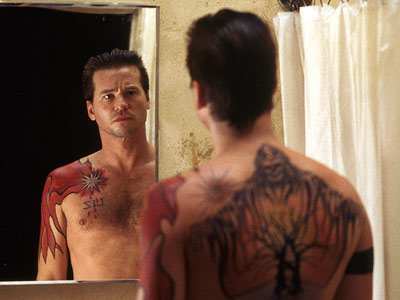
If Danny's over-edited, wacky drug world seems like a cheap knock-off of Trainspotting, at least it's got some interesting characters. Danny's best friend Jimmy the Finn, played by Peter Sarsgaard, is sad and beautiful, the antithesis of Danny, the man of intrigue. Jimmy may be strung out, but he's painfully honest and loving (in a bromance kind of way). His tattoo of his best friend might be creepy, if it wasn't so unselfconsciously loyal.

And let's not forget the other major player in Danny Parker's story, Pooh-Bear... a towering performance by Vincent D'Onofrio... whose shadow looms over Danny's whole world of tweaking, selling, and selling out. He's terrifyingly unpredictable, but calculated enough to be ruthless. His house is filled with things that don't make much sense, the errata of someone who can't keep his thoughts together... pigeons and a pillbox hat, a badger, scrambled eggs... but as you get to know the man, you realize something: these are all strange accessories to his cruelty, the little totems of violence that he's fetishized.

Make no mistake, Danny has a real story. It doesn't seem as fleshed out as a good drug story should be, and the difficult consequences of short-sightedness isn't interrogated. Even so, he's a convincing character, and his supporting cast is intriguing. In this story, he's a snitch for Gus and Al, two sneaky narcotics agents who may be a bit opportunistic, but who at least offer Danny this opportunity to be dishonestly moral, and to rat out his suppliers and get some of the meth and speed off the streets.

But then, as we sit through Danny's narrative, we get to see another story bleed through. This is the framing story of Tom Van Allen, a broken and distraught saxophonist whose life is imprinted on Danny Parker's back in a tattoo that says "The Salton Sea." And at the crucial structural moment of the film, we discover something important, the detail that justifies the existence and interaction of two half-formed storylines: we discover that Danny's story is fake, an adopted world and a constructed narrative, created to erase and overwrite that sad story that Tom Van Allen was supposed to tell. And suddenly, all the elements take on a new meaning. You just zoom out one level, and you get to see an unfamiliar landscape.

In Tom Van Allen's story, Jimmy and Pooh-Bear aren't important characters... they're just extras. For Jimmy, this is especially sad: he's an important character in a side-story, a loyal friend to a guy who doesn't really exist, except as a Macguffin for Tom Van Allen's revenge. More importantly, in Tom Van Allen's story, Gus isn't an ally... he's an enemy, the corrupt cop who interrupted a blossoming love. And for Tom Van Allen, the drugs that Danny finds so important are hardly note-worthy. They're just a distracting justification for the existence of a paper doll, the instrument of a minor betrayal that's ultimately in service of a greater one.

Betrayal: this is, of course, the factor that links Danny and Tom, the fake second personality and the real, but effaced, source character. Danny uses betrayal to get close to Gus, and Gus and Al think they're experts in using it to their advantage. However, what makes Danny such a powerful tool, and Tom Van Allen such a guru, is his mastery of betrayal. He's the meta-snitch, the best rat in the sewer, and he's ready to use "betrayal" as a weapon against the men who killed his lover. His deception works on so many levels, it can't be contained: he convinces the tweakers that he's a junkie, and he convinces the corrupt cops that he's a snitch; he even convinces Internal Affairs that he's on their side, when in the end, he's just using them to get into a well-guarded house and pull a gun out from under a table.

As I said, Danny's story doesn't just accompany Tom Van Allen's story – it erases it, replacing it with a fake-out hallucinogenic haze of freaks and self-indulgence. For this reason, Danny's story isn't that well-developed... but neither is Tom's story, which only glows a little in the cracks. Tom's story has been erased by a fantasy of revenge, built on layers of betrayal, and ultimately, these stories come together and destroy one another.

This destruction comes in Danny's apartment, which is actually Tom's apartment, where his identity has been sequestered away in a little box. It doesn't come from the poetic gesture of suicide... rather, Tom/Danny's death is at the hands of another side-character, one of the victims of Danny's snitching and Tom's moral self-righteousness. The perpetrator is a violent addict, a karmic weapon that brings Danny/Tom's betrayal back to kill him. This burning apartment is a place where lies and deception self-destruct, and destroy the truth in the process. Appropriately, it is only Danny's "true friend," the trace of his compassion and honesty, that appears as an angel of mercy.

It's a beautiful detail that this Tom/Danny character, who finally becomes nameless, is saved by his best friend from his inauthentic inner narrative. Jimmy the Finn is a fantastic foil for the violent, vengeful, and deceptive hero we've been following through his framing narratives. I don't think this final moment is the key to the film, though. I think the key moment in the film is that first scene, where everything burns around Tom Van Allen, and the framing narrative is watching itself be destroyed.

And ultimately, DJ Caruso, Val Kilmer, and Vincent D'Onofrio have made a movie that I won't forget.

Grittiness rating: 8

A drug movie plus a neo-noir framing narrative, with a cool-cat protagonist and one of the creepiest, most ruthless side-characters in movies. This film screams "story of the streets," and yet... it's a little too disjointed, a little too conceptual, to compete with the real killers of the genre. Sometimes its dirty aesthetic becomes a little too stylized, and because of its postmodern tendencies, it looks a little artificial. Even so, it deserves its place in the month of grittiness, and I'll defend it to the end.

Gritty February cross-post: The Shinjuku Incident

I don't usually do this, but since this is a themed month, I figured I'd call attention to a review I posted over at BlogCritics:

Movie Review: The Shinjuku Incident

Just to throw it out there, you should check out this movie if you want to see Jackie Chan's chops in a sweeping yakuza film where he doesn't do any comedic over-acting or kung fu whatsoever.

Grittiness rating: 7.5

The fight scenes are mean and the morals and politics are ambiguous. However, it doesn't reach the heights of cynical intimacy that seriously mean, gritty movies can attain. It gets an extra boost because it involves the yakuza, and because it didn't pass Chinese censors... and because of the occasional dismemberment.

Friday, February 05, 2010

Gritty February Kickoff at Benefit of the Doubt

So in honor of a streak of dark, atmospheric, crusty February movies (perfect for Valentine's Day!) I'm doing this month as "gritty February." I'll write BlogCritic reviews of cynical street movies as often as possible, and I'll be using this blog to talk about some classic gritty films, some of which you've probably seen, and some of which you haven't. For now, I guess it's time for an overview and a couple thoughts on the theme as a whole.

"Gritty" is a strange little literary term. Dictionary.com has no idea that it means what I'm using it to mean, although urbandictionary gets a lot closer. Presumably, it once referred to an actual texture, and the first association would be with gravel and corn-meal. However, I think, when we got obsessed with tone and atmosphere in our books and movies, we adapted it to refer to those places where texture tends to adhere: surfaces, rust, dirt, and cities. It subverts the artificial gloss of modern life, reminding us that as soon as we look away for a second, nature reclaims our stuff.

Texture as a fingerprint of nature, reclaiming the human artifact for the Earth: seems like a good start. By gradual inflection and implication, "gritty" has become an adjective meaning "naturalistic," but implying urban, as far removed from the pastoral as possible. Gritty movies are about difficult lives, lived in the throes of poverty, crime, and questionable morals. This is the product of a certain setting (generally urban), and a certain scale: close and intimate and uncomfortable, entangling the characters and the viewer in tension and hardship. It's an abstract, pervasive stylistic thing that probably ultimately qualifies as a "tone" or an "atmosphere," but that actually dictates the approach to content enough that it could be called a "style" or an "aesthetic."

I suspect Gritty Hollywood got its start in American genre film, especially film noir and (to a lesser degree) Western. However, it's propagated from there into a number of other cinematic spaces: drug movies, gangster and mob films, neo-noir, and even sports films. You can call a lot of films "gritty," if you just look at it as meaning "takes place in a degenerate world, or a city with a lot of dirty stuff"... and by taking this as a starting point, you can fake "gritty" pretty well. However, Benefit of the Doubt would like to adopt a more ambitious definition. To us, "gritty" means an intense narrative with an edge of realism, so the intrigue and drama are offset by a genuine real-world unpredictability. This is how the world looks through eyes of cynicism and uncertainty: our attempts to make things spiritual, meaningful, and sensible are frustrated uphill scrambles as the inevitable landslide of frustration drags us down.

I'm not sure I've seen a movie that epitomizes this quality as strongly as Scorcese's Taxi Driver.

Travis Bickle is a tortured, unhinged third-shift driver in a crusty, cynical 70's New York City. According to his own testimony, he is a Vietnam veteran, and the trauma of the war seems stamped upon his personality: he overreacts and undersleeps, reveling in his own obsessions and unable to control his paranoia. Bickle's moral alignment can't really be articulated... he certainly isn't an outright evil character ("evil" is generally shorthand for opportunistic and sadistic), but his sense of right and wrong is skewed and reactionary, only coming into relief at moments of stress and anger. He projects his frustration into unlikely targets, and channels it into unhealthy obsessions with women. He is completely out of control of the listing and jarring narrative of his everyday life.

Bickle also loves guns, and has an uncritical fascination with images of sexuality. As such, 70's New York City is almost a perfect place for him... he's surrounded by crime and violence and spectacle, and cheap sexual displays are readily available to him. Many... perhaps all... great cities have been showcases of grime and cynicism, since the aesthetic became such an art: 70's New York, 80's Los Angeles, 40's Chicago, and occasionally Boston -- these are the gritty cities where American filmmakers have discovered their criminal undergrounds. Kurosawa found it in Tokyo (Stray Dog) and Danny Boyle found it in Edinburgh (Trainspotting). With The Wire, it was Baltimore.

As for me, here's where I'll be looking. In theaters, I'm watching for Shutter Island, The Wolfman, The Shinjuku Incident, and the Red Riding trilogy. I'm also considering seeing Edge of Darkness and From Paris With Love, although those two aren't such high priorities.

At home, I think I'll watch some of the following, though I'm sure not all: The Salton Sea, King of New York, Gone Baby Gone, Pickpocket, Bicycle Thieves, and Ghost Dog: Way of the Samurai. I know not all of these may qualify as "gritty," but I'll make the call when I see them... and I'll be sure to write about them here.

Hope February has gotten off to a badass start for you all.

Monday, February 01, 2010

Caprica: Okay, I'll bite...

It's been a long time since I've watched any sort of television at all... as you can see from my archives, most of my consumption time is divided between movies, books, and occasionally graphic novels and blogs. However, I've seen some ads for Caprica around the subways, and the stark stylization and theo-philosophical innuendo of the posters hooked me. I'm a sucker for that "apple of knowledge" theme. So I'll try to follow it.

I just got through the pilot. Now, mind you, except for the pilot, I never saw Battlestar Galactica. I know, generally, that it's about the death of an interplanetary civilization and the final refugees escaping through deep space to find a mythical "seed planet." Also, I know that the Cylons are scary-ass antagonists because of their merciless hatred for humans, and because they manage such a perfect replication of the human body and mind. These are all things that intrigue me... but it was never enough for me to dive into the series, especially as late in the game as I was when I was informed of all this stuff. With Caprica, on the other hand... with this, I can start from the beginning.

For the moment, I'm going to look at a couple of the key "speculative fiction" concepts that make Caprica so interesting. Maybe I'll find other ways to tackle later episodes of the series... I don't know. I'm just trying to talk about what catches in my mental filter.

1 - How about the idea that you can fully reconstruct a personality, including memories, habits, opinions, and identity, by harvesting traces that person has left in the global information network?

At first, it seems massively far-fetched. But then, when you think of how much you might be able to learn about somebody from the various protected records of them, it becomes intriguing. For instance, your doctors, employers, and even the government might have files on you. The more visible you’ve been throughout your life, the more complete a picture they might be able to build. See, for instance, Douglas Hofstadter’s book I am a Strange Loop, in which he speculates that by getting to know someone intimately, you create a low-resolution imprint of them in your own brain. Zoe’s program... which resurrects a person from their distributed imprint in the infosphere... isn’t too far off conceptually.

But then you may think: when is it that people have taken records of you? If you were sick at a certain time in your life, there are probably an excess of medical records from that time. If you were ever accused of a serious crime, there would be a bunch more records from that period. And if you were ever considered for a very important job, you might have been highly scrutinized and recorded at that time, too. If someone tried to reconstruct you from your records, how would this "reconstructed personality" be tinted by exceptional cases? Would your avatar seem like a highly-qualified, medically-challenged savant with terroristic tendencies?

2 - How about the idea that when your personality is recreated digitally, you’ll have a terrifying anxiety about not having a body? This is a fear that Pauley, the Dixie Flatline, wrestled with back in 1985, when Gibson published the infamous Neuromancer.

I have to admit, the “reunion” scene with Tamara Adama and her father was the most compelling moment in the pilot episode(s) for me. If you’ve ever been in an altered state of mind without fully understanding it, you may have been able to identify with Tamara’s confused panic in the claustrophobic little virtual room. Some people (Zoe?) seem completely comfortable with not having a body and living solely as a mind, but I speculate that I would feel like Tamara feels… like I’m missing something essential to my existence.

So assuming that Zoe is a special type of person, able to exist solely as a cerebral construct, at ease without a physical body weighing her down, what type of person might this be? Is she transcendent? Or is she inhuman?

Other thoughts on the pilot:

Does Eric Stoltz remind anyone else of Craig Kilborn?

My inner espionage nerd would love to see how the meta-cognitive processor got stolen from Vergis, and how Sam got into the Defense Minister's bedroom so easily, when Caprican security is obviously pretty advanced.