WARNING: I will spoil some shit. There will be extensive discussion of the plot. I am bad at keeping secrets when I engage in close readings. Just sayin'.
So we move on to Nolan's Gotham City, first in terms of portrayal, and then in terms of its relationship to the stories of Batman and the Joker, Harvey, Bruce, and Rachel. The last post mentioned the importance of shooting Gotham in a real city, a creative decision that gave the environment its believability. Christopher Nolan chose Chicago to represent this dangerous metropolis, which makes sense, since Chicago has long been an icon of urban blight and faceless concrete. The use of Chicago is especially fitting because the backbone of The Dark Knight is a story about crime and politics, and Chicago is the greatest mob city in the United States. Chicago's personality has a lot to do with Gotham's grittiness; however, Nolan's unique perspective on the environment makes it a city of its own, the same way his direction, combined with Heath Ledger's brilliant acting, gave us a Joker we'd never seen before.
As an access point, let's contrast Nolan's Gotham with his Hong Kong, where Batman goes to retrieve the smuggler Lau. Considering the viewer only inhabits Hong Kong for a few scenes, it's striking how vivid a treatment the city is given, and how effective a foil it is for Gotham. Hong Kong feels like it was bled out of a completely different imagination, as though Nolan hired a new production designer and cinematographer for that city. It's a city in the clouds, where Bruce and Batman aren't even seen on the ground. The tall buildings allow for sweeping shots of Batman in flight, and the extensive glass facades give an acrophobic anxiety to the fight scenes. Batman is a beautiful sight in such a pristine environment, but it only serves to remind us how alien he is to that city.
Gotham, by contrast, is shot almost entirely in low shots, looking up at bridges and buildings. In scene after scene, we peer toward the buildings from the streets and the sidewalks, and the camera is constantly caught between walls of brick and concrete. It's a petrified tunnel system that Lucien Fox's sonar device temporarily converts into a visual swamp, and even in the daylight, it always seems cramped. This city is defined by two visual motifs that I'd like to draw attention to: the tunnel/underpass, and the ravine of unbroken buildings.
The tunnel/underpass is by far the most prominent visual motif of Nolan's Gotham City. We first see Batman in a parking garage, facing the mob, the Scarecrow, and a small gang of Batman impersonators. This low-ceilinged horizontal expanse is where Batman seems to be most at home, and this might be part of the reason that it feels spatially similar to the Bat Cave, though it's not as well-lit. However, later scenes draw him deeper into the tunnels of Gotham. Two-Face's final scene takes place in what looks like a cavern, carved out in Gotham's concrete flesh. Batman also emerges from these labyrinthine shadows into Gotham sunlight in the film's closing moments – this is a key scene, and it's one that I'll return to later in this reading.
The other important motif in The Dark Knight is the canyon formed by the building faces, which extend the claustrophobia of the tunnels into the daylight above the earth. This formation was essential to the attempted assassination of the Mayor – as a sniper on a fire escape points out, the police seem useless and vulnerable when faced with the surrounding walls of windows.
These two motifs converge in the long chase sequence, when Harvey Dent is being transported by a SWAT team beset by the Joker, and Batman emerges to confront him. This scene represents the struggle over Dent's life... a conflict that eventually sublimates into the struggle for Gotham's soul... and in order to gain the advantage, The Joker draws Harvey and Batman into the concrete underworld beneath Gotham. This is the descent into Hell, the stage for the confrontation that determines the course of The Dark Knight. After they endure The Joker's escalating trials, the chase re-emerges into the shadow of the Gotham buildings, and again, the canyon formation asserts itself. In this canyon, air support is useless, and The Joker is confident in facing Batman directly, in the middle of the street, without flinching.
Of course, it's Gordon, returning from the dead, who traps The Joker at the end of the confrontation. There's certainly more symbolic significance wrapped up in this emergence from the underworld, but I don't think I have the time to fully analyze it. However, if you want another interesting portrayal of a city, rendered as a labyrinthine Stygia and shadowy home to the restless dead, check out Venice in Nicholas Roeg's Don't Look Now. It's surreal and haunting, and if you've seen The Dark Knight, it may remind you of a more magical Gotham City.
Actually, for the time being, forget Venice. Christopher Nolan is building on a complex, very American history when he renders this gritty, noir Gotham City. Dennis O'Neil, a writer and editor of the Batman comics, said that "Batman's Gotham City is Manhattan below Fourteenth Street at eleven minutes past midnight on the coldest night in November" (see the Wikipedia article for the citation). It's worth noting that this remark was published in 1994, just before Rudy Guiliani became Mayor of New York and started cracking down on petty crimes and reducing urban decay. O'Neil is talking about the bohemian New York City of twenty years ago, and he's talking about the parts of the city where students and working-class residents were living. Gotham's business district is the cramped, cynical Wall Street of the 1980's; its residential areas are the East Village and Lower East Side apartments, the downtown church steps where panhandlers spent (and still spend) their nights. New York and Gotham have always been a bit enigmatic and intimidating.
This is the city Nolan has sketched for us, a vortex for Batman's vengeance and retribution, an underworld so overwhelming that it makes his heroism seem futile. In Nolan's lucid portrayal, however, Gotham isn't just a setting. It's also a theater for mythical characters and a lynchpin in their relationships. This relationship between the city and its inhabitants is what I'll be addressing in my final post on this topic. Tune in next week, kiddies, because we're coming into the home stretch.
Tuesday, July 29, 2008

Friday, July 25, 2008
A Dark Knight in Gotham Part I: Comic Book Film Cities
 I think we can generally agree that Christopher Nolan and Heath Ledger have created a goddamn masterpiece, and even though Christian Bale and Maggie Gyllenhaal didn’t really provide the magic that made it happen, they certainly pulled their weight. Everybody’s been talking about The Dark Knight, and there’s a reason for that… it’s an unmatched piece of cinema work, not just a great comic book film, but a great film in general. Disguised under the action, this is a film driven by the psychological confrontations, and it takes on the power of an epic suspense thriller, a la The Game or Primal Fear. It matches, and even surpasses these movies, because the villain is so powerful and terrifying, and because it develops its psychological relationships throughout a whole host of characters, rather than simply between two or three. I hope it’s the first comic book / action movie to win a really important Academy Award.
 There’s going to be a lot of talk about it, though, so I’m going to try to look at it through a specific lens. Rather than replicate the many orgasming movie critics and drooling bloggers, I’m going to try to analyze Nolan’s fine piece of work by way of an implicit “Other,” an almost Godlike character who appears in every scene, but who isn’t acted by anyone famous, and who doesn’t even appear in the credits. This character is
Note: there may be spoilers in the next couple blog posts. There aren't really any in this one, though.
A DARK KNIGHT IN
Fictional cities as the central figures in comic book films: however rare and quirky this sounds, it’s actually something that’s already come up, and something that’s going to be coming back up again soon. Give me a moment on a tangent, please… I’d like to talk about Frank Miller.
Frank Miller actually wrote the comic book The Dark Knight Returns, which is the landmark use of that nickname. His comic, published in 1986, was Batman’s ticket out of the blue suit and bad effects of the old Batman comics and television show. It was about Bruce Wayne returning from retirement to fight crime as an old man, and the psychological and ethical demons he had to face in a new era of crime and cruelty. Miller’s series established the gritty, violent image that Nolan is now working with. Within Nolan’s plot, the copycat Batmen may even be an homage to the imitators in Miller’s Dark Knight Returns. However, aside from this homage and the similarity in tone, the plot of Miller’s 1986 comic has nothing to do with Nolan’s film.

Miller created another comic title, independent of the DC mythology, entitled
I fear the same problem from Miller’s upcoming film, The Spirit. Again, The Spirit is about the character of a city… the tagline for the movie is, “My city screams. She is my lover. I am her spirit.” The trailers and promotional material give the sense of a city that’s defined by an anonymous hero and a twisted maze of sexual tension. Unfortunately, they also give the sense of a city that’s created in Adobe Illustrator, rather than discovered on the urban streets.
Nolan’s
Wednesday, July 16, 2008
Wall-e and Authorship: Pixar's Career as an Auteur
So Wall-e is the... what... ninth Pixar film? If you read my last post, you'll know my opinion of it... that it's a new level of craftsmanship on Pixar's part. Now, we've all seen artists who developed their skills to transcendent levels over the course of their careers -- Picasso's periods, Shakespeare's writings -- now we have a new artist (if you can call it that), the animation studio that's going to define the cinematic experiences of a whole generation, and it seems as though they've yet to peak.
Before this, Pixar's filmography was probably defined by Toy Story, Monsters Inc, and Finding Nemo. Toy Story made them famous and put them squarely ahead of their competition, and Monsters Inc. was their introduction to big-time at the Oscars, being nominated for Best Animated Feature, as well as three other awards, and winning Best Original Song (beating out all the live-action soundtracks that year). Finding Nemo was Pixar's clincher, the film whose characters and storytelling defied all the expectations of the critics. The Best Animated Feature award was the crown on Pixar's ascending head.
Pixar's other films, movies that everybody adored but that didn't quite change the landscape of media, include The Incredibles and Ratatouille... both of these could have taken that coveted Best Animated Feature award, but Finding Nemo just happened to be the earlier project. Wall-e might indeed be the next definitive movie in Pixar's oeuvre, not only because it had the immaculate craftsmanship of Finding Nemo, but also because it experimented with style and boundaries in such a way that it seemed to be a new experience, even for the seasoned Pixar fan.
Has anyone else noticed the strangeness of treating an animation studio -- Pixar -- as if it's a single human being, an author with a unified creative vision that sculpts the animated masterpieces we see each year? Nobody seems to have taken notice of this phenomenon, but it's definitely something new. In the past, any noteworthy film was attached to a director's name, and that film's artistic vision was credited to that director. This is the essence of auteur theory, and a cornerstone of Hollywood's celebrity marketing pitch: see the new Hitchcock / Kurosawa / Cronenburg / Woody Allen / Cohen Brothers film this summer, and return to the world of an artist you've fallen in love with.
The problem with this approach is that every film is a collision of hundreds of different talented people. The film industry is massive and evenly distributed over too many disciplines to count, and in every film, you can find the hand of a director, a cinematographer, a production designer, an effects supervisor, and a thousand consultants and lackeys. Maybe you don't actually like David Fincher... maybe you just happened to like Zodiac because he worked with Harris Savides, and so the photography direction was exceptionally brilliant.
In this sense, as strange as it sounds to treat Pixar as an individual auteur when it's actually a whole collective, it might actually be a more honest way to look at authorship in cinema. After all, even though the staff changes, there's a good chance that most of the principal personalities... concept artists, production designers, photography supervisors, and head writers... are carrying across from movie to movie. We can see the development of a company, and the streamlining of its vision, as we watch each successive triumph on the movie screen. We can stop pretending it's just one guy with a camera and some friends from acting school, and we can see that these things are the product of a vast, synchronized creative/corporate process.
As long as I trust that there is still room for the auteur in film... for people like Werner Herzog, who really do involve themselves deeply in every step of the process... then I'm also happy to treat a great company with the same respect I would give to a great artist. Artist, company, single, multiple... we're so over those binaries! This is the future!
Before this, Pixar's filmography was probably defined by Toy Story, Monsters Inc, and Finding Nemo. Toy Story made them famous and put them squarely ahead of their competition, and Monsters Inc. was their introduction to big-time at the Oscars, being nominated for Best Animated Feature, as well as three other awards, and winning Best Original Song (beating out all the live-action soundtracks that year). Finding Nemo was Pixar's clincher, the film whose characters and storytelling defied all the expectations of the critics. The Best Animated Feature award was the crown on Pixar's ascending head.
Pixar's other films, movies that everybody adored but that didn't quite change the landscape of media, include The Incredibles and Ratatouille... both of these could have taken that coveted Best Animated Feature award, but Finding Nemo just happened to be the earlier project. Wall-e might indeed be the next definitive movie in Pixar's oeuvre, not only because it had the immaculate craftsmanship of Finding Nemo, but also because it experimented with style and boundaries in such a way that it seemed to be a new experience, even for the seasoned Pixar fan.
Has anyone else noticed the strangeness of treating an animation studio -- Pixar -- as if it's a single human being, an author with a unified creative vision that sculpts the animated masterpieces we see each year? Nobody seems to have taken notice of this phenomenon, but it's definitely something new. In the past, any noteworthy film was attached to a director's name, and that film's artistic vision was credited to that director. This is the essence of auteur theory, and a cornerstone of Hollywood's celebrity marketing pitch: see the new Hitchcock / Kurosawa / Cronenburg / Woody Allen / Cohen Brothers film this summer, and return to the world of an artist you've fallen in love with.
The problem with this approach is that every film is a collision of hundreds of different talented people. The film industry is massive and evenly distributed over too many disciplines to count, and in every film, you can find the hand of a director, a cinematographer, a production designer, an effects supervisor, and a thousand consultants and lackeys. Maybe you don't actually like David Fincher... maybe you just happened to like Zodiac because he worked with Harris Savides, and so the photography direction was exceptionally brilliant.
In this sense, as strange as it sounds to treat Pixar as an individual auteur when it's actually a whole collective, it might actually be a more honest way to look at authorship in cinema. After all, even though the staff changes, there's a good chance that most of the principal personalities... concept artists, production designers, photography supervisors, and head writers... are carrying across from movie to movie. We can see the development of a company, and the streamlining of its vision, as we watch each successive triumph on the movie screen. We can stop pretending it's just one guy with a camera and some friends from acting school, and we can see that these things are the product of a vast, synchronized creative/corporate process.
As long as I trust that there is still room for the auteur in film... for people like Werner Herzog, who really do involve themselves deeply in every step of the process... then I'm also happy to treat a great company with the same respect I would give to a great artist. Artist, company, single, multiple... we're so over those binaries! This is the future!
Wednesday, July 09, 2008
Silence and the Lens: Innovations in wall-e

First of all, I will join the chorus of voices praising Wall-e, Pixar's newest offering. Those of you who watched Cars may have thought the company was finally in its decline (I had no such thought, because I haven't seen any Pixar film since The Incredibles). Wall-e should have proven you wrong -- the studio is still at the top of its game.
Even the best Pixar films... The Incredibles, Monsters Inc, and Finding Nemo... were simply excellent films. Since they revolutionized 3D animation with Toy Story, Pixar hasn't really managed any kind of true innovation. Like any good artist, they've simply been developing their motifs and honing their craft, building a body of work that demonstrates a commitment to their art. Wall-e, however, may actually represent a break with this trend. It doesn't just feel like an excellent film... it feels like a groundbreaking piece of work, maximizing and ultimately transcending the style that Pixar has been developing.
It's hard to identify exactly why this is true. After all, the film follows certain Pixar formulas to the letter. It's a journey of self-discovery undertaken by personified non-humans endowed with exaggerated but deeply sympathetic personalities, created with computer animation, and appealing to a wide age range by way of simple emotional cues. What makes it such a fantastic movie?
Perhaps the reason Wall-e is such a brilliant piece of cinema is that it wrestles with a number of formal and narrative boundaries at the same time. Though it might go unnoticed by the casual viewer, the actual technical treatment of the film is actually rather groundbreaking... aside from the obvious adoption of live action video, the film also introduces certain tropes of camera-work, like depth of field and real-world positioning, to simulate the actual craft of cinematography. They discuss this in the fourth section of this article, and in the middle of this video.
This seems subtle, but it has a profound effect. The use of realistic angles and tropes from the perspective of cinematography makes the world seem more present, and more evocative, than the previous primary-colored universes of Pixar have been. Roger Deakins, the cinematographer that Pixar consulted, has turned the virtual camera into something closer to a real one, and just as his shots through the reeds made us feel like we were actually on the prairie in The Assassination of Jesse James, so they made us feel the reality of a deserted, post-apocalyptic Big Apple in Wall-e. Don't mistake this for a novelty... deferral to a real-world cinematographer is a powerful new idea in computer animation.

Of course, just as it pushed this formal convention, so Wall-e expanded its narrative dimension, as well. Forsaking dialogue, the storytellers gave us characters that communicated almost entirely in gesture, so all their semantic messages were pared down to the simplest possible sentiments. This probably has something to do with the earth-shaking effectiveness of the pathos and sentimentality in Wall-e. This is not a lazy love story -- just as the world shines through Deakins' camera lens, so the characters' emotions pour out of their rudimentary movements and gestures, and the audience is able to appreciate Wall-e as an iconic sentimentalist, the most childish, desperate kind of romantic, whose love can drive a whole sequence of universe-spanning events.
In my rush to show how Wall-e was a unique moment in cinema, I've picked it apart for innovations, and I'm in danger of losing sight of the work of art itself. The political message of the film -- something that apparently has conservatives all tweaked out -- is below remark, doing little beyond supplying a premise and giving the film some topicality. It's not a film about humans destroying their world, nor is it about the heroic merit of rediscovering your humanity and returning to your home. The film is really a simple love story (rendered in brilliant non-verbal storytelling) set in an empty, hopeful world beyond the reach of human trivialities (rendered with the help of a visionary virtual lens). The innovations do what innovations must do in order to avoid becoming gimmicks: they vanish into the texture of a story whose power becomes the defining feature of the work of art.
Monday, June 16, 2008
Indiana Fall Panda Hulk: Movies I've Seen Recently
I have been seeing SO many movies... I'm sorry I've been so thin on the blogging, but I've hardly had time to breathe and develop a coherent thought about any of them. I'll take a moment now and summarize my recent experiences, even if I'm unable to furnish any detailed critique. Hopefully this will get me started reflecting on some parts of my recent cinema journey.
The last few movies I blogged about were My Blueberry Nights, The Forbidden Kingdom, and The Hunger. Since then, I've seen the following, and had the following thoughts about them:
1 - Indiana Jones and the Kingdom of the Crystal Skull
As much as I enjoyed some of the good lines from Harrison Ford (he can still deliver dialogue), and as much as I approved of Shia LaBouf as Indy's obnoxious protege, the lack of continuity and subtlety in KotCS definitely annoyed me. All the Indy movies are fantasy on some level, but they all take place within the mythological space established by their subject matter... within the religious, tribal, and ritual narrative domains. The whole Space Odyssey alien thing came out of nowhere, and it ran violently counter to the spirit of the series. It makes no sense for an archaeologist to be dealing with aliens... the point of Anthropology and Archeology (always Indy's great quest and motivation) is the knowledge of premodern HUMAN cultures. Aliens just don't fit into the narrative boundaries of the series.
Can I forgive it? Yes, but barely. Kids these days need to be overstimulated, and UFO's and huge apocalyptic explosions are probably essential to getting them interested in Archeology.
2 - The Fall
The critics gave The Fall a lukewarm reception, but I thought it was an excellent little piece of vanity cinema. The relationship that developed between Roy and Alexandria was laden with subtexts of fatherhood, desire, and emasculation, and they played out in Roy's improvised fantasy world in a compelling way. The gravitational center of the story... the ownership of the narrative that provided a shared space where Roy and Alexandria were able to communicate... was a great place for Tarsem to show off his conceptual cinematic style. Sure, it looks a little like a music video, but that doesn't mean it doesn't work for storytelling.
3 - Kung Fu Panda
I have to say, I was a big fan. Jack Black works very well as an animated character... he's not automatically typecast as the goofy, overbearing bumbling best friend, so he has a chance to play a real role. In this case, he was brilliant as a young, dorky, enthusiastic but insecure "chosen one" in a kingdom full of badass animals. This was a film of personalities, including the wavering leader, the sagely master, the good-hearted but overbearing second son, and the epic adversary. Ultimately, it was an ideal showcase for action, good-natured humor, and some classic moral and emotional insights.
4 - The Incredible Hulk
Well-executed and thoroughly enjoyable. I'd give Iron Man a 95%, and I'd give The Increduble Hulk about an 87%. There are a few key elements that made it good, and I'll summarize them. First, the Hulk's actual fight scenes were fairly awe-inspiring... his capacities were pushed further with each successive battle, and he was give the screen time to eventually reveal himself as the epic force of nature that needed so badly to impress the audience. The key moment... his confrontation with the sonic cannons and the gunship... was executed perfectly to make us cheer for the monster, and to give us a sense of his scale and scope. Second -- Edward Norton makes a fantastically nerdy Bruce Banner, a pale academic who's had to become a slippery, quick-witted fugitive to escape from the government. The contrast between Norton's Banner and the momentous force of The Hulk is a key to the authenticity of the film.
And I've watched a couple classics, as well...
1 - The Philadelphia Story
This is an excellent film that shows us how naturally a great actor can deliver sharp, fast-moving dialogue. With Grant, Hepburn, and Stewart on-screen together, we have a study of uniquely American personalities, and the emotional dynamic that develops between them... the shifting psychology and self-awareness of Tracy Lord, in particular... makes for an engaging experience. I'd recommend, however, that you sit down with this movie and give it 150% of your attention, because plot points and character subtleties are slipped into the witty dialogue with very few cues. You have to be quick to keep a handle on these characters.
2 - The Wild Bunch
A powerful movie, mixing the sentimentality of the lost Western consciousness with some really raw, violent conflict. Some research on the director -- Sam Peckinpah -- gives valuable insight into the logic of the film. This is the perfect final product from the mind of a tortured soldier, making films in a time of war and unrest, and reflecting on the turmoil of the world around him. I really dug it.
I've seen a few others... the remake of THX 1138, and Sergio Leone's A Fistful of Dollars, in particular. I'll try to check back as I have more experiences. For now, Benefit of the Doubt, signing off.
The last few movies I blogged about were My Blueberry Nights, The Forbidden Kingdom, and The Hunger. Since then, I've seen the following, and had the following thoughts about them:
1 - Indiana Jones and the Kingdom of the Crystal Skull
As much as I enjoyed some of the good lines from Harrison Ford (he can still deliver dialogue), and as much as I approved of Shia LaBouf as Indy's obnoxious protege, the lack of continuity and subtlety in KotCS definitely annoyed me. All the Indy movies are fantasy on some level, but they all take place within the mythological space established by their subject matter... within the religious, tribal, and ritual narrative domains. The whole Space Odyssey alien thing came out of nowhere, and it ran violently counter to the spirit of the series. It makes no sense for an archaeologist to be dealing with aliens... the point of Anthropology and Archeology (always Indy's great quest and motivation) is the knowledge of premodern HUMAN cultures. Aliens just don't fit into the narrative boundaries of the series.
Can I forgive it? Yes, but barely. Kids these days need to be overstimulated, and UFO's and huge apocalyptic explosions are probably essential to getting them interested in Archeology.
2 - The Fall
The critics gave The Fall a lukewarm reception, but I thought it was an excellent little piece of vanity cinema. The relationship that developed between Roy and Alexandria was laden with subtexts of fatherhood, desire, and emasculation, and they played out in Roy's improvised fantasy world in a compelling way. The gravitational center of the story... the ownership of the narrative that provided a shared space where Roy and Alexandria were able to communicate... was a great place for Tarsem to show off his conceptual cinematic style. Sure, it looks a little like a music video, but that doesn't mean it doesn't work for storytelling.
3 - Kung Fu Panda
I have to say, I was a big fan. Jack Black works very well as an animated character... he's not automatically typecast as the goofy, overbearing bumbling best friend, so he has a chance to play a real role. In this case, he was brilliant as a young, dorky, enthusiastic but insecure "chosen one" in a kingdom full of badass animals. This was a film of personalities, including the wavering leader, the sagely master, the good-hearted but overbearing second son, and the epic adversary. Ultimately, it was an ideal showcase for action, good-natured humor, and some classic moral and emotional insights.
4 - The Incredible Hulk
Well-executed and thoroughly enjoyable. I'd give Iron Man a 95%, and I'd give The Increduble Hulk about an 87%. There are a few key elements that made it good, and I'll summarize them. First, the Hulk's actual fight scenes were fairly awe-inspiring... his capacities were pushed further with each successive battle, and he was give the screen time to eventually reveal himself as the epic force of nature that needed so badly to impress the audience. The key moment... his confrontation with the sonic cannons and the gunship... was executed perfectly to make us cheer for the monster, and to give us a sense of his scale and scope. Second -- Edward Norton makes a fantastically nerdy Bruce Banner, a pale academic who's had to become a slippery, quick-witted fugitive to escape from the government. The contrast between Norton's Banner and the momentous force of The Hulk is a key to the authenticity of the film.
And I've watched a couple classics, as well...
1 - The Philadelphia Story
This is an excellent film that shows us how naturally a great actor can deliver sharp, fast-moving dialogue. With Grant, Hepburn, and Stewart on-screen together, we have a study of uniquely American personalities, and the emotional dynamic that develops between them... the shifting psychology and self-awareness of Tracy Lord, in particular... makes for an engaging experience. I'd recommend, however, that you sit down with this movie and give it 150% of your attention, because plot points and character subtleties are slipped into the witty dialogue with very few cues. You have to be quick to keep a handle on these characters.
2 - The Wild Bunch
A powerful movie, mixing the sentimentality of the lost Western consciousness with some really raw, violent conflict. Some research on the director -- Sam Peckinpah -- gives valuable insight into the logic of the film. This is the perfect final product from the mind of a tortured soldier, making films in a time of war and unrest, and reflecting on the turmoil of the world around him. I really dug it.
I've seen a few others... the remake of THX 1138, and Sergio Leone's A Fistful of Dollars, in particular. I'll try to check back as I have more experiences. For now, Benefit of the Doubt, signing off.
Thursday, May 22, 2008
The Hunger: 80's Lost Boy Blade Running vampire sex
I’m tapping a NetFlix account, ladies and gentlemen, in order to wander through the neighborhoods of film canon that I haven’t managed to visit. I mean, I’ve seen many of the essentials, from Persona to Star Wars, but there’s quite a block of work that I’ve missed. I’m trying to get a grasp on film canon, from early classics ("M") to Silver Screen ("Casablanca") to Western ("Fistfull of Dollars") to Noir ("Double Indemnity") to contemporary classics ("Pretty Woman"). If anyone can give me a few suggestions, I’d love to hear them. Drop them in the comments section.
 One of the first ones I’ve seen – and, admittedly, it’s not really an essential – was The Hunger, an erotic 80’s Vampire movie directed by Tony Scott. "But Jesse," you might ask, "Why, if you’re trying to see the great films, did you start with an obscure cult vampire movie?" Well, let me furnish you with a few different answers. They will come in a cluster, like grapes fresh off the vine.
First: it was available On-Demand from NetFlix, so I didn’t have to wait around for it.
Second: It starts fucking David Bowie and Susan Sarandon. What a cast! They’re perfect for the atmosphere, too... a lush, depraved vampiric world where Bowie’s gender ambiguity and Sarandon’s reserved strength make for a fascinating dynamic between the three main characters.
Third: It’s actually a fairly well-critiqued piece of postmodern cinema. Apparently Diane Fuss wrote an article on the film called "Inside Out." I haven’t read it, but I’d like to check it out... between the gender subversion and the obsession with death, images, and the gaze, this movie is a breeding ground for postmodern interpretation.
But superficial reasons aside, I think it was really worth sticking with it. I’ll give you a couple readings, and perhaps they’ll convince you to watch it, too, and maybe allow you to really appreciate it. The merits I see in this slow, decadent masterpiece may not be the first ones that most viewers notice, and they’re certainly nothing that Roger Ebert was prepared to appreciate, but they make the movie worth its screen time and its DVD space.
The Hunger actually reminded me of Blade Runner, which is another 80’s film commonly considered a "cult classic." Blade Runner was a cool sci-fi, but it wasn’t its science or its action that really made it worth watching. The film was really about finding something sentimental in a cynical, post-sentimental world. That dystopian landscape, a credit to authors like Gibson, was a critical part of this voyage, and the film was the product of its creative and production design as much as it was a product of a script or a director’s instructions.
Pure aesthetic value was a big part of The Hunger, too... a truly lush experience. The sets were gauzy and Victorian, filled in by light through windows, across curtains, and through dusty air. This erotic atmosphere was occasionally broken by the manic sterility of the hospital, or by the morbid anger of a gothic-looking nightclub, but by-and-large, the film took place in Miriam’s apartment, the dwelling place of the matriarch. The key scenes of the film weren’t violent, shocking, or morbid, like you’d expect from vampire and horror films... even John’s final scene was strangely intimate and melancholy. In fact, most of the emotional dynamic in The Hunger manifested in sexual encounters, including Mirian’s sex scenes with both John and Sarah.
No doubt, The Hunger is grown up, and especially so when compared to the other great 80’s Vampire movie, which we should all know and love. I speak, of course, of The Lost Boys, starring Keifer Sutherland and Corey Feldman, among other actor-types. The Lost Boys has the desperate savagery and loneliness of misspent youth, and it uses Vampire mythology to fully rewrite and re-envision deviant teenagehood. This includes a lot of rage, sacrifice, hostility, and ultimately, struggle and violence.
The Hunger, lesser known than its adolescent sibling, can be seen in parallel, but represents a much different aspect of the American Vampire myth. Where David and his gang were explosive, Miriam and John are sensual, and these are two complimentary sides of the gothic sin. Some vampires will kill you, but others will seduce you and offer you things you’re not prepared to accept, and this is itself a sort of suicide.
It’s telling, then, that Miriam’s victims are never seen in death. The beach party scene of murder and sacrifice, so central to The Lost Boys, is displaced in The Hunger with a scene of ritual confinement, a counterpoint to death that’s probably even more terrifying. Even Miriam’s final moments aren’t as violent as we might like them to be.
And as a youngen who wasn’t really there to experience the 80’s, I feel like I’ve unearthed some essential truth about the decade in comparing these two 80’s vampire movies. First, we see the aristocracy of capitalism and hegemony, the opportunistic Wall Street grandeur, that Miriam represents in The Hunger. Alongside this, we see the blossoming experimental energy of New Wave and Heavy Metal, the youth culture that found expression in David (The Lost Boys) and in David Bowie. In these vampire movies, the spirit of the times finds expression, polished off with a dose of gothic cynicism and postmodern consciousness.
This has been a rambling entry, but The Hunger led me through my retrospective experiences of the 80’s, the sourceless nostalgia that makes me such a fan of the culture I was too young to appreciate. It’s a reflection on the pure aesthetic of the setting, on the erotic undertones of vampire mythology, and on the 80’s as a time of both stagnation and innovation. I’d count those as at least three good reasons to go rent it.
One of the first ones I’ve seen – and, admittedly, it’s not really an essential – was The Hunger, an erotic 80’s Vampire movie directed by Tony Scott. "But Jesse," you might ask, "Why, if you’re trying to see the great films, did you start with an obscure cult vampire movie?" Well, let me furnish you with a few different answers. They will come in a cluster, like grapes fresh off the vine.First: it was available On-Demand from NetFlix, so I didn’t have to wait around for it.
Second: It starts fucking David Bowie and Susan Sarandon. What a cast! They’re perfect for the atmosphere, too... a lush, depraved vampiric world where Bowie’s gender ambiguity and Sarandon’s reserved strength make for a fascinating dynamic between the three main characters.
Third: It’s actually a fairly well-critiqued piece of postmodern cinema. Apparently Diane Fuss wrote an article on the film called "Inside Out." I haven’t read it, but I’d like to check it out... between the gender subversion and the obsession with death, images, and the gaze, this movie is a breeding ground for postmodern interpretation.
But superficial reasons aside, I think it was really worth sticking with it. I’ll give you a couple readings, and perhaps they’ll convince you to watch it, too, and maybe allow you to really appreciate it. The merits I see in this slow, decadent masterpiece may not be the first ones that most viewers notice, and they’re certainly nothing that Roger Ebert was prepared to appreciate, but they make the movie worth its screen time and its DVD space.
The Hunger actually reminded me of Blade Runner, which is another 80’s film commonly considered a "cult classic." Blade Runner was a cool sci-fi, but it wasn’t its science or its action that really made it worth watching. The film was really about finding something sentimental in a cynical, post-sentimental world. That dystopian landscape, a credit to authors like Gibson, was a critical part of this voyage, and the film was the product of its creative and production design as much as it was a product of a script or a director’s instructions.
Pure aesthetic value was a big part of The Hunger, too... a truly lush experience. The sets were gauzy and Victorian, filled in by light through windows, across curtains, and through dusty air. This erotic atmosphere was occasionally broken by the manic sterility of the hospital, or by the morbid anger of a gothic-looking nightclub, but by-and-large, the film took place in Miriam’s apartment, the dwelling place of the matriarch. The key scenes of the film weren’t violent, shocking, or morbid, like you’d expect from vampire and horror films... even John’s final scene was strangely intimate and melancholy. In fact, most of the emotional dynamic in The Hunger manifested in sexual encounters, including Mirian’s sex scenes with both John and Sarah.
No doubt, The Hunger is grown up, and especially so when compared to the other great 80’s Vampire movie, which we should all know and love. I speak, of course, of The Lost Boys, starring Keifer Sutherland and Corey Feldman, among other actor-types. The Lost Boys has the desperate savagery and loneliness of misspent youth, and it uses Vampire mythology to fully rewrite and re-envision deviant teenagehood. This includes a lot of rage, sacrifice, hostility, and ultimately, struggle and violence.
The Hunger, lesser known than its adolescent sibling, can be seen in parallel, but represents a much different aspect of the American Vampire myth. Where David and his gang were explosive, Miriam and John are sensual, and these are two complimentary sides of the gothic sin. Some vampires will kill you, but others will seduce you and offer you things you’re not prepared to accept, and this is itself a sort of suicide.
It’s telling, then, that Miriam’s victims are never seen in death. The beach party scene of murder and sacrifice, so central to The Lost Boys, is displaced in The Hunger with a scene of ritual confinement, a counterpoint to death that’s probably even more terrifying. Even Miriam’s final moments aren’t as violent as we might like them to be.
And as a youngen who wasn’t really there to experience the 80’s, I feel like I’ve unearthed some essential truth about the decade in comparing these two 80’s vampire movies. First, we see the aristocracy of capitalism and hegemony, the opportunistic Wall Street grandeur, that Miriam represents in The Hunger. Alongside this, we see the blossoming experimental energy of New Wave and Heavy Metal, the youth culture that found expression in David (The Lost Boys) and in David Bowie. In these vampire movies, the spirit of the times finds expression, polished off with a dose of gothic cynicism and postmodern consciousness.
This has been a rambling entry, but The Hunger led me through my retrospective experiences of the 80’s, the sourceless nostalgia that makes me such a fan of the culture I was too young to appreciate. It’s a reflection on the pure aesthetic of the setting, on the erotic undertones of vampire mythology, and on the 80’s as a time of both stagnation and innovation. I’d count those as at least three good reasons to go rent it.
Saturday, April 26, 2008
Forbidden Kingdom: We're All Coming of Age

Mark Rahner of the Seattle Times says of Forbidden Kingdom, "It might take a Zen master to explain exactly what audience this is aimed at." I left the Tibetan temple behind long ago, like any worthy Bhoddisatva bringing Nirvana to the world, and my koans might be a bit rusty at this point, but I’m going to give it a shot. Sit, my son, before the peace of Benefit of the Doubt, and be enlightened by the Tao of Media Commentary.
Like tiger with face of Easter Bunny, Forbidden Kingdom presented itself in a way that may have confused some critics and audiences. The original trailer showed fascinatingly-costumed, exotic martial arts characters, slow-motion martial arts, beautiful settings, and enigmatic effects. The unknowning trailer-surfer may anticipate a slow, beautiful, well-shot kung-fu opera, in the style of (if not the scope of) Hero, or Curse of the Golden Flower. These expectations are waves that have been dashed against the rocks of popular cinema.
Perhaps this confusion was at work in Mark Rahner’s mind. Seeing Forbidden Kingdom as a work of authentic kung-fu, he may not have been prepared to accept it for what it was. When the tiger’s fluffy pink visage fell away, it revealed itself not as an updated kung-fu epic, but as another update, and another kind of epic. The audience looking for beautiful wire-fu may have been disappointed, but those of us who saw the truth were pleased with its revelation.
The movie was actually a return to the coming-of-age fantasy movies of our youth. I personally didn’t get wind of this until I was about to go see the movie, and the synopsis said something about an American teenager who loves kung-fu movies, and who finds an old staff that takes him to ancient China. Many of us may have wanted a grand, semi-artistic kung-fu adventure to frame the combined talent of Jet Li and Jackie Chan, and in this we may have been severely disappointed. Fortunately, many of us were also raised in the 80’s and early 90’s, where the true thematic inspiration for Forbidden Kingdom was born.
If you remember Neverending Story, Last Action Hero, and Labyrinth, and even before these, Peter Pan, Alice in Wonderland, and The Wizard of Oz, then you may have been able to appreciate this movie for what it really offered. The cheesy dialogue, the absurdly liberal rendering of ancient China and traditional folklore, and the comically implausible training sequences and montages... these were all in keeping with that well-established mythology that we grew up on.
There are a lot of interesting precedents here, too. The earliest of the examples I’ve mentioned above are Peter Pan and Alice in Wonderland, and you could also class the Narnia Series with these. These examples are "coming of age" stories that involve a temporary flight into a dream world, whether it’s the hallucinatory, disturbing, and politically-relevant Wonderland of Alice, or whether it’s the whimsical, profoundly psychological Neverland of Wendy and Peter.
The "worlds of our imagination" have changed in recent years, though. Starting with Neverending Story, the storytellers have started to acknowledge the mediated, represented component of our dreams and fantasies. In Neverending Story, Bastian finds his inner universe in the pages of an old book, and he enters it through the mind of Atreyu, its main character. This brilliant film was a staple in many of our childhoods, and it set some profound precedents for honest, sensitive, and troubling portrayals of adolescence and fantasy.
Last Action Hero pulled the fantasy-world coming-of-age story further into the present. This was one of The Governator’s less popular films, a thoroughly light-hearted but deceptively self-conscious popcorn flick about a kid who gets pulled into the unrealistic world of action movies. In that short space between Neverending Story (1984) and Last Action Hero (1993), we watched our cultural imagination move from the world of books to the world of movies. The troubled child building his life around reading became the irresponsible kid obsessed with action flicks. Even so, we were still following the same track: growing up within the space of our imagination, whether that space was built from words or film clips.
The Forbidden Kingdom follows this formula a step further, showing us the inner world of a teenager who can’t get his head out of kung-fu flicks. He ends up facing his fears and building his personality in an alternate-reality Orientalist China, filled with mysterious maidens, silent monks (what a badass character), and Drunken Masters. This is the kind of place where a kid can become a kung-fu guru in about three days worth of training, and where henchmen are available at dime-store prices, but only if you’re evil. It’s also a world well-populated with self-conscious kung fu movie references, many of which I’m sure I don’t understand in the slightest.
The coming-of-age fantasy tropes were EVERYWHERE in this movie, and that's part of what made it both lighthearted and interesting. The bullies at the beginning were right out of Neverending Story, and one of the most charming elements was the appearance of Lu Yan and Golden Sparrow in the real world, a technique right out of Wizard of Oz, where Dorothy's fantasy companions turned out to be dream-versions of the people in her real life. It was also an endearing, and brilliant, casting decision to cast Michael Angarano as the main character... Angarano isn't the tricked out pretty-boy we're used to seeing in every action movie these days. He has the quirky facial features of an awkward high-schooler, and this is a noble concession to make to those original 80's and 90's movies, where we could really believe that the main character was a normal kid.
Many of our parents will roll their eyes at the idea that our imaginations are being built on Hong Kong cinema, just as (with Last Action Hero) they may have been dismayed that their kids’ fantasy world were being built around violent, unrealistic action movies. We may look back fondly on Bastian, whose inner universe came from old books and fairy tales, and we may be nostalgic for Neverending Story’s innocence. The point, though, and the lesson that this whole genre has for us, is that no matter how we form our flights of fancy, they will always allow us to pass safely through childhood and face the real world on the other side. A personality formed through kung-fu is no less authentic than one formed in the pages of a young-adult fantasy novel read in a school attic.
And aside from the ADHD-ridden 13-year-olds that Mark Rahner mentions, I think I know who Forbidden Kingdom was aimed at. It was aimed at those of us who grew up through the media, reading fantasy novels, acting out kung-fu movies and ninja cartoons, and ultimately entering our adulthood through those scraps of fantasy. When we saw those other "coming of age" movies, like Neverending Story and Last Action Hero, we understood that we were those adolescent characters (Bastian, Danny, and now Jason Tripitikas), growing into whole people by embracing our fantasy worlds. This movie was aimed at us... in particular, it was aimed at me.
Saturday, April 19, 2008
Wong Kar-Wei's My Blueberry Nights: A strange familiarity

I know, it's been a month. I've been working on my thesis. That's my excuse. Here's a post with some substance, though, and hopefully these will become more regular very soon.
Wong Kar-Wei directs aesthetically. His films are not designed for your twenty-first century American ADHD sensibility... you’re going to have to give up your explosions and sex scenes and learn to appreciate long pauses and pregnant looks, drawn-out emotional revelations, and stares into the uncertainties of characters’ souls. You may come out of his films feeling like there’s suddenly a lot of random overstimulating shit going on in the world, but at the very least, you’ll find the beauty in the mundane interstitial moments, standing alone in the city streets.
My Blueberry Nights is Wong’s first American production, and he seems to be pushing the "American" aspect pretty hard. He casts Jude Law, Norah Jones, Natalie Portman, and Rachel Weisz in the primary roles, and he follows his main character from neighborhoody New York to dive-bar Memphis, Tennessee, and then to the dusty flats and flashy personalities of Las Vegas. In keeping with the American-made aesthetic, My Blueberry Nights is faster-paced, and has more closure, than Wong’s other work, though it’s not a Bruckheimer film by any means.
Wong is sort of an eighties futurist, from what I can tell. Take a look at his commercial for the Phillips Flat-Panel TV... the neon lights and the fiber-optic sensibility, complimented with oceans of reflective glass and plastic, are what we probably thought the future would look like back when we were first being introduced to ergonomic product design and artificial polymers. Wong experiments with other atmospherics, of course... much of 2046 took place in gilded-age classical architecture, just slightly run down, so that it integrated the epic sensibility of an old city with the pseudo-normalcy of tragic, emotional everyday life. He did something similar with the Nevada desert in My Blueberry Nights, providing a well-rendered vision of an empty Southwest, where his characters could be alone with their emotional dynamics. Despite these breaks, however, it’s always that nightlife neon decadence that runs through Wong’s films.
Wong’s New York and Las Vegas seem like the ideal locations for his stylistic tastes. They both have that neon thing going on, and you’re likely to find those avant-garde fashion tastes and shiny, artificial cars in both cities. However, Wong rarely actually visits the most hyperstimulating parts of the cities he's trying to depict. He never depicts Times Square or Wall Street... he shows a neighborhood café in New York, and he provides a number of long shots of subways traveling above-ground. In Las Vegas, he depicts some small-time casinos and a lot of deserted outdoor landscapes, but I don’t remember seeing much of the strip (I may have been in the bathroom at the time, though). Even so, his visuals seem replete with those ghosts of neon lights reflected off wet pavement. Is he displacing the stylistic center of the city into its margins? Did he see the outskirts of New York and Vegas as containers for the spirit of Times Square and the strip?
Even if it seemed abstractly appropriate in New York and Vegas, Wong’s Memphis, Tennessee definitely doesn’t seem like the right place for his sensibility. His characters... particularly Sue Lynn and her boyfriend... looked like Manhattan fashion models, and all their cars... even Arnie’s truck... look like they've just been picked off a lot and waxed to perfection. The bar where Elizabeth works glows like a downtown nightclub. This isn’t the Memphis of the popular imagination, and though it may be a worthy spin on it, it doesn’t seem to jive with the Southern mythology we’re all so familiar with.
These slight missteps make Wong’s United States seem a bit alien. Perhaps he sees Hong Kong wherever he goes, and perhaps those neon lights are just the optics of Wong’s dreams and imagination.
The city compliments the characters, though, and these really are figures of American mythology. Jude Law’s Jeremy is a perfect Brit turned small-town romantic, charming and well-adjusted in a little neighborhood café. Norah Jones’s Elizabeth is an icon, as well, an innocent, trusting girl who devotes herself to exploring the world in the aftermath of a personal romantic tragedy. Arnie, Sue Lynne, and Leslie are all equally iconic pieces of American character mythology. These are the compliment to Wong’s slightly alien portrait of the landscape – his American characters are so familiar that they almost seem abstracted and imaginary... archetypal... even stereotypical, though that word is probably too harsh.
So it’s largely a mixed bag of traditional, mythological Americana... why does it work so well? It works because those settings and characters are really just a framework for Wong’s characteristic storytelling. The settings are nice, and the characters are endearing, but what makes it a good movie is the obsessive attention to the emotional intersections and turbulence between these characters, all of whom are still clearly discovering themselves. This is the ripple of confusion that underlies all of the established rhythm of Americanism. Even your most artificial settings and your most recognizable characters are the products of their own issues, desires, and failures. Even the most familiar building becomes fascinating when its framework is laid bare.
It might also be a little narcissism talking. In each of the on-screen characters I saw fragments of my own experience of New York, and this is probably why them seem so recognizable. In a sense, I recognize them wherever they go, and I identify with their hope and sadness. That's the mark of a good director -- it’s Wong’s skill with nuance and uncertainty that makes the movie possible.
Monday, March 10, 2008
Watchmen: Bring It Zack Snyder
 Comic books movies, especially early on, before they're well-explored, tend to inspire two perhaps contradictory emotional reactions in fans: on one hand, rabid excitement, and on the other, abject terror. Comic book kids are all eager to see a brilliant adaptation of a favorite graphic storyline, and they're massively appreciative when one works out (as many were for Sin City), but they also realize that the vast majority of comic adaptations crash and burn, failing to capture any of the essential elements of the adapted story.
Hellboy, for instance, embodied both sides of the equation. Mike Mignola's fans are diehards, and they were overjoyed to see Ron Perlman cast as Hellboy. They were ready for a beautiful, brutal gothic/mid-century throwdown. Unfortunately, they got a movie that represented the title character well, but dropped the ball on the supporting cast and the atmosphere. There was scarcely a gothic arch, and the World War II occultism was crowded out by big shiny apparatuses that looked more like plastic than tarnished metal. The themes of self-realization, defiance, and creeping Lovecraftian danger were dissolved in a messy stew of comic book cliches: we have to keep our identities secret! Love will save the day!
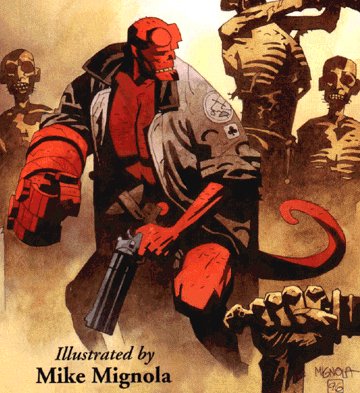
So for many Hellboy nerds (me especially), the dream was deferred, and we hold scarce hope for The Golden Army, which seems to be beset with more of the same downfalls.
There's another comic book movie coming out, based on what might be the most influential modern comic series, though it's certainly not the best-known. This comic series, since resold as a convenient graphic novel, is Watchmen. Alan Moore's graphical urban epic was about the demise of heroism, the struggle with real-world moral issues, and the consequences of disillusionment and war in a post-industrial society. It was complex and challenging, and a true masterpiece of the medium.
A film adaptation has been in the works for a while, and it's finally been created under the direction of Zack Snyder. When I first heard about this, it inspired the "fear" reaction. It's hard to imagine an accurate recreation of the world of Watchmen... it's a decaying, rusty New York City, but not a Gotham City kind of way. It's mostly shown in daylight, and the dregs of the city are bored locals and homeless vagrants, rather than innocent old ladies and the criminals who beset them. It's not a dangerous world, but rather a listless, uneventful world, shuffling toward the end of history. It's also a world of the 80's, and it still emanates nostalgia, remembering the Hollywood/disco glory of its 70's superheroes. These heroes, all retired after a wave of social reform, are the protagonists of Moore's story.
 This is a complex milieu, and it's next to impossible to recreate on film, I would imagine. It's almost cheesy enough to cover the superheroes in skin-tight primary-color spandex, but Moore's world isn't quite ready to make that much of a mockery of itself. It has to find a postmodern balance between edgy and used up... between updated and outdated. This is why I was afraid for the film. I really couldn't imagine how any creative director could strike the balance required to make the world work.
From the initial stills from the movie, though, it seems that Snyder may be on his way to doing it right. He's picked some perfect actors, like the gaunt, severe Jackie Earle Haley as Rorschach. On top of the casting, we've seen some initial images of costume and production design, and these do a miraculous job of achieving the right look. The outdoor shots look great: the city is gritty and unadorned at night, and it's blank and pedestrian during the day. The costumes are bulky and plastic, which is probably necessary to reproduce the intentional kitsch in Alan Moore's art, but they're also dark and unironic, the stuff of superheroes who are vengeful, ready to return to their work in the world.

So I've gone from frightened to excited... from apprehensive to hopeful. This movie could really work. Now Snyder's production company has to gather the myriad themes and narrative threads in Moore's book, and they have to build them into a fluid, well-paced action movie with some believable moments of psychology and introspection. He hasn't won me over yet, but hey, I'm ready to watch.
Saturday, March 01, 2008
Is M. Night Shyamalan making fun of himself?

This poster has been appearing at theaters, and at long last, the trailer has appeared to accompany it. It's a dark, mysterious movie about an unexplained global phenomenon, replete with twists and narrative trickyness, titled with an ominous, non-specific noun, and it's being released on Friday the 13th. Come on... does anyone else find this funny? Does Mr. Shyamalan himself?
If it was done by anyone else, it would just look like a supernatural disaster movie. Those have had a resurgence recently... Cloverfield and the forthcoming The Signal are two pretty obvious examples, and I Am Legend sort of counts, as well. This could even be a poster for a more benign 28 Days Later. The Happening doesn't have the most brilliant marketing, but Shyamalan's other movies haven't either. I don't think any of us are suckers for the totally enigmatic, minimalist black-background ambient noise approach at this point. Signs, The Village, and Lady in the Water have all been carried by Shyamalan's name at the box office, and that's fine. He proved himself with The Sixth Sense, and now we know the guy's just a good filmmaker.
So his name's on it, and we kind of know what we're in for. In fact, looking at the poster, it seems like we know almost EXACTLY what we're in for. This looks like Signs and The Village revisited, with those stormy skies and that strange, threatening outside world. You may already smell the twist at the end, the discovery that it's all a trick of the mind, or that it was a conspiracy perpetrated on you alone, and the rest of the world was just playing along. You may already anticipate that the escape plan has been there from the start, and you were just overlooking it. When you saw that two-word title... The Happening... you might have laughed.
But read the tagline, and tell me you don't think Shyamalan isn't laughing too, at least to himself. "You've Sensed It. You've Seen the Signs. Now... it's Happening." The people working on this movie have no desire to create a one-of-a-kind film experience. They wanted to make a Shyamalan movie, and they wanted it to inherit the awesomeness from his previous efforts.
But if you're like me, that might be good enough to get you out there:

Hey, I'm there, ten bucks in hand.
Tuesday, February 26, 2008
Cool Shit Alert: Jon Arbuckle's existential misery
I was introduced to something minor but fascinating today. It's a blog, hosted on Tumblr, called Garfield minus Garfield, and it's one of those amusing little media experiments that works out surprisingly well, if you're able to read it receptively. Here's the introduction to the blog:
Is there anything to this strange, funny, perhaps unsettling phenomenon, besides simple weirdness? Well, it might stem partly from the fact that Jon Arbuckle is a secondary character whose role is to bear Garfield's ridicule. Of course, Fat Orange Kitty normally distracts us from Jon's tribulations and lightens the mood, but when you remove him, you're left wondering how Jon got like this, what's going on in his head, and how he bears his lonely life. If you removed Sherlock Holmes from Watson's life, would you be left with a failed, lonely writer wandering a ghostly London town? Is secondary characterhood a great curse to be borne throughout literary history?
 The empty panels are an effective part of this phenomenon, as well. The blank spaces around Jon give a sense of both physical emptiness (i.e. an empty room) and extended silence. When you have a single line by an afflicted Jon, surrounded by space and silence, you get a very lonely effect... you may sense that the world simply doesn't need Jon Arbuckle, and more frighteningly, you may realize that he feels the same way.
In this way, this reminds me of something else similarly spooky. Rene Magritte painted a piece called "Now, You Don't" which consists of four identical sitting rooms, only one of which contains a human being. His presence is ultimately irrelevant to the room he's sitting in, and ultimately, Jon seems totally insignificant, nonsensical, and even invisible, without his main character to give meaning to his little absurdities.
If you're interested in other creepy phenomena in Sunday funnies, I can suggest a few leads. If you can find it in a library, check out "Family Circus of Horrors" in The Book of Zines, which makes an interesting case about the human condition in Family Circus. You can also check out a Garfield-related existential crisis in the strips of Halloween 1989, which is generally chronicled online, in sites such as this one. Also take a look at the Christian (and anti-Jewish and Muslim) themes in Johnny Hart's comic B.C., which are hard to deny after a review of a few examples.
"Who would have guessed that when you remove Garfield from the Garfield comic strips, the result is an even better comic about schizophrenia, bipolor disorder, and the empty desperation of modern life?Yes, friends, it's a simple experiment: remove Garfield, the commentator and primary personality, from a mundane comic strip and get a glimpse into the angst of a permanent secondary character. Some of the more recent ones are just goofy... "Something is wrong with my pants" is probably my favorite... but if you go back toward the beginning, you discover untold levels of existential anxiety and psychological disorder (such as February 18th, which was truly a miserable day for Jon Arbuckle).
Friends, meet Jon Arbuckle. Let’s laugh and learn with him on a journey deep into the tortured mind of an isolated young everyman as he fights a losing battle against lonliness and methamphetamine addiction in a quiet American suburb."
Is there anything to this strange, funny, perhaps unsettling phenomenon, besides simple weirdness? Well, it might stem partly from the fact that Jon Arbuckle is a secondary character whose role is to bear Garfield's ridicule. Of course, Fat Orange Kitty normally distracts us from Jon's tribulations and lightens the mood, but when you remove him, you're left wondering how Jon got like this, what's going on in his head, and how he bears his lonely life. If you removed Sherlock Holmes from Watson's life, would you be left with a failed, lonely writer wandering a ghostly London town? Is secondary characterhood a great curse to be borne throughout literary history?
 The empty panels are an effective part of this phenomenon, as well. The blank spaces around Jon give a sense of both physical emptiness (i.e. an empty room) and extended silence. When you have a single line by an afflicted Jon, surrounded by space and silence, you get a very lonely effect... you may sense that the world simply doesn't need Jon Arbuckle, and more frighteningly, you may realize that he feels the same way.
In this way, this reminds me of something else similarly spooky. Rene Magritte painted a piece called "Now, You Don't" which consists of four identical sitting rooms, only one of which contains a human being. His presence is ultimately irrelevant to the room he's sitting in, and ultimately, Jon seems totally insignificant, nonsensical, and even invisible, without his main character to give meaning to his little absurdities.
If you're interested in other creepy phenomena in Sunday funnies, I can suggest a few leads. If you can find it in a library, check out "Family Circus of Horrors" in The Book of Zines, which makes an interesting case about the human condition in Family Circus. You can also check out a Garfield-related existential crisis in the strips of Halloween 1989, which is generally chronicled online, in sites such as this one. Also take a look at the Christian (and anti-Jewish and Muslim) themes in Johnny Hart's comic B.C., which are hard to deny after a review of a few examples.


Thursday, February 21, 2008
Monroe and Lohan: Is there anything worth talking about?
Okay, so here's an interesting parallel for discussion: Marilyn Monroe versus Lindsay Lohan? The question was raised recently, as Bert Stern, famous for photographing Monroe during "The Last Sitting," decided to recreate said monumental event using Lindsay Lohan as a stand-in. Let's try to do what we do here, and dig under the cheesy provocation and sensationalism for some meaning. In this case, there's quite a bit to discover.
I think the metaphor is obvious, after all. Just as with Marilyn, Lohan is a Hollywood starlet, famous for her charm and her body and infamous for her spotty background and bad behavior in the public eye. Marilyn's last photoshoot was looked upon in light of her death, which occurred shortly afterwards; Lohan herself has been plagued with addiction and rehabilitation, and with the attendant paparazzi attention, and her rendition of the photoshoot will be colored by her own recent controversies.
Now, very few of us will be willing to buy Lohan as a new Marilyn. At the most basic level, this return to Monroe's farewell seems like a stunt, something that's been done before, and Lohan seems fairly soulless compared to Monroe, who has a whole mythology and legacy behind her. After all, Lohan is just one of a handful of Hollywood A-List brats currently in the headlines. Marilyn is a one-of-a-kind historical figure, and that's what makes her photoshoot meaningful and culturally relevant.
Another point that needs visiting... something that's important to any feminist critique of the occasion... is that Monroe's portraits seem so honest, at least to our jaded postmodern eyes. She isn't a plastic replica in those shots. She isn't surgically altered or airbrushed, and nobody was able to hide the vulnerable look in her eyes. The whole package -- the flawed soul -- is coming from Marilyn herself, the source of the legend.
Lohan's body looks painfully fake by comparison, and it's the kind of fake that I hope some of us are getting tired of. She's got big boobs, sure, and I'm not one to complain about that, but her figure is boyish, with no hips and scarce buttocks. Stern is obviously shooting for a modern fashion eye, trained by ready-to-wear and Twiggy and Calvin Klein, and it seems like a tired mockery of Marilyn's curves and slight pudge. In that regard, if anything, we can look at these two photoshoots as a lesson in how homogeneous and inauthentic our ideals of beauty have become. Silicon boobs and airbrushed skin, boy-hips and blond wigs. Yawn.
But this can't just be a long opportunity to Lindsay-bash. There's enough of that going on. I want to step back and note something important that a lot of the commentators aren't saying.
Why are these original photographs of Marilyn so important to us? Why do I have the automatic urge to reject Lohan's attempt at the role?
It's because Marilyn is a myth and a legend for our current culture. Her self-destructive habits are part of a beautiful, flawed panorama of life and success and hardship, and we're willing to see her as a whole person, and to see her bad behavior in perspective. She certainly deserves it.
Unfortunately, we're not able to give this benefit to the struggling, self-abusive starlets of our day. Lohan's not healthy, and she's a shitty role-model, but she's faced with a whole culture that's intent on demonizing her and exposing her shortcomings. What chance has she ever had to make us happy? Do these girls have to endure the slings and arrows of stardom, and simply have faith that some day, after they've OD'd, we'll look back on them and see their unique beauty and vulnerability, and read it as a positive contribution to our cultural heritage? What hope do they have that one day we'll forgive their idiocy and irresponsibility, just as we've forgiven Marilyn's?
Maybe the lesson here: enjoy the photos, and stop being so hard on the girls who are stuck in the molars of a culture that's trying to consume and devour them.
I think the metaphor is obvious, after all. Just as with Marilyn, Lohan is a Hollywood starlet, famous for her charm and her body and infamous for her spotty background and bad behavior in the public eye. Marilyn's last photoshoot was looked upon in light of her death, which occurred shortly afterwards; Lohan herself has been plagued with addiction and rehabilitation, and with the attendant paparazzi attention, and her rendition of the photoshoot will be colored by her own recent controversies.
Now, very few of us will be willing to buy Lohan as a new Marilyn. At the most basic level, this return to Monroe's farewell seems like a stunt, something that's been done before, and Lohan seems fairly soulless compared to Monroe, who has a whole mythology and legacy behind her. After all, Lohan is just one of a handful of Hollywood A-List brats currently in the headlines. Marilyn is a one-of-a-kind historical figure, and that's what makes her photoshoot meaningful and culturally relevant.
Another point that needs visiting... something that's important to any feminist critique of the occasion... is that Monroe's portraits seem so honest, at least to our jaded postmodern eyes. She isn't a plastic replica in those shots. She isn't surgically altered or airbrushed, and nobody was able to hide the vulnerable look in her eyes. The whole package -- the flawed soul -- is coming from Marilyn herself, the source of the legend.
Lohan's body looks painfully fake by comparison, and it's the kind of fake that I hope some of us are getting tired of. She's got big boobs, sure, and I'm not one to complain about that, but her figure is boyish, with no hips and scarce buttocks. Stern is obviously shooting for a modern fashion eye, trained by ready-to-wear and Twiggy and Calvin Klein, and it seems like a tired mockery of Marilyn's curves and slight pudge. In that regard, if anything, we can look at these two photoshoots as a lesson in how homogeneous and inauthentic our ideals of beauty have become. Silicon boobs and airbrushed skin, boy-hips and blond wigs. Yawn.

But this can't just be a long opportunity to Lindsay-bash. There's enough of that going on. I want to step back and note something important that a lot of the commentators aren't saying.
Why are these original photographs of Marilyn so important to us? Why do I have the automatic urge to reject Lohan's attempt at the role?
It's because Marilyn is a myth and a legend for our current culture. Her self-destructive habits are part of a beautiful, flawed panorama of life and success and hardship, and we're willing to see her as a whole person, and to see her bad behavior in perspective. She certainly deserves it.
Unfortunately, we're not able to give this benefit to the struggling, self-abusive starlets of our day. Lohan's not healthy, and she's a shitty role-model, but she's faced with a whole culture that's intent on demonizing her and exposing her shortcomings. What chance has she ever had to make us happy? Do these girls have to endure the slings and arrows of stardom, and simply have faith that some day, after they've OD'd, we'll look back on them and see their unique beauty and vulnerability, and read it as a positive contribution to our cultural heritage? What hope do they have that one day we'll forgive their idiocy and irresponsibility, just as we've forgiven Marilyn's?
Maybe the lesson here: enjoy the photos, and stop being so hard on the girls who are stuck in the molars of a culture that's trying to consume and devour them.
Monday, February 11, 2008
Barack Obama: An old medium for a new media age
Cynical, jaded age of media savvy… meet Barack Obama. Despite all your postmodern disillusionment, your mistrust and confusion, despite the transparent opacity of your catch phrases and rhetorical maneuvers, you’ve still left a space for someone to make an impression, and Barack Obama has come to fill that space. How has Obama managed to penetrate our national defenses? And more importantly, should we still guard ourselves against his dulcet tones?
Obama’s online presence is a critical factor. His mainstream media presence? Perhaps less so, but still important. Even the aggrieved attention of his opponents, the attack dogs on both the right and the left wings, are probably bolstering the power of his campaign with their misguided hostility. Somebody who draws that much fire is a big target, and paradoxically, the mud-slinging seems to be making him more noticeable.
However, I believe it’s the power of the oldest of media that’s managing to penetrate a society that’s colored by the newest. Sure, the Internet and YouTube are powerful things, but Ron Paul certainly didn’t win the Republican nomination… and if the Internet was going to choose a president, Ron Paul would probably win by a landslide. Obama’s sudden rush of endorsements and his unstoppable momentum in the primaries must be due to some other factor.
Myself, I think the critical factor is Obama’s oratory skill, and the new development is the fact that he’s getting more opportunities to present himself personally to the American people. A few wins in the primaries put his face on a lot of television screens, and they gave new a new spark to his public addresses… a platform of victory, even if it’s partial, is a great place to construct oneself as a public image. Obama’s speeches have been reaching more and more ears as his momentum has increased, and I include my own among those new additions.
There, on that podium, is where Obama finds his greatest strength. People will attribute it to his deep voice, but that’s just a shiny paint-job. It’s the muscle car underneath that’s really carrying the campaign. Obama’s content is hopeful and idealistic, but his voice and his delivery are full of conviction, free of hesitation or apology, and this is bound to strike a cord with a jaded voter.
Jesus, so the man is good at public speaking… what are we all so excited about this?
Well, on a simple cultural level, we’ve always placed a profound emphasis on verbal communication. From Plato to the bible to Saussure, the spoken word has always been considered the voice of the soul, and written communication has been seen as a pale reflection of that voice. We’ve got a bit of a cultural prejudice in favor of verbal communication, and whether we see the man speak on TV or on YouTube or in person, the fact that he has a body and a voice are bound to give him some extra weight.
Aside from that, though, I think that it’s more difficult to hide fear and uncertainty in a verbal speech than in a written statement. There are certainly failures of verbal communication – we’ve all tried to communicate something and failed in the delivery – but a successful speech, statement, or assertion is worthy of a great amount of trust, because human beings have a penetrating intuition when it comes to tone of voice and gesture. People who bought into Bush’s stage character may have bought his rhetoric, but I think very few of us trusted him… especially those of us who know about the glamour of prepared speeches and catch-phrases. The media-savvy community was never really convinced by Bush. Obama, on the other hand, has convinced a lot of us.
The speeches themselves are brilliant, and they often confront our cynicism directly, on its own terms. One of the most powerful phrases I’ve heard Obama use was “That cynicism, that sometimes masquerades as wisdom, but is really just a fear of reaching for something higher.” This is rhetorical sharp-shooting at its finest: Obama implicitly asks us to question the naïve sense of superiority that many politicians bring to the table, which so many of us accepts without question. At the same time, he asks us to question our own cynicism, which feeds from this self-satisfied disillusionment that so often turns into hopelessness. So yeah, good speeches.
It’s the questions, though… Obama fielding the inquiries of individuals… that pinpoint him as a man who may be worthy of our trust. If it’s difficult to disguise hesitation in a the delivery of a prepared speech, it’s next to impossible to disguise it in a series of impromptu answers to unscripted questions. Obama fields each of these confidently, with a thought-out answer, and his confidence attests to his authenticity.
Thus, a description of Obama’s persuasive method, but also an argument for people to put trust in it. Obama is an old orator for a new age, and the meta-media of the Internet and cable news have become a mere vehicle for a voice that they can’t distract us from. If we can’t trust anything anymore, why does this guy sound so damn convincing? And shouldn’t we trust that last vestige of intuition we’ve got, and start placing our trust in him?
Obama’s online presence is a critical factor. His mainstream media presence? Perhaps less so, but still important. Even the aggrieved attention of his opponents, the attack dogs on both the right and the left wings, are probably bolstering the power of his campaign with their misguided hostility. Somebody who draws that much fire is a big target, and paradoxically, the mud-slinging seems to be making him more noticeable.
However, I believe it’s the power of the oldest of media that’s managing to penetrate a society that’s colored by the newest. Sure, the Internet and YouTube are powerful things, but Ron Paul certainly didn’t win the Republican nomination… and if the Internet was going to choose a president, Ron Paul would probably win by a landslide. Obama’s sudden rush of endorsements and his unstoppable momentum in the primaries must be due to some other factor.
Myself, I think the critical factor is Obama’s oratory skill, and the new development is the fact that he’s getting more opportunities to present himself personally to the American people. A few wins in the primaries put his face on a lot of television screens, and they gave new a new spark to his public addresses… a platform of victory, even if it’s partial, is a great place to construct oneself as a public image. Obama’s speeches have been reaching more and more ears as his momentum has increased, and I include my own among those new additions.
There, on that podium, is where Obama finds his greatest strength. People will attribute it to his deep voice, but that’s just a shiny paint-job. It’s the muscle car underneath that’s really carrying the campaign. Obama’s content is hopeful and idealistic, but his voice and his delivery are full of conviction, free of hesitation or apology, and this is bound to strike a cord with a jaded voter.
Jesus, so the man is good at public speaking… what are we all so excited about this?
Well, on a simple cultural level, we’ve always placed a profound emphasis on verbal communication. From Plato to the bible to Saussure, the spoken word has always been considered the voice of the soul, and written communication has been seen as a pale reflection of that voice. We’ve got a bit of a cultural prejudice in favor of verbal communication, and whether we see the man speak on TV or on YouTube or in person, the fact that he has a body and a voice are bound to give him some extra weight.
Aside from that, though, I think that it’s more difficult to hide fear and uncertainty in a verbal speech than in a written statement. There are certainly failures of verbal communication – we’ve all tried to communicate something and failed in the delivery – but a successful speech, statement, or assertion is worthy of a great amount of trust, because human beings have a penetrating intuition when it comes to tone of voice and gesture. People who bought into Bush’s stage character may have bought his rhetoric, but I think very few of us trusted him… especially those of us who know about the glamour of prepared speeches and catch-phrases. The media-savvy community was never really convinced by Bush. Obama, on the other hand, has convinced a lot of us.
The speeches themselves are brilliant, and they often confront our cynicism directly, on its own terms. One of the most powerful phrases I’ve heard Obama use was “That cynicism, that sometimes masquerades as wisdom, but is really just a fear of reaching for something higher.” This is rhetorical sharp-shooting at its finest: Obama implicitly asks us to question the naïve sense of superiority that many politicians bring to the table, which so many of us accepts without question. At the same time, he asks us to question our own cynicism, which feeds from this self-satisfied disillusionment that so often turns into hopelessness. So yeah, good speeches.
It’s the questions, though… Obama fielding the inquiries of individuals… that pinpoint him as a man who may be worthy of our trust. If it’s difficult to disguise hesitation in a the delivery of a prepared speech, it’s next to impossible to disguise it in a series of impromptu answers to unscripted questions. Obama fields each of these confidently, with a thought-out answer, and his confidence attests to his authenticity.
Thus, a description of Obama’s persuasive method, but also an argument for people to put trust in it. Obama is an old orator for a new age, and the meta-media of the Internet and cable news have become a mere vehicle for a voice that they can’t distract us from. If we can’t trust anything anymore, why does this guy sound so damn convincing? And shouldn’t we trust that last vestige of intuition we’ve got, and start placing our trust in him?
Wednesday, February 06, 2008
Partisan philosophies according to National Convention Web Pages
I know this is a bad day to post about political things. We're probably all tired of hearing about the parties and their delegates and their constituencies and their districts. Still, something very interesting was brought to my attention today, and I thought I should at least mention it.
Compare the Democratic National Committee page and the Republican National Committee page.


Okay, so the Dems don't have a "Favorites" icon. Egregious, but forgivable. But what about the fact that the GOP's page has been displaying attack ads against the Democrats all day, even on Super Tuesday, whereas the Democratic National Committee's page has been keeping tallies of votes, urging people to get involved, and generally running non-partisan ads?
Seriously, who has the perspective here? Who is really in support of a cooperative democracy? Setting aside the slippery slope between nationalist and patriot, who is real Patriotic here, working for the good of a nation, rather than for the good of a partisan ideology? Seeing these two side-by-side is almost like a political punchline. The philosophies embodied in these two visions are so different, and the right-leaning one has become such a caricature of itself, that we're basically all voting on a bedrock of stereotypes.
Maybe that's why McCain is winning for the GOP... he embodies, on some level, a backpedal from that slope of narcissistic politics (after all, he did vote against the Bush tax cuts). Still, there's no real end in sight... this desperation for conflict and sensation, rather than debate and compromise and pluralism, is still ingrained in the right wing. When will people get tired of groundless, useless, ineffective internal hostility and just build a platform on the basis of their own merits?
I'd like to pause, before I finish, and apologize that this became such a rant. I'm aware that a politics of meta-aggression... being hostile at people because they're hostile... may ultimately be counterproductive. This is something that I'm counting on the current presidential candidates to transcend, although they've only been marginally effective so far. Still, Barack Obama's platforms of campaign reform and transparency, McCain's commitment to restraint and civility, and even Hillary Clinton's tough realism could all help break up this poisonous political climate. Unfortunately, I'm here contributing to it, along with the Republicans. I suppose it's just a function of saying what I think.
Well, at least this whole thing reminds me why I'm proud to be a fucking leftist liberal pussy democrat.
Compare the Democratic National Committee page and the Republican National Committee page.


Okay, so the Dems don't have a "Favorites" icon. Egregious, but forgivable. But what about the fact that the GOP's page has been displaying attack ads against the Democrats all day, even on Super Tuesday, whereas the Democratic National Committee's page has been keeping tallies of votes, urging people to get involved, and generally running non-partisan ads?
Seriously, who has the perspective here? Who is really in support of a cooperative democracy? Setting aside the slippery slope between nationalist and patriot, who is real Patriotic here, working for the good of a nation, rather than for the good of a partisan ideology? Seeing these two side-by-side is almost like a political punchline. The philosophies embodied in these two visions are so different, and the right-leaning one has become such a caricature of itself, that we're basically all voting on a bedrock of stereotypes.
Maybe that's why McCain is winning for the GOP... he embodies, on some level, a backpedal from that slope of narcissistic politics (after all, he did vote against the Bush tax cuts). Still, there's no real end in sight... this desperation for conflict and sensation, rather than debate and compromise and pluralism, is still ingrained in the right wing. When will people get tired of groundless, useless, ineffective internal hostility and just build a platform on the basis of their own merits?
I'd like to pause, before I finish, and apologize that this became such a rant. I'm aware that a politics of meta-aggression... being hostile at people because they're hostile... may ultimately be counterproductive. This is something that I'm counting on the current presidential candidates to transcend, although they've only been marginally effective so far. Still, Barack Obama's platforms of campaign reform and transparency, McCain's commitment to restraint and civility, and even Hillary Clinton's tough realism could all help break up this poisonous political climate. Unfortunately, I'm here contributing to it, along with the Republicans. I suppose it's just a function of saying what I think.
Well, at least this whole thing reminds me why I'm proud to be a fucking leftist liberal pussy democrat.
Friday, January 18, 2008
Cool Shit Alert: simulating a 3D environment on the Wii
THE COOL SHIT ALERT:
Johnny Chung Lee, a Carnegie Melon student and known Wii-hacking supergenius, has developed something that's not only an amazing technology hack, but simply an amazing concept in general. It strikes me that this would be revolutionary, no matter what technology it was exhibited on... the fact that the Wii makes it easy is just a testament to the versatility of Nintendo's hardware.
Here's the video. Be patient for the first minute and a half, as Johnny zips through a short explanation. Once you get to the demo of the display, it becomes rather mind-blowing.
When we think of 3D displays, we usually think of filtered glasses, allowing a screen to split an image into a "left-eye" version and a "right-eye" version. This creates the illusion of depth as the brain synthesizes the two images. Though it's also a two-dimensional take on 3D, Lee's display is working from a completely different paradigm.
Instead of simulating depth from a fixed point of view, Lee's program is simulating space by adapting a 2-D image to the position of the viewer. This is, in fact, more advanced than the traditional fixed-point approach used in movies like Beowulf. Here, the user can interact with the simulated space by moving around the frame and processing multiple viewing angles.
This could really be the next generation of displays for consoles and simulation. Even from the video, you can tell that it's mind-blowingly immersive, and it promises new heights of simulation and interaction.
I think it's also a testament to technology that this could be developed and disseminated by a man who is essentially an amateur, working with pre-existing tools and an incredibly innovative brain. He didn't need a room full of engineers to sit around and develop this with him, nor a corporate sponsor to give him financial backing and public exposure... he created it and publicized it himself, and nobody can ever take that credit away from him. That's a kind of visionary independence that's never been possible in any other culture or era.
Quickly, I'd like to throw in my own thought for expanding on this innovation. Perhaps somebody else has already suggested this, but I figure I may as well record it for posterity.
MY IDEA:
Okay, at the end of the segment, Johnny mentions that this will only work for one person at a time. This is because the display has to adapt to the user's position and adjust the image accordingly, and the same image can't accommodate two different points of view simultaneously. I'm not an inventor, and for me this is all speculative, but I have an idea of how to solve this particular problem.
I've heard of a technology that uses interlacing and wavelength filtering (i.e. through filtering glasses) to display two different images on the same screen at the same time. The screen would just interlace two images (image A and image B) that are projected for two different wavelengths, and the users (user A and user B) would each wear a different pair of glasses (glasses A and glasses B). The final result: user A would only see image A, and user B would only see image B. This would be a lovely alternative to split-screen viewing in two-player video games. Both players would be able to use the entire screen to steer their Kart.
Combining this technology with Lee's head-tracking wouldn't be difficult. He himself used a pair of safety goggles to track his head movement. If you just put filtering lenses in two pairs of goggles, you could give each of two users their own individualized content on the same screen. Thus, you could have the same scene, adapting to the positions of two different people at the same time, and you could create two-player games where each player got their own unique 3D experience.
COME ON, NINTENDO!!! DO EET!!! This is the future!
Johnny Chung Lee, a Carnegie Melon student and known Wii-hacking supergenius, has developed something that's not only an amazing technology hack, but simply an amazing concept in general. It strikes me that this would be revolutionary, no matter what technology it was exhibited on... the fact that the Wii makes it easy is just a testament to the versatility of Nintendo's hardware.
Here's the video. Be patient for the first minute and a half, as Johnny zips through a short explanation. Once you get to the demo of the display, it becomes rather mind-blowing.
When we think of 3D displays, we usually think of filtered glasses, allowing a screen to split an image into a "left-eye" version and a "right-eye" version. This creates the illusion of depth as the brain synthesizes the two images. Though it's also a two-dimensional take on 3D, Lee's display is working from a completely different paradigm.
Instead of simulating depth from a fixed point of view, Lee's program is simulating space by adapting a 2-D image to the position of the viewer. This is, in fact, more advanced than the traditional fixed-point approach used in movies like Beowulf. Here, the user can interact with the simulated space by moving around the frame and processing multiple viewing angles.
This could really be the next generation of displays for consoles and simulation. Even from the video, you can tell that it's mind-blowingly immersive, and it promises new heights of simulation and interaction.
I think it's also a testament to technology that this could be developed and disseminated by a man who is essentially an amateur, working with pre-existing tools and an incredibly innovative brain. He didn't need a room full of engineers to sit around and develop this with him, nor a corporate sponsor to give him financial backing and public exposure... he created it and publicized it himself, and nobody can ever take that credit away from him. That's a kind of visionary independence that's never been possible in any other culture or era.
Quickly, I'd like to throw in my own thought for expanding on this innovation. Perhaps somebody else has already suggested this, but I figure I may as well record it for posterity.
MY IDEA:
Okay, at the end of the segment, Johnny mentions that this will only work for one person at a time. This is because the display has to adapt to the user's position and adjust the image accordingly, and the same image can't accommodate two different points of view simultaneously. I'm not an inventor, and for me this is all speculative, but I have an idea of how to solve this particular problem.
I've heard of a technology that uses interlacing and wavelength filtering (i.e. through filtering glasses) to display two different images on the same screen at the same time. The screen would just interlace two images (image A and image B) that are projected for two different wavelengths, and the users (user A and user B) would each wear a different pair of glasses (glasses A and glasses B). The final result: user A would only see image A, and user B would only see image B. This would be a lovely alternative to split-screen viewing in two-player video games. Both players would be able to use the entire screen to steer their Kart.
Combining this technology with Lee's head-tracking wouldn't be difficult. He himself used a pair of safety goggles to track his head movement. If you just put filtering lenses in two pairs of goggles, you could give each of two users their own individualized content on the same screen. Thus, you could have the same scene, adapting to the positions of two different people at the same time, and you could create two-player games where each player got their own unique 3D experience.
COME ON, NINTENDO!!! DO EET!!! This is the future!
Hopes for 2008: Horror rediscovered in Cloverfield and The Signal
Okay, so when I did the "movie projections for 2008" post, I said I would do two more to follow it. I may end up only doing this one more; my other projection didn't hold up so well, once I started working through it on-screen. At the time, I was going to talk about comic book movies. Now I think I'm going straight to horror.
I haven't seen Cloverfield yet. It's right up there with No Country for Old Men and Juno on the "movies I need to hurry up and see" list, but sometimes that list just doesn't get taken care of. Instead of commenting on the movie directly, I'm going to comment on what I've surmised from trailers... after all, this is a "looking forward" post, rather than a movie review. I'll also talk a little about another movie coming out, The Signal, and I'll discuss the general history of horror a bit.
Frankly, I was impressed with the presentation of Cloverfield in its advance promotion. The trailer had me genuinely interested, using the sense of immediacy and alarm to generate fear, rather than the sudden noises and creepy children that have become tricks of the trade. It set up a sort of vast unknown to be confronted, and it left its monster so indeterminate that there was no way for the viewer to really confront an image directly. In some scenes, it looked giant, and in others, it looked like a humanoid-sized beast. All we, as the audience, could see was the devastation and fear that it generated.
When I first saw the trailer, I seriously hoped that this would be the movie version of Watchmen. There is a movie version of Alan Moore's graphic masterpiece in the works, and most of his fans are skeptical... if they had taken this grim, epic, uncertain angle on it, it might have made it genuinely fresh. If you haven't read the comic, I'm sure you don't understand what I'm talking about. You should go read the comic.
The power in this trailer, I think, is a power that horror has largely surrendered during the last decade. If you go back to the roots of horror... the old gothic tales, like Melmoth the Wanderer... you discover stories that are entirely submerged in ambiguity and shadow, where the most powerful forces are the ones never described (Melmoth's dire words to each of his victims, from whence they always turn away). This trend continues through into the classic Tales of the Strange, like Lovecraft and his cohorts and influences. Lovecraft's stories were always built around phenomena that seemed complex and inexplicable... malevolent elder Gods who were so rooted in history that the reader couldn't hope for anything but an ominous surface knowledge of them.
Unfortunately, I fear Lovecraft may have started paving horror's new path, out of fear of the unknown and into the giddy panic of violence and self-preservation. Some of his stories, like The Rats in the Walls and The Colour Out of Space, were truly, entirely enigmatic, but others, like the Cthulu story itself, climaxed with a terrifying description of the creature at the source of the story's trauma. Before Lovecraft, I don't know if writers ever brought their stories to a climax where the supernatural adversary was confronted in the flesh. That's a trend that has changed with modern horror.
I'll skip over the discussion of literature... from Pet Semetary to R. L. Stine... and side-step into cinema. Horror movies have largely replaced the terror of the unknown with the embodied enemy, whether in the furnace-blasted skin of Freddy Kruger or in the TV-escaping little girl in The Ring. Jack Torrance, Michael Myers, and Leatherface are all embodiments of horror, but not in the soul-shaking sense that Lovecraft mastered. They are embodied as physical threats, as icons of torture, pain, degeneration, and of our own vulnerability.
This is the trend that I hope these new horror films will turn around, at least for a moment, in 2008. Cloverfield presents a gathering of tension around an invisible force too vast for anyone to really confront, and the individual characters only see a fragment of the picture. That sense of uncertainty and limitation is a key element in classic tales of fear, and it manifests in some similarities. Just as Lovecraft always wrote his stories from the limited point of view of an observer, usually as a troubled memoir, so in Cloverfield, Reeves' vision is through the lens of an individual's handheld camera, perhaps imbuing the experience with the same fear of the unknown that Lovecraft was so powerful in inspiring.
Of course, Cloverfield is walking a fine line. If we're shown the monster at the end of the movie, it might destroy the enigma that made the concept so powerful. If we never see the monster, we may just feel cheated and manipulated. That's the danger of locating your terror in a single malevolent force (like Cthulu, for instance)... you catch yourself in the space between the vast unknown and restitution with the enemy.
The Signal is the other movie that looks like it has a lot of potential, and if Cloverfield's embodiment of the enemy is its weakness, The Signal might find its strength in its refusal to give us this indulgence. While the poster is a little cheesy, the footage shown in the trailer is compelling, with the unpolished, unflinching quality of an indie film. The premise described in the trailer -- the mysterious signal that seems to randomly awaken a bestial impulse in people -- is strange and terrifying, because it doesn't give us a sense that there's an enemy, or an external threat to confront. Instead, it suggests a world that we can't count on, a fragment of humanity that we can't possibly account for.
This is a frightening premise: the keystone of our functional lives is the fact that we live in a world where people share the same sense of order, and when this keystone is removed, the whole thing seems to topple around us. These characters have always built their own identities on their sense of shared experience, on their relationships with the people around them. When these people spontaneously become murderers, it threatens our own integrity as individuals, as well.
In a sense, this is a reconstruction of the "zombie" premise... it's frightening that within each of us there may lurk a cannibalistic, unreasoning ghoul. However, Signal does something exciting with it. Even in zombie movies, the fact that the zombies are dead, or are infected with a virus and robbed of their active agency, allows us to see them as the radical other. In The Signal, there's nothing different between you and the person next to you who just turned homicidal. You have to confront "the other" without knowing what makes him any different.
Sublimation of the fear of the other into the fear of oneself... I hope The Signal manages to pull it off. It may be an exciting year for horror.
I haven't seen Cloverfield yet. It's right up there with No Country for Old Men and Juno on the "movies I need to hurry up and see" list, but sometimes that list just doesn't get taken care of. Instead of commenting on the movie directly, I'm going to comment on what I've surmised from trailers... after all, this is a "looking forward" post, rather than a movie review. I'll also talk a little about another movie coming out, The Signal, and I'll discuss the general history of horror a bit.
Frankly, I was impressed with the presentation of Cloverfield in its advance promotion. The trailer had me genuinely interested, using the sense of immediacy and alarm to generate fear, rather than the sudden noises and creepy children that have become tricks of the trade. It set up a sort of vast unknown to be confronted, and it left its monster so indeterminate that there was no way for the viewer to really confront an image directly. In some scenes, it looked giant, and in others, it looked like a humanoid-sized beast. All we, as the audience, could see was the devastation and fear that it generated.
When I first saw the trailer, I seriously hoped that this would be the movie version of Watchmen. There is a movie version of Alan Moore's graphic masterpiece in the works, and most of his fans are skeptical... if they had taken this grim, epic, uncertain angle on it, it might have made it genuinely fresh. If you haven't read the comic, I'm sure you don't understand what I'm talking about. You should go read the comic.
The power in this trailer, I think, is a power that horror has largely surrendered during the last decade. If you go back to the roots of horror... the old gothic tales, like Melmoth the Wanderer... you discover stories that are entirely submerged in ambiguity and shadow, where the most powerful forces are the ones never described (Melmoth's dire words to each of his victims, from whence they always turn away). This trend continues through into the classic Tales of the Strange, like Lovecraft and his cohorts and influences. Lovecraft's stories were always built around phenomena that seemed complex and inexplicable... malevolent elder Gods who were so rooted in history that the reader couldn't hope for anything but an ominous surface knowledge of them.
Unfortunately, I fear Lovecraft may have started paving horror's new path, out of fear of the unknown and into the giddy panic of violence and self-preservation. Some of his stories, like The Rats in the Walls and The Colour Out of Space, were truly, entirely enigmatic, but others, like the Cthulu story itself, climaxed with a terrifying description of the creature at the source of the story's trauma. Before Lovecraft, I don't know if writers ever brought their stories to a climax where the supernatural adversary was confronted in the flesh. That's a trend that has changed with modern horror.
I'll skip over the discussion of literature... from Pet Semetary to R. L. Stine... and side-step into cinema. Horror movies have largely replaced the terror of the unknown with the embodied enemy, whether in the furnace-blasted skin of Freddy Kruger or in the TV-escaping little girl in The Ring. Jack Torrance, Michael Myers, and Leatherface are all embodiments of horror, but not in the soul-shaking sense that Lovecraft mastered. They are embodied as physical threats, as icons of torture, pain, degeneration, and of our own vulnerability.
This is the trend that I hope these new horror films will turn around, at least for a moment, in 2008. Cloverfield presents a gathering of tension around an invisible force too vast for anyone to really confront, and the individual characters only see a fragment of the picture. That sense of uncertainty and limitation is a key element in classic tales of fear, and it manifests in some similarities. Just as Lovecraft always wrote his stories from the limited point of view of an observer, usually as a troubled memoir, so in Cloverfield, Reeves' vision is through the lens of an individual's handheld camera, perhaps imbuing the experience with the same fear of the unknown that Lovecraft was so powerful in inspiring.
Of course, Cloverfield is walking a fine line. If we're shown the monster at the end of the movie, it might destroy the enigma that made the concept so powerful. If we never see the monster, we may just feel cheated and manipulated. That's the danger of locating your terror in a single malevolent force (like Cthulu, for instance)... you catch yourself in the space between the vast unknown and restitution with the enemy.
The Signal is the other movie that looks like it has a lot of potential, and if Cloverfield's embodiment of the enemy is its weakness, The Signal might find its strength in its refusal to give us this indulgence. While the poster is a little cheesy, the footage shown in the trailer is compelling, with the unpolished, unflinching quality of an indie film. The premise described in the trailer -- the mysterious signal that seems to randomly awaken a bestial impulse in people -- is strange and terrifying, because it doesn't give us a sense that there's an enemy, or an external threat to confront. Instead, it suggests a world that we can't count on, a fragment of humanity that we can't possibly account for.
This is a frightening premise: the keystone of our functional lives is the fact that we live in a world where people share the same sense of order, and when this keystone is removed, the whole thing seems to topple around us. These characters have always built their own identities on their sense of shared experience, on their relationships with the people around them. When these people spontaneously become murderers, it threatens our own integrity as individuals, as well.
In a sense, this is a reconstruction of the "zombie" premise... it's frightening that within each of us there may lurk a cannibalistic, unreasoning ghoul. However, Signal does something exciting with it. Even in zombie movies, the fact that the zombies are dead, or are infected with a virus and robbed of their active agency, allows us to see them as the radical other. In The Signal, there's nothing different between you and the person next to you who just turned homicidal. You have to confront "the other" without knowing what makes him any different.
Sublimation of the fear of the other into the fear of oneself... I hope The Signal manages to pull it off. It may be an exciting year for horror.
Sunday, January 06, 2008
Trends to Watch Out For in 2008 #1: the derivative cinema
This is a three-part entry on some trends I've noticed in the cinema coming in 2008. I did a short review of upcoming movies, mostly using the list found here: Slashfilm's Must-See Movies of 2008, and I came to some thoroughly premature judgments on the films we have to look forward to in the coming year. First, I'll dispense with the over-generalizations.
I can't BELIEVE the number of films that are built on recognizable source material. I mean, I know these have always been out there... adaptations, sequels, and remakes... but now, in 2008, I feel like a sweeping majority of films are depending on their source material for their marketing appeal. We have: films based on books (Lovely Bones, Spiderwick Chronicles, Choke, Angels and Demons, Time Traveler's Wife, Horton Hears a Who, 21, etc.), books based on franchises (Indiana Jones, Prince Caspian, Star Trek, Harry Potter, James Bond, Hellboy, Speed Racer, Get Smart, and Bruno), movies based on highly recognizable directors' styles (Scorcese's "Righteous Kill," Kaufman's "Synecdoche", Guy Ritchie's "RocknRolla," Pixar's "Wall-e", and Shyamalan's "The Happening"), and all sorts of other recycled cultural material, cluttering up our movie screens.
Now, I haven't actually verified that this is an exceptional year in this respect. What percentage of movies, historically, are based on entirely, or mostly, original screenplays? I know a lot of the greatest films, from The Godfather and Clockwork Orange to the Lord of the Rings movies, have drawn their genius largely from the genius of their source material. But there's something singular about stories written entirely for the screen... people like M. Night Shyamalan and Guy Ritche, and movies like Memento and The Matrix... these all seem to be really pushing the boundaries of the art form, and of the art of storytelling.
I don't have a strong thesis here, and I'm talking around a phenomenon that I can't quite put my finger on, but these are stories written specifically to take advantage of the two essential characteristics of film, those that differentiate it from both visual art and from written stories. They take the chronological aspect of storytelling, which can't be reproduced in a still image, or even in a sequence of stills, and they combine it with the visual immediacy of visual art, which can be described, but never really captured, in writing.
And I think Memento and The Matrix are perfect places to find these phenomena. Could Memento, a bewildering head-trip of paranoia and backwards narrative, have taken place anywhere but in the realm of film? Sure, a written story can be told backwards, but when you're reading the words on a page, you have time to process the descriptions and mull over the implications of the broken sequence. Without the forward momentum of the screen, with its edits and scenarios, there would be no way to step into the shoes of short-term memory loss. This was a great movie, but it was also a profound experiment in portraying the debilitating experience, rather than simply the story, of a crippling brain dysfunction.
The Matrix was another story that couldn't have been told in the same way in any other medium. It combined the choreographed art of the kung-fu movie with film's power over time and space, slowing, stopping, and disrupting the physical laws that kung-fu depends on. In a movie about the break between reality and simulacrum (to use an unnecessary academic word), it's critical that the audience experience the difference between real and virtual space. Again, film's niche is as a chronological, sensory medium... chronological in that it captures a sequence of events over time, and sensory in that it involves direct, rather than described, experience.
The visionaries of the future of cinema are going to be the people who create stories to be told specifically on screen, harnessing the power of film and using it to construct something that couldn't be done anywhere else. These are the writers and directors of original screenplays.
So back to 2008... I can honestly say, I think some of the most daring work coming this year is going to be the work created exclusively for the screen. The first and most obvious example is Cloverfield, which harnesses the silver screen's ability to depict a reality that seems too strange and threatening to imagine. In the same way that Blair Witch Project used the camera to situate the viewer directly within the sensory space of the characters, so Cloverfield (from what I can tell in the trailers) will put the audience in the middle of an apocalyptic panic. If it does its job well, it will test the limits of the medium and show us all something we've never seen before.
The other film that seems to push the boundaries of storytelling is Teeth, a strange-looking film about a girl whose vagina has... you know... mastication apparatus. Now, this is traditionally a figure of speech, a verbal trope that represents males' fear of unleashed femininity. In film, where we have to deal with direct sensory input, Mitchell Lichtenstein will have the opportunity to make that metaphor a literal reality for us. That's a disturbing but brilliant take on film's power over reality, its ability to turn an idea into an intimate experience.
That's my first take on film in 2008. Stay tuned for two more entries: first, a look at a strange "replacement movie" phenomenon that will surface in comic book films, and second, two upcoming movies that may use an intimate lens to revitalize the horror genre.
I can't BELIEVE the number of films that are built on recognizable source material. I mean, I know these have always been out there... adaptations, sequels, and remakes... but now, in 2008, I feel like a sweeping majority of films are depending on their source material for their marketing appeal. We have: films based on books (Lovely Bones, Spiderwick Chronicles, Choke, Angels and Demons, Time Traveler's Wife, Horton Hears a Who, 21, etc.), books based on franchises (Indiana Jones, Prince Caspian, Star Trek, Harry Potter, James Bond, Hellboy, Speed Racer, Get Smart, and Bruno), movies based on highly recognizable directors' styles (Scorcese's "Righteous Kill," Kaufman's "Synecdoche", Guy Ritchie's "RocknRolla," Pixar's "Wall-e", and Shyamalan's "The Happening"), and all sorts of other recycled cultural material, cluttering up our movie screens.
Now, I haven't actually verified that this is an exceptional year in this respect. What percentage of movies, historically, are based on entirely, or mostly, original screenplays? I know a lot of the greatest films, from The Godfather and Clockwork Orange to the Lord of the Rings movies, have drawn their genius largely from the genius of their source material. But there's something singular about stories written entirely for the screen... people like M. Night Shyamalan and Guy Ritche, and movies like Memento and The Matrix... these all seem to be really pushing the boundaries of the art form, and of the art of storytelling.
I don't have a strong thesis here, and I'm talking around a phenomenon that I can't quite put my finger on, but these are stories written specifically to take advantage of the two essential characteristics of film, those that differentiate it from both visual art and from written stories. They take the chronological aspect of storytelling, which can't be reproduced in a still image, or even in a sequence of stills, and they combine it with the visual immediacy of visual art, which can be described, but never really captured, in writing.
And I think Memento and The Matrix are perfect places to find these phenomena. Could Memento, a bewildering head-trip of paranoia and backwards narrative, have taken place anywhere but in the realm of film? Sure, a written story can be told backwards, but when you're reading the words on a page, you have time to process the descriptions and mull over the implications of the broken sequence. Without the forward momentum of the screen, with its edits and scenarios, there would be no way to step into the shoes of short-term memory loss. This was a great movie, but it was also a profound experiment in portraying the debilitating experience, rather than simply the story, of a crippling brain dysfunction.
The Matrix was another story that couldn't have been told in the same way in any other medium. It combined the choreographed art of the kung-fu movie with film's power over time and space, slowing, stopping, and disrupting the physical laws that kung-fu depends on. In a movie about the break between reality and simulacrum (to use an unnecessary academic word), it's critical that the audience experience the difference between real and virtual space. Again, film's niche is as a chronological, sensory medium... chronological in that it captures a sequence of events over time, and sensory in that it involves direct, rather than described, experience.
The visionaries of the future of cinema are going to be the people who create stories to be told specifically on screen, harnessing the power of film and using it to construct something that couldn't be done anywhere else. These are the writers and directors of original screenplays.
So back to 2008... I can honestly say, I think some of the most daring work coming this year is going to be the work created exclusively for the screen. The first and most obvious example is Cloverfield, which harnesses the silver screen's ability to depict a reality that seems too strange and threatening to imagine. In the same way that Blair Witch Project used the camera to situate the viewer directly within the sensory space of the characters, so Cloverfield (from what I can tell in the trailers) will put the audience in the middle of an apocalyptic panic. If it does its job well, it will test the limits of the medium and show us all something we've never seen before.
The other film that seems to push the boundaries of storytelling is Teeth, a strange-looking film about a girl whose vagina has... you know... mastication apparatus. Now, this is traditionally a figure of speech, a verbal trope that represents males' fear of unleashed femininity. In film, where we have to deal with direct sensory input, Mitchell Lichtenstein will have the opportunity to make that metaphor a literal reality for us. That's a disturbing but brilliant take on film's power over reality, its ability to turn an idea into an intimate experience.
That's my first take on film in 2008. Stay tuned for two more entries: first, a look at a strange "replacement movie" phenomenon that will surface in comic book films, and second, two upcoming movies that may use an intimate lens to revitalize the horror genre.
Subscribe to:
Comments (Atom)