Showing posts with label memes. Show all posts

Thursday, October 28, 2010

Kanye West's Runaway, post 3: Who is this guy?

This is my final post about Kanye's recent music video opus Runaway. You can go to the first post to see the video and check out some other blogs' reactions; the second post discusses some precedents for this type of narrative music video treatment.

You got the story on where this fits in... today, I'll talk more about what sets it apart. And I want to start with the opinion of one of its commentators, The House Next Door's Oscar Moralde.

Moralde gets one particular thing right -- like many music videos, this short film stands on the virtue of its individual moments. The extended ballet sequence was particularly visually effective, I think, as the dance itself was beautiful. It was an interesting creative decision: this is the moment when the debutante dinner is watching Kanye the most closely. Thus, this moment represents the spectacle of Kanye's act, and in the middle of an orgy of spectacle, he chooses something restrained and expressive to draw the audience's gaze. And he doesn't half-ass it... it's about 10 minutes long, at the exact center of the 30-minute video. I love the sequence, and I love its contrast with Kanye's persona.

Is it all too grand? Is it all too cheesy? I think this is what some of the commentators think, but this isn't a paradigm that demands great restraint. After all, the "art film" pretense is just a gloss -- this film is made with a musical sensibility, rather than a cinematic one. Where the fine arts of cinema and theater are always looking for new stories to tell and fresh, transgressive ways of telling them, music is more cyclical. In the pop music worlds (rock, rap, country) we don't criticize artists for writing yet another song about love, or another self-praise anthem backed by ironic retro samples. And we have a good deal of tolerance for high drama in music, to the point of celebrating some truly epic melodramatic songs (The Killers and Guns n Roses, I'm looking at you guys). These tolerances bleed over into the world of music video, as well... we appreciate and celebrate lots of music videos weighed down with high drama, repeating the same cyclical structures: performance, abstract, story, performance.

Convention has its place, and the the "cliches" of Kanye's short film are fairly purchased by its musical nature. Just listen to the songs: "Can we get much higher?" ... "Turn up the lights in here baby" ... "Lost in the World." In the music, the self-importance, the epic drama, is a part of the package, and it's not only tolerable... it's necessary. This is where the video is rooted. This is why the project fits together.

Certainly, this video opus is excessive, but it's also very authentic. Kanye put himself into his video piece, including all his self-importance, his feeling of isolation, and his ambivalence about his industry patrons. He also acknowledges that he's kind of a ridiculous centerpiece for a sweeping drama... Oscar Moralde may interpret his lines as simply bad, but for me, they worked great as humorous asides in a very self-important work of art. When his neighbor at the dinner asks if he realizes his companion is a bird, he says, stupidly and drolly, "I never noticed that."

This little clip of dialogue is turned into a strange moment of discomfort and recognition when the patronizing neighbor makes a xenophobic remark. The cheesiness of this moment is mitigated by the awkward line that precedes it, which has already brought some levity to the moment. The recognition of injustice doesn't manifest as shock or heroic indignation, so much as a tiny crack in Kanye's total obliviousness. This makes him a strange character, an idiot-savant center of attention who doesn't fully understand what he's bringing to the table (so to speak).

You can claim he just looks stupid because he's actually stupid, but I don't really buy this. "Felliniesque" is certainly an overstatement, but the guy is shrewd, and he presumably knows what messages he is sending. Seen in this light, his character is a sort of hip-hop Forrest Gump, and his lines, like "First rule in this world, baby: don't pay attention to anything you see in the news" represent intentionally simple-minded wisdom. Life is like a box of chocolates, baby.

This kind of sounds like his Twitter personality, too. He's got GW Bush's pithyness and Joe Biden's tact. And he knows this. "Let's have a toast to the douchebags" is as much a self-criticism as a snipe at his peers.

This self-criticism is part of the general tone that makes this video unique. It may be decked with the trappings and ostentation of big-money hip-hop videos (the Michael Jackson parade! Jesus!), but Kanye's character isn't exactly a hard-ass baller. He's got a cool car and a nice crib, but rather than counting his bitches, he's falling in hopeless, almost adolescent love. Rather than taking over the party, he's asking whether he even wants to be a part of it.

Now, this is on top of the rather uncontroversial "central metaphor" of the film, which is that the phoenix represents Kanye's career, which is being reborn from its own ashes. Now, everybody kind of takes that metaphor for granted, because it's so easy to sum up, as I just did. But if you actually look into it, it's not so simple. The 2009 VMA's were Kanye's Taylor-Swift-boat, but is he equating this process with crashing down into a cesspool of critics, in anticipation of rising up again to return to his fame? Considering the video is about love and loss within this transitional period, and that Kanye himself appears as a companion and a guide through this "lower world," I don't think this metaphor is so cut-and-dry. There's a sense of alienation and uncertainty to the phoenix's predicament, but not a sense of failure or trial-by-fire. In fact, she seems to approach her situation with hope, and with some measured joy. You could say the metaphor is underdeveloped, or you could say it's loose and ambiguous... but it's not so simplistic that you can wave it away as below consideration.

Part of the mixed message, I feel, is that Kanye actually appreciated being lost and dismissed as an artist (now, it's arguable whether this was ever really true, but we'll play along). On Earth, where the phoenix is exiled, there's all sorts of pettiness and sniping and unfulfilled promises... but there's also hope for love, some excellent dancers, fireworks, and the epic paper mache heads of music legends. And Phoenix, when she finally leaves, doesn't seem triumphant or ecstatic to return to her place in the heavens. Indeed, she seems to be tortured by mixed feelings, knowing that she's leaving behind a sad Kanye. And Kanye himself knows that, however broken he found his career to be, his challenges after a "renewal" will probably be all the more stressful (mo' money, you know the story).

There has always been a bit of adolescence and a bit of vulnerability to Kanye, even at his moments of purest arrogance. All of these things come across in Runaway. It may be audacious, self-centered, and grossly over-the-top... but I'd like to give Kanye my props, knowing that he's an artist who will try some crazy shit when it suits him. This is who he is. Hear, hear.

Tuesday, October 26, 2010

Kanye West's Runaway, post 2: Man, you referenced the wrong history

This is my second post on Kanye West's recent music video epic, Runaway. In the first post, I discussed the general story framework, and the critics' reactions. I also linked to the video, so click through to see it. Tomorrow, I'll talk about some interesting thematic elements that make this a unique media artifact.

Today: where this project fits into recent mass media history.

Kanye is a big star, and he knows how to make headlines. Just recently, he got a pop music meditation written about him by Taylor Swift and performed at the VMA's, and no matter how you judge that, it's proof that he's made an impression. His Twitter account is followed madly for its insight and comic touch. He's had a funny relationship with SNL, leading to an interesting performance on the show recently. At this point, he's in danger of overexposure. But he's not the first guy to take over the mass media for a while... and his most recent output, that batshit insane music video, is not the first project of its kind, either.

The House Next Door mentions Michael Jackson, who did this sort of thing from time to time. Of course, the MJ line in the song and the paper mache MJ in one of the scenes is a reference to Jacko, who was the progenitor of this narrative-montage format. In terms of message, Runaway is a far cry from Moonwalker, which was strictly a hero fantasy with no sense of irony or self-criticism at all. However, in tone and scale, Runaway strongly resembles the object of comparison, and given how few such projects have really come together, I think this comparison works to Kanye's credit.

This video also strongly reminds me of Madonna's historic Like a Prayer. It's partly the color palette and the thematic ambition; it's partly because of the image of a mythical figure coming to life as an object of desire, and because of the use of classical performers as a backdrop to a pop performance. Madonna was also exploring her own media condition as a theme. Her piece was shorter and much more focused; Kanye is ready to say something about everything. Again, I see this as an asset.

I'm sorry if it just sounded like I said Jesus is a myth, by the way. I meant "mythical" in scope and cultural influence.

There are a couple more notable resonances between these two videos. As with Madonna's black Jesus, Kanye includes a racial theme, where the female protagonist appears to be of mixed race. Kanye also references white oppression in the form of a child in a Klan hood -- a reference that Madonna shares in her controversial video. However, unlike Madonna's video, Kanye doesn't come across as making an activist statement: many of the black characters are the wealthy exploiters, in a clear shot at the big money of hip-hop. It's never clear, along racial lines, who perpetrates the oppression.

Madonna and Kanye also both use the female body as an element of the spectacle, with lots of cleavage in both cases. Obviously this is for different thematic purposes: Madonna's liberated sexuality was transgressive, a feminist response to the controlling power of conservative media, reinforced by her relationship with the black character. By contrast, Kanye's media environment is not conservative, and his use of the female form isn't exactly taboo-breaking at this point; in his case, the almost nude model is garbed in a fashion designer's fantasy of divine wings. Kanye is celebrating the permissiveness and spectacle of his media, using this powerful and remote female presence as a symbol of innocence and desire. Make of this what you will -- it probably deserves a few words from a good feminist critic.

Of course, there's almost a touch of Lady Gaga in her fashionable excess, isn't there? Gaga, who's been mixing narrative and fashion for a few media cycles now, and who is notably influenced by Bjork. The phoenix (non)-costume is reminiscent of Bjork's iconic swan dress from the 2001 VMA's. The phoenix is Runaway's nod to the fashion world, which goes hand in hand with hip-hop and with the global media spectacle as it evolves.

How about another one? As I've written about Runaway, I've realized it also feels like Guns n' Roses' epic rock and roll videos, like November Rain, from back in 1992. Again, it's the themes: love and loss, the return to oblivion as a signal of redemption. It's also some of the techniques. Like Axl Rose, Kanye performs his piece on a piano before a captivated audience; like Slash, he then stands on that piano to deliver the climax.

The context here -- Madonna, MJ, GnR -- demonstrates one of the notable quirks about Kanye: he has the sensibility of a rock music video artist, even as he has the sense of irony and "arrogance" (read: self-praise) of the hip-hop artists who inform his sound. Apparently, when he talked about this video, he talked about it being "Felliniesque," which is a little silly. Hype Williams probably doesn't know who Fellini is. But Italian art cinema just wasn't quite the right context for this project ("Them Italians sure know how to make what the ________s want").

A better context would have been this history of epic music videos, that don't subscribe to the same standards of subtlety and taste. It may have a lot of ideas and references spinning around in there, but this is not intended to play out like literature. It's all about the spectacle, like those giants of the form: Jackson, Madonna, Bjork, Axl and Slash. And watching the videos above, I think Kanye's intense, ostentatious approach is going to prove an asset in the long run.

Luckily, despite all the nostalgia, there's also something here that's uniquely Kanye. I'll cover that tomorrow, when I discuss this particular video's subtexts.

Monday, October 25, 2010

Kanye West's Runaway, post 1: Not terribly well-received

I happened to catch Kanye's new music-video-cum-short-film opus Runaway on Vimeo the night it came out. I didn't even realize it would be a phenomenon. I think I was lucky in this regard -- I didn't have to see it so much as a media artifact of fame and arrogance, as just a video project, as with everything I see randomly on the Vimeo front page. But now the blog responses have started coming in, and I feel compelled to provide my own bit of discussion.

It's a mythic hip-hop saga of a playah (Kanye, who may or may not be playing himself) who runs across a fallen Phoenix, descended like an angel in a ball of fire. They go through the standard stewardship ritual, where he introduces her to the world in its beauty and tragedy, by way of some baroque music video set-pieces. Of course, he falls in love with her, and then (in the oldest tragic love-story trick in the book) has to let her go.

If you've got a free 30 minutes, watch it below:


First, I ran across the reaction from Monika Bartyzel at Cinematical, to which I responded: what? Your only reaction was to be totally sarcastic and unsympathetic? Haven't you ever seen a music video? Un-subtle symbolism is not a crime against sensibility... it's just a guy going crazy with the expressive tools at his disposal. Surrealism was no less blatant; neo-realism wasn't much more opaque about its deeper implications. If you insist on sputtering vitriol, please give it some substance!

Second, the reaction from Oscar Moralde at The House Next Door. This one is less hostile -- still delivered with an undertone of condescension, but it makes concessions to the imagery and the ambition. His initial problem seems to be that the video is arrogant and self-aggrandizing, and that it's got the sensibility of a film student. I submit that these complaints aren't that serious, either... rappers are generally expected to be adept in the art of self-praise, and cultural reference is one of their stocks in trade. And perhaps he's not exactly a mature, restrained filmmaker, but don't a lot of artists make their best work in their student period? Wouldn't you rather have the ambition of a student who's preoccupied with great works of art, rather than the routine of a rap video with no interest in showing anything but bling and bitches and booty, or (in the case of early gangsta rap) a bunch of dudes engaged in a pot-smoking rager?

[EDIT: I re-read Moralde's piece, and it's much more well-rounded than I give it credit for. He actually does discover some beauty and noble purpose in the video, and honestly, along with his criticism, his take is probably even more balanced than my own. So thanks for that, Oscar -- just wanted to put it out there.]

Okay, so needless to say, I don't buy these criticisms. In fact, I rarely buy criticisms without some sympathetic acknowledgment of what the artist was trying to do, or what makes their vision unique. And in Kanye's case, we have a guy aligned with the rap scene (complete with help from Hype Williams) but who wants to capture an epic tableaux of love, passionate, and self-destruction. It's got the pomp and circumstance and self-importance of the rap game, which is one of Kanye's essential themes, but it's also got a consciousness of myth and the universal human story.

In my next couple posts on the topic, I'll talk about two things: tomorrow, visual precedents for this kind of treatment; Wednesday, the oddities of theme and character that make this video uniquely Kanye.

Monday, October 11, 2010

Banksy stacks The Simpsons with different levels of messaging

Banksy's recent opening sequence for The Simpsons is striking and discomforting, which is a small triumph right from the get-go, as far as I'm concerned. However, more brilliant is the way Banksy has used this forum to navigate a gauntlet of corporate pressure and open critique. He's done this by subverting his own message with sarcasm, which provides just enough of a hook for FOX to let the ad run; it may make the sequence more diffuse in its targeting, but it also makes it much more effective, if only by giving FOX a reason to put it on the air.

WTF am I talking about? Check out the sequence:


Well, let's start with the most obvious reading of the intro: that it's an exposé and a direct, open attack on FOX and The Simpsons' overseas outsourcing policies. I'll call this the CRITICAL READING -- the interpretation that Banksy has used this forum to make a direct comment on FOX's corporate immorality.

This raises an obvious first question: how did this get past the FOX executives? It doesn't matter how powerful Matt Groening is in the FOX heirarchy... the network would never PAY a video artist to create a direct attack on its own policies, and then air it on a high-visibility network show. They also wouldn't give such a dangerous artist completely free license; they would only hire him on particular conditions of review and approval. So how'd Banksy make this work?

Presumably, if this sequence was too literally on-target, it wouldn't have run. If FOX was actually perpetrating human rights abuses for the purposes of creating FOX animation and merchandise, and it wasn't a public issue, and the network was trying to keep quiet about it, then they wouldn't have touched this bit of subversive commentary by Banksy. So there must be something else going on here, something that subverts the CRITICAL READING that's initially evident.

Well, guess what? There IS another reading out there. After all, this information about FOX outsourcing from Korea... this is already public, and the public has already had a chance to chew on it and gripe about it. So the suggestion that The Simpsons outsources its labor isn't so dangerous. People who realize this are seeing this opening sequence as being a satire of media hype, a wry hyperbole of critics' misinformed ideas of foreign labor. This reading, seeing the segment as more tongue-in-cheek and humorous, is what I'd call the SARCASTIC READING.

And it's an adept turn of message that the SARCASTIC READING subverts the CRITICAL READING. Certainly, this was enough of a selling point for Banksy to get the network to agree to air this segment. They know The Simpsons has always been edgy and self-critical, so when Banksy tells them that his opening sequence is actually making fun of the critics for being so sensitive about this "sweatshop labor" outsourcing thing, they buy it. They understand that the segment is controversial, but not outright dangerous to them, so they agree to run it. It's good for all parties.

It's important to note that even with the specific FOX-focused criticism slightly declawed, this intro sequence still makes a statement. For one thing, many people won't notice the sarcastic reading and will just come away with the critical reading. For another, there is a higher-level critical reading that isn't preemptively invalidated: the reading that this intro is a general critique of American consumerism and lack of global awareness. People may follow this insight to a dead end with regards to FOX, but at least they will have taken a moment to consider where their products come from. And there will be lots of people -- the smartest of them -- saying, "Well, maybe FOX isn't the worst offender in terms of exploitive labor, but there are definitely American companies out there who are actually just this bad." ... "And honestly, we don't know about FOX, either. Maybe this is closer to the mark than we realize."

Banksy is walking a deeply ambivalent line between co-opting the instruments of mass culture, and selling out to them. His ability to simultaneously skewer FOX and its critics shows just how complex his messages can be. As much as this attests to his skill at working with the information apparatus, it still begs the question: for whose benefit is this media artifact created? You're sending a valuable message, but is it enabling the offender? Which is more important: what you say? Or on whose behalf you say it?

Tuesday, October 05, 2010

Rock and Roll Done Right: Nostalgia with Chris Cunningham and Courtney Love

I had almost forgotten my old tastes in music before I ran across the two videos I saw last week, minor but strangely poignant clips from creative minds that I greatly respect. I had forgotten what it feels like to look into the cultural slipstream and see how history flows through us, from the past into the future. And I had mostly forgotten about Chris Cunningham and Courtney Love, before these two videos turned up and reminded me how interesting they always were.

The first one was Chris Cunningham's beautiful, subdued, abstract visual piece, exhibited this past month at the MoMa. It's called New York is Killing Me, and it's an audio-visual remix of a song by Gil-Scott Heron. The original was a multi-channel work, shown on three screens simultaneously (must have been a hell of an experience). It's bluesy, and dark gritty ambient, and for some reason, I feel like the bastard child of those forms is some sort of rock and fucking roll, a kindred spirit to Joy Division. You can see a clip at Cunningham's website.

Now, this is a pretty chilled-out clip for Chris. He's famous for the ferocious, cerebral insanity of Come to Daddy and Rubber Johnny, the kind of work that makes you grit your teeth. New York is Killing Me is more of a meditation, reflecting the broader, more cunning nature of urban oppression. Gone is the twitchy, glitchy effects work, replaced with a steady hand and an eye for juxtaposition and composition. This is about the landscape, without and within the mind.

The other one, posted later in the week at The House Next Door, is a little Courtney Love moment, among her more photogenic: she sings Lady Gaga's Bad Romance to a tiny crowd in what looks like the back room of a bar. Take a look:


There are so many evocative elements and undercurrents in this video. It all adds up to something strangely beautiful in its nostalgic sincerity. Courtney is part of a whole lineage (arguably its Godmother) of female rock stars cum publicity monsters, succeeded by people like Amy Winehouse and Lady Gaga. Between Love and Winehouse, we seem to have adapted to bad behavior enough that we could laugh at Amy, whereas we tended to sneer at Courtney... and with Gaga, we have come to see outlandish public appearances as a sort of performance art. I support this. Lady Gaga is great at what she does.

But here, Courtney is not being an inane fuck-up, which is what she's arguably most famous for. Instead, she's exhibiting those things that made us appreciate her (or forgive her). She's not puking or getting naked -- she's performing a song by the new Mad Diva, obviously not completely knowing it (reminiscent of Johnny Rotten and Sid Vicious), but ready to share it with the crowd she's part of. She was unstable, but this wasn't what made her great... what made her great was her work with Hole, her razor-sharp, well-written albums and studio tracks, and her general unwillingness to compromise anything about herself. Here, after Joaquin Phoenix self-destructs for show, we get a performance by the real shit, the model train-wreck.

And doesn't she look like she's having the time of her life, singing her ambivalently sarcastic tribute? When Courtney stands up and gets a ripple of love from the crowd, it's a quietly epic moment. It feels like she's bearing her soul, in the same strange, private way that Cunningham seems to be doing in his MoMa piece. These are rock and roll icons with their accolades stripped away, so we can see why they're so untouchable: because they love this shit, and they're 100% sincere about it.

There's something else about these short films: both of them remind me of New York City. The open, endless urban sprawl, interlaced with subterranean rhythms, is an essential part of the texture of Cunningham's video. Now, I know Courtney's video was shot in Paris, but it still has that sweaty, claustrophilic, center-of-the-universe sense that you get from the back room of a bar in a big city, whether it's the Givenchy Party or the Knitting Factory. So the face of the city is reflected in the faces of these artists, which is why it's such a great idea to put the right kinds of visuals with your aural stimulation.

I can watch these a bunch more times, and turn the sound up as high as it goes, and it empties me out and leaves me feeling raw and monolithic. It's good to know that Chris Cunningham is still realigning the audio-visual forces of rock and roll, and it's great to be reminded that Courtney Love's presence screams and echoes in the history of crazy bitch rock and roll. But these little intellectualizations are ultimately irrelevant... the real point is to feel the blood pumping through these media artifacts, drowning out the anesthetized world.

Thursday, September 23, 2010

Katy Perry: Kicked off Sesame Street

Katy Perry recorded a segment for Sesame Street, found below:


Maybe you heard about this? If your reaction was anything like mine, your initial response was, "Woah. That seems weird..." But if you're anything like me, you got over that pretty quickly, realizing that Sesame Street has long featured counter-cultural guest stars and musicians whose work is a bit outside the suburban family mainstream. They've done references to Mad Men, and appearances of Danny Devito, Johnny Cash, Kofi Annan, and Queen Latifah. They seem to know how to make all different types of guests work.

But oops! Not everybody got over it as fast as I did. After it aired on YouTube, the network decided not to broadcast Katy Perry's performance on TV. Watching the video, it's clear why this would come about, even if (like me) you don't think it's necessary. Katy Perry is wearing a gold strapless top that shows her shoulders, and some undeniable cleavage. She isn't as fully desexualized as parents in our culture expect celebrities to be. Obviously the wardrobe people at Sesame Street thought this was well within the bounds of reason, but for the YouTube patrol, it was too outrageous.

My own appreciation of Katy Perry is compromised by her homophobic streak and her occasional outbursts of moralization. But I still recognize her as a talented pop act, committed strongly to her aesthetic and capable of delivering catchy-as-hell bubblegum pop, stuff that's smartly directed at my age group (and a little below it, I guess) by combining the energy and charm of teenagehood with the romantic and sexual concerns of the 20-something crowd. Despite the quantity of skin showing, the clip wasn't crass. It wouldn't confront children with inappropriate images of sexual feelings or body parts. It was a perfectly relatable, decent adaptation for kids who constantly hear this song on the radio.

My opinion aside, the clip makes me wonder: how does Katy Perry play for very young children? I don't know my adolescent psychology too well, but she honestly seems right at home. Her energy comes out clearly in her on-screen persona, and she's all about the bright colors and expressive expressions. If there's anybody I could believe has more energy than Elmo, and wants to play even when he gets tired, it's Katy Perry.

It strikes me as weird, sometimes, that one of our most beloved pop princesses seems like she could double as a childrens' performer. Goes to show that infantilization and "cute" have become perfectly valid aesthetic modes, whether via Hello Kitty, or Katy Perry, or Betsy Johnson. People like Jim Windolf of Vanity Fair have expressed concerns that it's drowning out all the other cultural modes, and though I disagree, I see the point there.

I don't think Katy Perry should have to worry about covering up like a Victorian for a musical number on Sesame Street. If anything, I still think we're a little too touchy about the female body in our culture, especially since we're also obsessed with genuinely sexual images. If we stigmatize Katy Perry's innocuous costume design, but can't stop the sexual images from major fashion companies on every urban billboard, we're going to end up with a pretty damn neurotic next-generation.

Yet, there is still something cautionary about this little debate, and we can't throw the other side out completely, either. With a culture that's so immersed in cute, where the aesthetics of childhood seep so deeply into everyday life, we need to be careful not to let sexuality become infantilized and trivialized. That's on the other side of the demilitarized zone of "reasonable tolerance."

My opinion on the Katy Perry video stands, but I know it's a gray area, you know? Let's hope we can find a healthy relationship to sex and maturity somewhere in there.

Wednesday, September 08, 2010

A Short Survey: Microcinema from RSA, Harmony Korine, and Maxence Cyrin

Up until the digital age, the forum for short video and film has been pretty emaciated. MTV provided a market for the very small commercially-viable subgenre of music videos, and there were a couple shows for the experimental animated shorts... MTV's Liquid Television, and Sci-Fi Channel's Exposure... but generally, you could only see shorts at the film festivals, along with independent films and niche cinema. This is comparable to the short story, which could only get an audience through small periodicals and specialized anthologies.

But now, it's the age of Vimeo and YouTube, and there are new gatekeepers: blogs like Motionographer and Shape+Color (Vimeo channel here), funneling traffic into the most interesting and ambitious work. Of course, the music video is still a dominant subgenre, especially now that publicity has cemented the alignment between free entertainment and brand recognition. However, the new media environment is also creating some strange sinews between the worlds of cinema and advertising (Wong Kar Wai's Philips short film), and fashion (Lynch's short for Dior). These films are aesthetic collisions: fragments of these distinctive and studied directors in all their boldness and idiosyncracy, repurposed to reinforce the calculated and focus-tested images of these branded companies.

The short-form film/video space is vast and versatile, covering a lot of ground. Below are a few interesting instances I've discovered in the past week or so, with a little commentary on each of them.

1. RSA's shorts for Agent Provocateur and Quatre

These two shorts are contracted for intimate fashion companies; they're sufficiently erotic and risque to remind us of the fashion spreads we often see in designer magazines, which are famous for focusing heavily on the shape and sleekness of the body, in all its suggestive capacity. What makes them interesting is that they transcend the basic advertising paradigm, which pretty much always focuses the viewer's attention on a gimmick, a catch-phrase, or a pure product image; commercial narratives are always constructed to advance these product punchlines. These two shorts, on the other hand, are structured around opaque and elliptical narratives, skeletons of storylines abstracted into motifs of power and indulgence and objectification. Unlike the common commercial, it's hard to tell exactly what these pieces are trying to say, and for a certain breed of viewer, this is a powerful technique.

The two shorts offer a case study in empowering versus objectifying sexuality. In the Agent Provocateur short, the traditional gender power dynamics are reversed, with the male playing a role as object to the dominant female. He ends up working as a diminished embodiment of male desire: easy to satisfy, easy to manipulate, and often adolescent and self-involved. The film both highlights and critiques the traditional gender roles by reversing the gaze and subjecting male sexuality to its withering power. This is in stark contrast to the short for Wallpaper, which is a case study in male dominance and female submission, by way of the wandering eye and the closed door. It's possible that RSA literally decided to make the most self-consciously sexist erotic film possible: female sexuality overturned and activated purely for the panoptical eye of the male, looking out of a closed door; the eventual possession of the various women by the male Casanova, who is apparently absolutely justified in thinking he's entitled to this sexual indulgence.

And both are beautifully shot, of course... a common effect of having a short duration to fill, and a large budget and a lot of freedom to fill it.

2. Act Da Fool - Harmony Korine's short for Proenza Schouler

Korine is a bastard child of the video age of filmmaking, a reckless skateboarding maverick who's famous for his challenging films about degenerate outsider America. Act Da Fool is a microcosm of Korine's style, focusing on urban environments and filtered through mutilated film effects, with a stream of consciousness voiceover. It sounds disjointed and raw, but as it goes, you'll discover a flow, through defiance and crassness and into subtle, angst-ridden meditation on the cold reassurance of the indifferent universe. The visuals feel like they were shot with an amateur's hand, but they're too consistent and rhythmic to be dismissed as amateurish; it's really a handcrafted dusting of grime and distortion to distance us just enough from the subjects that we have to make an effort to approach them.

This seems even less goal-driven than the previous shorts. Korine's style is infamously off-putting, even to avant-garde viewers, and it's not going to sell any fashion by making it look sleek and sexy. Luckily, we finally live in a time when being challenging and unpredictable can be profitable, which allows Korine's brutal style to be a valid marketing point. All Harmony Korine has to do is be interesting, and use opportunities as they come... as he used this one, a chance to express his uncompromising view on the beauty and frustration of idle urban life.

3. Maxence Cyrin's film/pop remixes

Here is an interesting project: Maxence Cyrin recomposes pop songs on the piano, and then uses them as a score for re-edited film sequences from classic films. My favorite so far is The Cocteau Twins' Ivo cut with scenes from L'Atlante; there's also Where is My Mind (The Pixies) + The Mysterious Lady, Crazy (Beyonce) + Last Year at Marienband, Around the World (Daft Punk) + 1930's synchronized swimming footage, and D.A.N.C.E. (Justice) + Burlesque footage.

If (somewhat like me) you've always found really old, primitive film footage interesting in theory, but not necessarily for watching, these might appeal strongly to you. Maxence's compositions both defamiliarize and refamiliarize the footage, stripping away the camp and the old-fashioned pacing and the bad dialogue and voiceovers, and creating a more melodic and fluid space for these old images to occupy. The songs, which are recognizable, but still adapted enough to evoke a certain state of mind, are able to transform this footage into something hypnotic and hazily enchanting. Within the listless and disconnect aural space of a solo piano playing melancholy pop tunes, the sentimentality reemerges from this outdated footage, converted into video and reborn for modern eyes.

Friday, September 18, 2009

Cut from the Same Cloth: 9 by Shane Acker and MORE by Mark Osbourne


9 looked like it would be pretty amazing, from the well-edited trailer, and from the stamp of approval offered by Tim Burton. Unfortunately, it was far from the final word, either on grim industrial animation (Final Fantasy VII was more innovative by far), or in post-apocalyptic narrative. It was filled with tropes and cliches, and reeked of lazy scriptwriting... you could tell as soon as you heard the main character confront the "clan elder" and accuse him of being a coward.

Okay, so the movie's biggest flaw was the story itself, which was packed with dramatic cliches, such as the following:

  • artificial intelligence has inexplicably turned on its human creators; and by the way, it has a single glowing red eye!

  • the rag dolls seem to form a society of RPG archetypes: the big brute, the stodgy old wizard, the battle maiden, the enigmatic twins (who also fill the role of the lovable scientist), and (one of my favorites) the prophetic madman who draws mysterious scribbles on the walls

  • small characters run across a bridge to get away from a larger character; chasing them turns out to be a bad idea for the larger character

  • messiah character must make a pilgrimage to his place of origin to discover the truth about himself and his anointed task

  • one minion, designated "extra creepy", wears a discarded doll head

  • SPOILER: movie ends with a gathering of the living and the dead, appearing as translucent, glowing green figures (they're like little Jedi's)

This movie obviously wasn't made because Tim Burton was drawn to the originality of the writing. The merit of the film... which the writer may have wanted to focus on a little more... was the atmosphere, the visual style, and stylistic treatment, which went a long way toward setting a mood.

You may or may not know that this distinctive style and atmosphere is actually derived from an older, more compact piece of film. Though it's not really in the same mode, this original version of 9, by the same director, could be compared favorably with its long-form reiteration. It was so compact that it couldn't have fallen prey to the shortcomings snarkily listed above. It left the mystery mysterious, and it offered a simple, utilitarian narrative framework for its gothic treatment. It can be found below:


Okay, so Shane Acker's short film is pretty sweeeet... some gothic, some steampunk, some post-human melancholy, all hung on a nice little story of action and escape. Did it get a little overblown in the feature film? Yeah, maybe. But still, the originality is there in the short, right? And it deserves some praise and attention.

However, to find the real genesis of the most compelling ideas in this video, we have to dig even further back, climbing out of CGI and into, of all things, STOP-MOTION. I sense that the soul of 9, in both its forms, is actually "inspired" (to use a very generous word) by an older short film by Mark Osbourne (no affiliation with Ozzy) called MORE. MORE was a 6-minute narrative short, the first ever filmed on iMax stock, that got famous on the Internet for a while, and was eventually used by the band Kenna for their song "Hell Bent."

Here is the original:


It should be obvious how much of 9 is a reiteration of the style and concepts in MORE. The character design is the most obvious point of convergence, but a lot of the themes are there, as well. The rag-doll characters have hollow insides where they can protect things that are spiritually significant. Both (all three!) films end with a gathering in the shape of a circle, a ritual site of meeting and restitution.

On a broader atmospheric basic (atmosphere is a vehicle for theme, no less than narrative), both of these stories evoke the feeling of living in the aftermath of some great mistake... that something has gone wrong in the world, and these characters are drowning in its consequences, without ever fully understanding the nature of the catastrophe. However, MORE brings this theme out with more power and subtlety -- its weird clay Metropolis is the wrong turn that's taken on the way to utopia, and the main character, in a microcosmic metaphor, shows us that dreams can always lead one far in the wrong direction.

These are beautiful, melancholy, almost Baudrillardian stories of hopelessness, and upon this legacy, "9" builds an interesting mythology, even if it's not necessarily a groundbreaking movie. I'll cover that in my next post on the topic.

Monday, March 10, 2008

Watchmen: Bring It Zack Snyder

Comic books movies, especially early on, before they're well-explored, tend to inspire two perhaps contradictory emotional reactions in fans: on one hand, rabid excitement, and on the other, abject terror. Comic book kids are all eager to see a brilliant adaptation of a favorite graphic storyline, and they're massively appreciative when one works out (as many were for Sin City), but they also realize that the vast majority of comic adaptations crash and burn, failing to capture any of the essential elements of the adapted story.

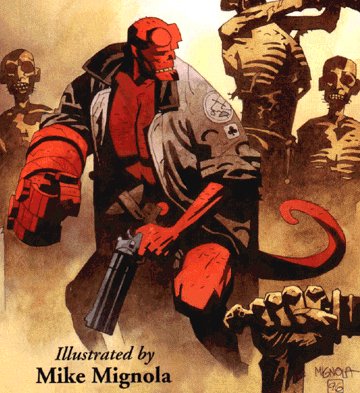
Hellboy, for instance, embodied both sides of the equation. Mike Mignola's fans are diehards, and they were overjoyed to see Ron Perlman cast as Hellboy. They were ready for a beautiful, brutal gothic/mid-century throwdown. Unfortunately, they got a movie that represented the title character well, but dropped the ball on the supporting cast and the atmosphere. There was scarcely a gothic arch, and the World War II occultism was crowded out by big shiny apparatuses that looked more like plastic than tarnished metal. The themes of self-realization, defiance, and creeping Lovecraftian danger were dissolved in a messy stew of comic book cliches: we have to keep our identities secret! Love will save the day!

So for many Hellboy nerds (me especially), the dream was deferred, and we hold scarce hope for The Golden Army, which seems to be beset with more of the same downfalls.

There's another comic book movie coming out, based on what might be the most influential modern comic series, though it's certainly not the best-known. This comic series, since resold as a convenient graphic novel, is Watchmen. Alan Moore's graphical urban epic was about the demise of heroism, the struggle with real-world moral issues, and the consequences of disillusionment and war in a post-industrial society. It was complex and challenging, and a true masterpiece of the medium.

A film adaptation has been in the works for a while, and it's finally been created under the direction of Zack Snyder. When I first heard about this, it inspired the "fear" reaction. It's hard to imagine an accurate recreation of the world of Watchmen... it's a decaying, rusty New York City, but not a Gotham City kind of way. It's mostly shown in daylight, and the dregs of the city are bored locals and homeless vagrants, rather than innocent old ladies and the criminals who beset them. It's not a dangerous world, but rather a listless, uneventful world, shuffling toward the end of history. It's also a world of the 80's, and it still emanates nostalgia, remembering the Hollywood/disco glory of its 70's superheroes. These heroes, all retired after a wave of social reform, are the protagonists of Moore's story.

This is a complex milieu, and it's next to impossible to recreate on film, I would imagine. It's almost cheesy enough to cover the superheroes in skin-tight primary-color spandex, but Moore's world isn't quite ready to make that much of a mockery of itself. It has to find a postmodern balance between edgy and used up... between updated and outdated. This is why I was afraid for the film. I really couldn't imagine how any creative director could strike the balance required to make the world work.

From the initial stills from the movie, though, it seems that Snyder may be on his way to doing it right. He's picked some perfect actors, like the gaunt, severe Jackie Earle Haley as Rorschach. On top of the casting, we've seen some initial images of costume and production design, and these do a miraculous job of achieving the right look. The outdoor shots look great: the city is gritty and unadorned at night, and it's blank and pedestrian during the day. The costumes are bulky and plastic, which is probably necessary to reproduce the intentional kitsch in Alan Moore's art, but they're also dark and unironic, the stuff of superheroes who are vengeful, ready to return to their work in the world.

So I've gone from frightened to excited... from apprehensive to hopeful. This movie could really work. Now Snyder's production company has to gather the myriad themes and narrative threads in Moore's book, and they have to build them into a fluid, well-paced action movie with some believable moments of psychology and introspection. He hasn't won me over yet, but hey, I'm ready to watch.

Thursday, February 21, 2008

Monroe and Lohan: Is there anything worth talking about?

Okay, so here's an interesting parallel for discussion: Marilyn Monroe versus Lindsay Lohan? The question was raised recently, as Bert Stern, famous for photographing Monroe during "The Last Sitting," decided to recreate said monumental event using Lindsay Lohan as a stand-in. Let's try to do what we do here, and dig under the cheesy provocation and sensationalism for some meaning. In this case, there's quite a bit to discover.

I think the metaphor is obvious, after all. Just as with Marilyn, Lohan is a Hollywood starlet, famous for her charm and her body and infamous for her spotty background and bad behavior in the public eye. Marilyn's last photoshoot was looked upon in light of her death, which occurred shortly afterwards; Lohan herself has been plagued with addiction and rehabilitation, and with the attendant paparazzi attention, and her rendition of the photoshoot will be colored by her own recent controversies.

Now, very few of us will be willing to buy Lohan as a new Marilyn. At the most basic level, this return to Monroe's farewell seems like a stunt, something that's been done before, and Lohan seems fairly soulless compared to Monroe, who has a whole mythology and legacy behind her. After all, Lohan is just one of a handful of Hollywood A-List brats currently in the headlines. Marilyn is a one-of-a-kind historical figure, and that's what makes her photoshoot meaningful and culturally relevant.

Another point that needs visiting... something that's important to any feminist critique of the occasion... is that Monroe's portraits seem so honest, at least to our jaded postmodern eyes. She isn't a plastic replica in those shots. She isn't surgically altered or airbrushed, and nobody was able to hide the vulnerable look in her eyes. The whole package -- the flawed soul -- is coming from Marilyn herself, the source of the legend.

Lohan's body looks painfully fake by comparison, and it's the kind of fake that I hope some of us are getting tired of. She's got big boobs, sure, and I'm not one to complain about that, but her figure is boyish, with no hips and scarce buttocks. Stern is obviously shooting for a modern fashion eye, trained by ready-to-wear and Twiggy and Calvin Klein, and it seems like a tired mockery of Marilyn's curves and slight pudge. In that regard, if anything, we can look at these two photoshoots as a lesson in how homogeneous and inauthentic our ideals of beauty have become. Silicon boobs and airbrushed skin, boy-hips and blond wigs. Yawn.

But this can't just be a long opportunity to Lindsay-bash. There's enough of that going on. I want to step back and note something important that a lot of the commentators aren't saying.

Why are these original photographs of Marilyn so important to us? Why do I have the automatic urge to reject Lohan's attempt at the role?

It's because Marilyn is a myth and a legend for our current culture. Her self-destructive habits are part of a beautiful, flawed panorama of life and success and hardship, and we're willing to see her as a whole person, and to see her bad behavior in perspective. She certainly deserves it.

Unfortunately, we're not able to give this benefit to the struggling, self-abusive starlets of our day. Lohan's not healthy, and she's a shitty role-model, but she's faced with a whole culture that's intent on demonizing her and exposing her shortcomings. What chance has she ever had to make us happy? Do these girls have to endure the slings and arrows of stardom, and simply have faith that some day, after they've OD'd, we'll look back on them and see their unique beauty and vulnerability, and read it as a positive contribution to our cultural heritage? What hope do they have that one day we'll forgive their idiocy and irresponsibility, just as we've forgiven Marilyn's?

Maybe the lesson here: enjoy the photos, and stop being so hard on the girls who are stuck in the molars of a culture that's trying to consume and devour them.

Friday, January 18, 2008

Cool Shit Alert: simulating a 3D environment on the Wii

THE COOL SHIT ALERT:

Johnny Chung Lee, a Carnegie Melon student and known Wii-hacking supergenius, has developed something that's not only an amazing technology hack, but simply an amazing concept in general. It strikes me that this would be revolutionary, no matter what technology it was exhibited on... the fact that the Wii makes it easy is just a testament to the versatility of Nintendo's hardware.

Here's the video. Be patient for the first minute and a half, as Johnny zips through a short explanation. Once you get to the demo of the display, it becomes rather mind-blowing.


When we think of 3D displays, we usually think of filtered glasses, allowing a screen to split an image into a "left-eye" version and a "right-eye" version. This creates the illusion of depth as the brain synthesizes the two images. Though it's also a two-dimensional take on 3D, Lee's display is working from a completely different paradigm.

Instead of simulating depth from a fixed point of view, Lee's program is simulating space by adapting a 2-D image to the position of the viewer. This is, in fact, more advanced than the traditional fixed-point approach used in movies like Beowulf. Here, the user can interact with the simulated space by moving around the frame and processing multiple viewing angles.

This could really be the next generation of displays for consoles and simulation. Even from the video, you can tell that it's mind-blowingly immersive, and it promises new heights of simulation and interaction.

I think it's also a testament to technology that this could be developed and disseminated by a man who is essentially an amateur, working with pre-existing tools and an incredibly innovative brain. He didn't need a room full of engineers to sit around and develop this with him, nor a corporate sponsor to give him financial backing and public exposure... he created it and publicized it himself, and nobody can ever take that credit away from him. That's a kind of visionary independence that's never been possible in any other culture or era.

Quickly, I'd like to throw in my own thought for expanding on this innovation. Perhaps somebody else has already suggested this, but I figure I may as well record it for posterity.

MY IDEA:

Okay, at the end of the segment, Johnny mentions that this will only work for one person at a time. This is because the display has to adapt to the user's position and adjust the image accordingly, and the same image can't accommodate two different points of view simultaneously. I'm not an inventor, and for me this is all speculative, but I have an idea of how to solve this particular problem.

I've heard of a technology that uses interlacing and wavelength filtering (i.e. through filtering glasses) to display two different images on the same screen at the same time. The screen would just interlace two images (image A and image B) that are projected for two different wavelengths, and the users (user A and user B) would each wear a different pair of glasses (glasses A and glasses B). The final result: user A would only see image A, and user B would only see image B. This would be a lovely alternative to split-screen viewing in two-player video games. Both players would be able to use the entire screen to steer their Kart.

Combining this technology with Lee's head-tracking wouldn't be difficult. He himself used a pair of safety goggles to track his head movement. If you just put filtering lenses in two pairs of goggles, you could give each of two users their own individualized content on the same screen. Thus, you could have the same scene, adapting to the positions of two different people at the same time, and you could create two-player games where each player got their own unique 3D experience.

COME ON, NINTENDO!!! DO EET!!! This is the future!

Tuesday, December 25, 2007

Christmas Meditations: Childhood Innocence in the Music Video Era

Christmas is a time to reflect on authenticity and obligation, especially when it comes to issues of maturity and disillusionment. It's an inescapable question... it's safe to say that anyone who knows the experience of the Christian holiday also knows how much it changes when you enter adulthood. Santa Clause leads the way for a loss of innocence, and over the course of a few landmark years, we stop seeing Christmas as a singular, mystical time and start to see it as a confusing mix of familial love and troublesome economic and social obligation. If any of you are like me, you probably spend a large part of the holiday searching within yourself for that excited, innocent child who could just enjoy the bright colors and ritualistic songs, and who could just indulge in attention and wish-fulfillment.

So here I am, looking into pop culture for some statements on the shifting winds of innocence and disillusionment. Interestingly, I've found the most salient themes during my diversion into the world of music video.

Sigur Ros's recent music video for the song Hoppipolla is a great example. Before you even think about the social statement it makes, try just watching it and feeling the spirit of the piece. It's simple and beautiful and thematically cryptic, but it represents something spontaneous and touching. It's a brilliant piece of short-form cinema, crafted around an excellent song.


Like I said, thematically cryptic: one of the beautiful aspects of this video is that it doesn't seem to be purveying a judgment or advocating any reform. If anything, it's an invitation to the viewer to imagine an entire life lived as a child, or at the very least, a final return to the joys of childhood at the twilight of old age.

Thus, there's something in this video calling us out of the severity of middle age, showing us the triumph of experience extracted from the prisons of ambition and self-consciousness. It's even making me ashamed to be writing about it this way... this essay is such a trite rationalization of a video that amounts to a siren's song of spontaneity and humanity. I have to write about the video, when I'd rather be creating it, or (better yet) simply living it.

But it leads me to consider another video that makes a complex statement on maturity and self-seriousness, but from a different direction. Take a look at B.I.G.'s video for Sky's the Limit:


Directed, of course, by the indomitable Spike Jones, it takes a simple casting quirk and turns it into a strange experience with traces of a complex statement on maturity within a music genre. Jonze's deadpan strangeness gives the video a different flavor than the Sigur Ros piece, and (as appropriate to the music) it's a less beautiful and more conflicted piece.

Jonze manages to bring a sense of tension to this video that makes it hard to read as message-bearing communication. We often envision rap as a posturing, inflationary cultural complex, proud but fraught with negativity. Granted, I'm speaking as a pretentious indie kid, the demographic that Jonze's videos normally appeal to, rather than as a street kid, the demographic that Biggie's music targets. Still, the very fact that Jonze directed this video... such a departure from his other source material, like Weezer and Fatboy Slim... opens up this contradiction in the first place.

Sky's the Limit is saying that beneath rap's posturing, there's something childlike. You can read this as a compliment or as a critique... are these children acting out this scenario because hip-hop is playful and spontaneous? This is a natural reading if you consider the tone of the music, which is generally reassuring. After all, [the] Sky is the limit and you know that you can have what you want, be what you want. Then again, if it makes you uncomfortable to see children in big bling, buying entirely into a decadent lifestyle of fast cars and easy women, you might see something different. Maybe the kids represent the immaturity of the rap scene, which (arguably) has spent the last ten years replacing defiance and strength of character with glamour and self-praise.

So is it about finding the past within the present? Or is it about losing the past through a painful process of disillusionment? It's hard to say... and that's what makes it a great video. Spike Jonze knows ambiguity, perhaps more than any other short-form director, and he's fully harnessed it here.

Whether you're grasping at the past or interrogating the present, whether you're searching for the sublime or for the naivety of your youth, this Christmas is probably a time to think about who you were and who you're becoming. These music videos offer one small take on an enormous question that we all have to keep asking... even knowing that we probably won't be finding an answer any time soon.

Sunday, October 21, 2007

Cool Shit Alert: The Cadbury Gorilla


I really like this commercial: Gorilla Feels the Groove. I haven't written about a meme in a while, and this advert gives me a good feeling, so I think I can find an excuse to write about it.

First of all, why am I so attracted to it? It's the simplicity -- the gorilla's nonverbal acting, an expressed and gestured emotion, with a perfectly appropriate Phil Collins song. There's something profoundly sincere about the drumming and the monkeyface, looking toward the sky, and I think the fact that it's a gorilla makes it more austere somehow, and more authentic.

Cadbury beats Apple, in my opinion... as far as feeling the pure joy, vicariously making love to the music, Gorilla affects me more than the rockin' silhouettes, who look like they're having fun, but may be a little too awkward, or choreographed. It might be because the silhouettes seem to be dancing for, and/or addressing, the camera, whereas Gorilla seems to be alone in a studio, complete at peace with his Genesis. If that was a human making that enchanted face, I don't think I'd buy it.

Of course, you might take a second and look for meaning, thereby delaying the inevitable happiness that the commercial can bring. Make no mistake... the search for some sort of pun is futile. The commercial is a non-sequiter.

But you need to get past that to see why it's so damn successful. The point of a commercial is to induce an effect in the viewer, to take over a piece of mental space, and the Gorilla kicks some serious ass in that regard. First, you have to catch the audience's attention, like the Apple commercial does with bright colors. The extreme close-up of a Gorilla face does the trick, in my opinion, through a combination of fascination and confusion.

The commercial never explains the gorilla, but before we get so confused that we're bored, it moves on to the second effect: inducing a mental state. When you make the connection between the blissful, distracted expression and the ghostly soundtrack, you start to get it. When the bass kicks and the gorilla fully surrenders to the beat, you fall in with him. A few riffs later, you're in love with the song, and with the gorilla, and you're either laughing in amusement or tapping in empathy. Once you get the second effect, the carefully-crafted cerebral response, you get the product shot. There doesn't need to be an explicit connection. They just need to be correlated.

It's not manipulation, necessarily. If you're not making claims about the product, you certainly can't be lying. If you can craft such a simple image of pure joy, you've probably experienced it, and you probably know its nuances, and you probably want to bring it to your audience. This is my universalist optimism about good advertising... consumers are so savvy these days that the only way to seem sincere is to be sincere.

So I'm going to stake my faith in the idea that the director of this commercial doesn't give a shit whether I buy Cadbury chocolate. I think he was just using that forum as an excuse to bring the joy of music to his Gorilla, and through his Gorilla, to me.

Tuesday, October 02, 2007

Dove Onslaught and the Cold War of Culture

Dove's released a new video, OnSlaught, following the success of their PSA "Evolution" last year. I'm a big fan of the campaign... it's emblematic of a new sensibility developing in corporations, who are trying to create productive relationships with their clientelle, instead of just repeating taglines and saturating media with their logo. Those who want to destroy capitalism will still object, seeing this as another method of appropriation. Those who would rather meet the market half-way... people like me... should see this for what it is: a step forward for the culture, wherein the interests of the company, the consumer, and the society are becoming more intertwined and symbiotic.

This new Dove video is interesting to me, as a media student. Intentional or not, the ad references one of the most famous PSA's in history, the "Daisy Girl" ad created by Tony Schwartz in 1964. Schwartz has discussed his own inspiration in creating the ad, saying that it isn't designed to tell the public what to buy, so much as to activate the latent emotions they already have. In that way, Daisy Girl differs significantly from previous "sales pitch" and newsreel ads. Instead of pitching adjusted informational content, Schwartz creates a visual and audio environment that elicits an emotional response and taps an audiences anxieties and preconceptions.

Some people call this fearmongering, or propaganda... I see it as a new respect for evocation and the psychology of politics. Daisy Girl was an audacious PSA that addressed peace and militarism as resonant concerns for voters during the Cold War, and it made an abstract statement that spoke to the specific fears of the public. If corporations have harnessed this method to misrepresent products and play on anxieties and stereotypes, I don't think it's Mr. Schwartz's fault.

Onslaught, I feel, renews Schwartz's productive use of mass media. On the most superficial level, we're shown an intimate portrait of a child, and then our gaze is reversed and cast upon the dangers that confront her. There's no mention, textually or audibly, of sex, objectification, or feminism, but with the juxtaposition Dove presents, viewers realize that they know this imagery is dangerous and offensive. Try to explain it and you get lost in the words. Show it, out of context, in a river of sensory overload, and we're forced to confront it and deal with our own innate response.

And when these things converge -- the abstract, oblique theories (feminism, psychoanalysis, media critique) and the gut reactions (the intuitive revulsion and anxiety that Dove elicits) -- when these yield the same result, I'm disposed to believe it: that the beauty industry, with its fashion and cosmetic culture, is an ideological payload being dropped that needs to be diffused and neutralized.

Wednesday, September 26, 2007

Petraeus or Betray Us? A Subtle and Compelling Question

Lordy, I've done so much STUFF since I last wrote in here. I've seen four movies in theaters, started two novels, started and finished a graphic novel, and I've started writing some criticism for PopPolitics. The four movies were 3:10 to Yuma, King of Kong, The Assassination of Jesse James by the Coward Robert Ford, and Eastern Promises. The novel I'm focused on is Spook Country, by William Gibson, and I'm looking forward to the train ride tomorrow morning, when I'll be reading it again. The graphic novel was The Nightly News, which was intense and comes recommended.

Sometime during this whirlwind of consumption, something political came to my attention: MoveOn.org ran a muckraking ad about General Patraeus, the commander of the Iraqi freedom defense military security awesome force (IFDMSAF). The ad makes a clever pun ("Patraeus or Betray Us?") to hook readers and put knots in conservative jock-straps, and then it basically argues that Patraeus is misrepresenting the facts to keep the IFDMSAF in Iraq.

Obviously, there's been an overwhelming media response, including the requisite posturing by editorial columnists and tweaking out by bloggers. I'm about a week late, but I think I should add my own pinch of salt to this heaping portion of mystery meat.

Here's the deal: the ad was aggressive, a very visible expenditure of the vast resources MoveOn has accumulated. Maybe it got into some peoples' heads. Maybe it just provided an easy target for conservative nay-sayers to take shots at. But seriously, "Betray Us"? What a juicy prompt for a slathering partisan frenzy of affirmation and condemnation. It takes a real message - the question about honesty and misplaced loyalty - and turns it into a bloody battle over propriety and respect, which are sort of the little bags of candy that manipulative people use to keep us distracted while the big people play.

All they had to do was put some more effort into the initial presentation. It's possible to get people engaged in a question without bludgeoning them with a rhetorical golf club. Get people interested BEFORE you make them angry... pull them into the facts before they have a chance to flatly reject your politics.

I think, in service of this goal, MoveOn needs to recruit some people from AdBusters. These guys are as radical and confrontation as you can get, but they always know how to frame an idea in a way that makes it striking and unfamiliar. I mean, AdBusters is pretty much pinned as a leftist radical organization, but if you decontextualize their work, you can see that it's interesting and intense before it's partisan. Unfortunately, their primary forum is a niche magazine that sells for impractical amounts of money.

AdBusters could frame an ad in such a way that it got attention, though, and they could definitely use their 1337 design sk1llz to drag some conservative cheerleaders into a serious, thoughtful argument. AdBusters knows how to disguise their arguments until it's just the right time for them to come out... MoveOn could use a lesson in that regard. In return, MoveOn could contribute their massive piles of Internet-generated wealth to distributing AdBusters' radical but carefully-articulated ideas, injected into the brains of the masses like heroin being forced on a helpless child by an insane homeless person.

The networkers, the designers, and the public, hungry for brain-food... sounds like a ménage à trois made in heaven, my friends. It's time to get on top of this.

Thursday, August 23, 2007

Free Culture: Lessig and Frozen Yogurt


It's hard to find an authentic example of irony in pseudoironic postmodern culture, but this might be it. The other day, I was on the train when I saw a familiar type treatment on the back of a newspaper (and in this case, by type treatment, I mean both the words themselves and the way in which they were designed). It said "Free Culture," which is the name of a book I really liked by Lawrence Lessig.

The book is about creating a free environment for art and innovation, and it sketches a very convincing argument about the dangers of runaway copyright law. It's a refreshingly non-partisan take on the subject, and the discussion is rooted heavily in the realm of fact, history, and measured argument. Lessig argues that within any media environment, innovation has to feed off itself, and if intellectual property laws are too strictly enforced, the society will become closed and stagnant, and growth will be discouraged.

It was a great book, but I never expected to see it in a full-page ad on a daily newspaper. I took a closer look to figure out what was going on. Turns out it was an ad for Bloomingdales' free carrot frozen yogurt giveaway. The arrangement of the text isn't quite the same (the ad headline is on two lines), but both are in all caps, and they're in a similar, highly geometrical, sans-serif font. More importantly, it's the SAME PHRASE.

My intention here is not to cry plagiarism. Jesus, plagiarism wouldn't even make sense... there's no way for Bloomingdales to profit off a reference to Lessig's book. Outside the academic/economist/technologist circle, this book isn't exactly a world-renown piece of literature, and I doubt it's a demographic that Boomingdales is targeting right now. Oddly, the ad heading doesn't make a whole lot of sense on its own. "Free Culture" is a little too awkward a phrase to be useful if it's only being taken totally literally. So whether or not you assume their innocence, the advertisement doesn't seem to make a whole lot of sense.

My assumption is that some designer saw Lessig's book on a shelf, or had read it a while ago, and they had the phrase "Free Culture" lingering in their head. I've seen it happen... a designer, writer, artist, marketer, etc. assumes they're pulling a line from their imagination, but they're actually peeling it directly from something they've seen or read recently. I've done it myself, in fact.

Of course, there's the irony that a phrase got pulled directly from a book whose mission is to allow appropriation to happen. It's a little fragment of postmodern poetry.

But there's also the little bit of insight here: Bloomingdales has proven Lessig's point, that media feeds on itself, and it only works because there's a rich, sometimes overwhelming space to draw from. Who know... maybe Lessig has helped Bloomingdales to sell some frozen yogurt? If so, I'd like to think he approves.

Friday, July 13, 2007

Healthcare! Viral Agents! And the well-being of the media according to Michael Moore and Mika Brzezinski

Oops... Michael Moore freaks out a little at Wolf Blitzer.

Here we see another moment of rampant leftist opinionation. It follows closely on the heels of this video of Mika Brzezinski, which contradicts it, in a certain way. Here are two people who really seem to care about what they're doing. For the moment, I'm going to talk about Moore, because... his clip is longer, I guess.

The man is not just running a media stunt. He's not a good enough actor to pull that off. No, indeed, Moore is stuttering and twitching because he's truly pissed at the segment that ran about Sicko, and I can understand why... the segment's mildly oppositional tone is irritating, and its argument is pretty incomprehensible. Let's look at that for a moment.

The segment concedes, almost in passing, that the US is #37 on the WHO's list of national health care systems. It makes an even briefer mention of the fact that we're the only industrialized nation without universal health care. After conceding these EXTREMELY important facts, the segment grants exaggerated importance to some rather empty arguments. The US is superior in terms of waiting times for non-essential medical procedures? Now THAT is a highly-qualified achievement. And then the segment inadvertently reminds us that the United States has worse waiting times for physician appointments than four out of five other industrialized nations, surveyed by some unnamed source. HOW does this demonstrate that service in the US isn't so bad? WHY are we supposed to care so much about Canada's wait times?

The segment was a pretty strange logical construction, and it seemed to take its points pretty seriously. This annoyed me as a viewer, but it really annoyed Moore, whose film was its subject.

As my roommate confirms (another good contribution from Dom), Moore has an unfortunate habit of wrecking his own credibility by freaking out at newscasters who are interviewing him. Why he spends ten minutes spazzing at Wolf about his underrepresentation is beyond me, especially when Wolf makes it clear that Moore has, in fact, been invited back, and Moore has consistently declined.

Contrast Michael Moore's credibility issues with Mika. She's part of the media industry that she's criticizing... mainstream television news... and as a result, she's pre-stocked with a solid reserve of credibility. She spends some of it here, but spent carefully, as Mika does it, the net result is more credibility in the future. After all, she's just demonstrated that she cares more about her job as a social function than as a service to her bosses. Moore has spent too much of his credibility on partisan rants, and at this point, his outburst at Wolf seems like a cliche instead of a statement.

In light of this shortcoming, I was glad to see the interview turn reasonably intelligent at around nine minutes. When Moore calmed the fuck down, his arguments became much more persuasive.

Jesus Christ... the equivalent of six 9-11's a year. Moore says he doesn't debate in sound bites, but as far as sound bites go, that's a powerful one.

Moore knows how to drive a point home, as he's demonstrated in each film he's released. However, in terms of standing up to the news agencies themselves, I think Mika Brzezinski does a better job from within the confines of the institution than Moore does from outside.

Wednesday, June 20, 2007

Street Fighter II is still King

My roommate just drew my attention to this remarkably simple video, featuring a fully stationary female guitarist rocking a song from one of my favorite games of all time, Street Fighter II: The World Warrior:


She's pretty awesome. This is what glam-riff guitar rock was made for, and she does it right... standing still, not giving us anything but that gorgeous post-disco soundtrack riff from the American Military Base in all our 14-year-old imaginations. At that age, I could beat my Super Nintendo version with Guile, Chun-Li, Ryu, Ken, and Blanka, and along with a couple other exceptional games, it was one of the only ones I could play over and over and over again. SF II deserves every homage made for it.

Thursday, June 07, 2007

Special Report: Literature may be coming for YOUR child

We live in scary times. Just watch the news… that tenacious media bastion, reassuring us with a dose of truth in the face of everyday challenges. They’re the only ones you can trust these days, as newscasters are quick to tell: politicians, the homeless, minorities with their reverse racism, scientists with their global warming…

Atheists with their discrimination…

Libraries with their sexual predators…

Emo with its girl-pants…

It’s you against the world, with only the evening news by your side. Every day, FOX and ABC and NBC give you the low-down on the newest alert colors. For the former optimist, the inner enlightenment philosopher we all have to overcome, it begs the question: why has the world gone to shit?

I think I’ve got it. What’s the great link between “libraries,” “emotional drama,” and “godless enlightenment?” What bane, what threat to our collective complacency, do we find at the center of that sinister Venn diagram? What’s been sitting under our noses for hundreds… nay, thousands of years, feeding these cultural instabilities that are looming before us, threatening us all?

The answer is obviously literature.

Here’s what our field researchers have discovered.

REASON THE FIRST: It’s found in libraries.

How can you trust a place that’s so quiet, so self-enclosed, so free of corporate advertisements and loud noises? It’s not only (as Carl Monday pointed out) a breeding ground for sexual predators. It’s also a breeding ground for books, and this is much worse. Stephen Colbert was the first to see the danger, but he’s continually underestimated it. The book is the crack in society’s moral foundation, and libraries are the syphilitic, spongiform masses where those cracks begin to propagate.

REASON THE SECOND: Books are constantly expressing things.

You may say, “But Jesse! You’re expressing something right now! How can you so quickly condemn?” Well, I say to you, AWAY, shuffling abomination with your logic drool! You obviously haven’t SEEN what’s to be found in these books! Literature gives voice to all sorts of nooks and crannies of the human soul that are better left in shadow. Pederasty? Lolita. Childhood fratricide? Jude the Obscure. Self-inflicted eye-poking? Oedipus, one of the oldest of the so-called “books.” Homosexuality? You’ve read Oscar Wilde. Don’t tell me you didn’t pick up on it.

And by “expressing” these destructive impulses, books are obviously advocating for them… urging us to carry them out in our everyday lives. Forget Steal This BookKill This Baby is scrawled across every surface in our cultural history. No wonder emo kids are all cutting themselves.

REASON THE THIRD: I don’t actually have a third reason, which sort of offends my fairytale sensibilities.

At any rate, it’s time for us to take action against this lurking threat. These sin-holes, these tomes of the damned, these liberal fascist tools of Satan must be purged from our libraries… nay, the libraries themselves must be purged from the epidermis of our sacred culture. What would our founding fathers think if they found us harboring all these instruments of degeneracy?

There’s only one answer: they must be set ablaze. Firemen would probably be the best people for this job. I don’t remember who it was that suggested that course of action, but dammit, they were right.